
Table of Contents
- Start With a Ruthless Declutter
- Group by Frequency of Use, Not Just Category
- Maximise Vertical Space With Double Hanging and Tiered Storage
- Design Smart Shoe and Accessory Zones
- Use Drawer Inserts and Concealed Storage for Clutter-Free Surfaces
- Bespoke Fitted Wardrobes: When Custom Joinery Solves Awkward Spaces
- Wardrobe Organisation Tips for Seasonal Rotation and Long-Term Upkeep
- Custom Wardrobe Interior Design: Lighting, Mirrors and Accessibility
- Frequently Asked Questions
Last Updated: September 13, 2026
Start With a Ruthless Declutter
The most effective way to organise a walk-in wardrobe is to remove everything that does not belong there before planning a single shelf. It is a dedicated dressing room, not a storage overflow.
Pull everything out and sort into four piles: keep, repair, donate, bin. Be honest about the “repair” pile, most of it has sat unworn for two years.
A common mistake is decluttering by category rather than actual use, keeping a suit because it is a suit, not because you have worn it since 2023. Ask one question per item: have I worn this in the last twelve months?
- Remove every item from rails, shelves and drawers
- Sort into keep, repair, donate and bin piles
- Apply the twelve-month rule to each garment
- Store off-season pieces separately before they return
Once the room is empty, you can finally see its actual shape: the awkward corner, the low ceiling slope, the useless gap beside the door. That is where real planning begins.
Group by Frequency of Use, Not Just Category
Organising by category alone creates beautiful wardrobes that are annoying to use. Group by how often you reach for something.
Daily items belong at eye level and within easy reach; occasional pieces go higher or lower.
Think in three tiers:
- Everyday: workwear, favourite jeans, regular shoes, at waist to shoulder height
- Weekly: smarter pieces, seasonal layers, just above or below the everyday zone
- Rarely: formalwear, holiday clothes, keepsakes, on the highest shelves or in concealed storage
A capsule wardrobe mindset helps: if most of your week runs on twenty or thirty pieces, those deserve the best real estate in the room.
Frequency changes with the season, so build flexibility into your plan now and seasonal rotation later becomes almost effortless.
Maximise Vertical Space With Double Hanging and Tiered Storage
Vertical storage is where most walk-in wardrobes waste the most room. The gap between a single hanging rod and the ceiling is often half a metre of dead air.
Double hanging solves it: two rails, one above the other, with shirts and jackets on top and trousers, skirts or shorter items below. You roughly double your hanging capacity in the same footprint.
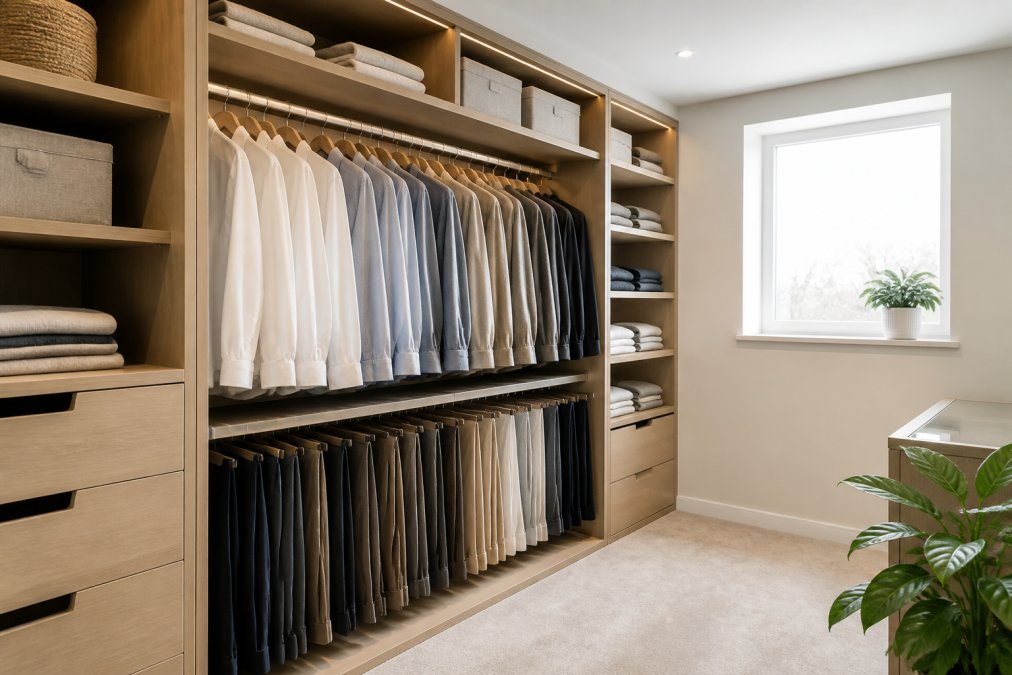
Above the rails, adjustable shelving handles folded knitwear, storage bins and rarely used items. Tiered storage works on the same logic: stack vertically rather than spreading sideways.
Measure your longest garment before committing to double hanging. A rail set too low leaves coats dragging, and a rail set too high wastes the space you just created. Long coats usually need a full-height section of their own.
Pull-down bars are worth considering for the highest rails if anyone in the household struggles to reach.
Design Smart Shoe and Accessory Zones
Shoes destroy wardrobe floors unless you give them a proper home. A dedicated shoe zone keeps them visible, protected and off the ground, and it is where most walk-in wardrobes quietly fail.
Start by counting. A realistic adult household runs to roughly 20-40 pairs in active rotation, and the wardrobe must absorb all of them without a single pair living on the floor.
Shoe storage mechanisms, ranked by what they actually solve:
- Angled racks at low level, the workhorse. A slight tilt (around 15-20 degrees) lets you see every pair at a glance rather than staring at a wall of heels. Best for daily shoes near the entrance to the room.
- Pull-out shoe drawers, shallow drawers with a sloped internal base, usually two to three pairs deep. Ideal for formal shoes you want protected from dust but still visible.
- Adjustable shelving with a lip, a small raised edge stops pairs sliding forward when the shelf is only partly full. Cheap detail, big difference.
- Tall boot section, boots need full-height clearance and often a clip or rod to hold the shaft upright. Do not try to fold them into a standard rack.
Keep daily shoes near the entrance and formal pairs higher or further back, and rotate by season so the racks never overflow.
Accessories need different treatment again, because they fail in different ways:
- Belts and ties on a pull-out rack or hooks inside the door, hanging them flat prevents the creasing that comes from coiling
- Jewellery in a shallow lined drawer, not loose on a shelf, ideally with a felt or velvet base so chains do not tangle
- Bags on open shelving where they hold their shape, stuffed lightly with tissue or bubble wrap to stop handles collapsing
- Scarves rolled in a drawer insert or basket, rolling rather than folding avoids the deep crease line down the middle
- Hats on a high shelf with a small stand or hook so brims keep their form
Drawer inserts are the quiet hero of accessory storage: a shallow insert with dividers turns a messy drawer into a display case. Shelf dividers do the same job on open shelving, keeping folded stacks upright.
Measure your tallest boots and your widest shoe before you commit to a rack depth. A 35 cm deep shelf handles most footwear, but knee-high boots and wide-fit trainers often need 40 cm or more, and a rack that is too shallow means shoes sit at an angle and slide off.
One detail most guides skip: ventilation. Shoes trap moisture, and a closed shoe cupboard with no airflow will smell within a season. Open racks, or drawers with a vented base, keep footwear fresher and protect the wardrobe interior from damp. Maintaining this level of air circulation is just as essential when you are curating a capsule wardrobe guide to ensure your seasonal pieces remain in pristine condition while stored.
Use Drawer Inserts and Concealed Storage for Clutter-Free Surfaces
Every visible surface in a walk-in wardrobe collects clutter unless it has a job. Concealed storage keeps the room calm, but whether it works comes down to three things: depth, runner quality, and labelling.
Drawer depth is not arbitrary. Get it wrong and you either waste space or create a pit you cannot see into:
- Shallow (around 8-10 cm): jewellery, watches, ties, sunglasses, small accessories. Deep enough to hold a lined insert, shallow enough that nothing disappears underneath.
- Medium (around 15-20 cm): folded shirts, knitwear, underwear, gym kit. The everyday workhorse depth.
- Deep (around 25-30 cm): bulky knitwear, spare bedding, seasonal items. Use sparingly, deep drawers encourage stacking, and stacked items are the ones you forget you own.
Full-extension runners are worth the upgrade. A standard runner pulls out about two-thirds of the way, leaving the back third a blind spot; full-extension runners let you see and reach the back. Soft-close mechanisms stop the slam that eventually loosens the drawer front.
Labelling is what makes concealed storage self-maintaining. An unlabelled bin is just a mystery box you will avoid opening. A simple approach:
- Label by category, not by season, ‘spare bedding’, ‘winter hats’, ‘gym kit’, so the bin stays valid year-round
- Use a consistent label style (printed, not handwritten) so the room looks intentional
- Keep a master list on your phone or in a notes app of what lives in each high or concealed bin, this is the low-effort version of digital inventory management, and it saves you pulling down four bins to find one thing
- Review the list twice a year during seasonal rotation, and relabel anything that has drifted
Do not fill every drawer to capacity on day one. Wardrobes that start at 100% full have nowhere to absorb new purchases, and within a year the overflow ends up back on the floor. Leave roughly 15-20% headroom in every drawer and bin.
Long-term upkeep is the gap most guides ignore. Concealed storage only stays organised if maintained:
- Monthly: a two-minute scan of visible surfaces. Anything that has landed without a home gets put away or reassigned.
- Quarterly: check drawer runners for smoothness. A runner that starts to stick will soon be avoided, and an avoided drawer becomes a dumping ground.
- Twice a year: the seasonal rotation. Pull everything out of high and concealed bins, reassess against the twelve-month rule, and relabel anything that has changed.
- Annually: check shelf fixings and drawer fronts for looseness. Wipe surfaces rather than wet-washing them, and keep the room ventilated to prevent damp, particularly in older properties where external walls stay cold.
Storage bins on high shelves handle the awkward items: spare bedding, winter hats, gym kit. Label them, keep them to a consistent size so they stack cleanly, and treat the high shelf as a real storage zone rather than a graveyard. The NHS guidance on preventing damp and mould in the home is worth reading if your wardrobe sits against an external wall, since ventilation affects both your clothes and the room itself.
A wardrobe organised on day one and never maintained will revert within a year. A light maintenance rhythm, a monthly scan, a quarterly check, a twice-yearly rotation, keeps it functional for the life of the joinery.
Bespoke Fitted Wardrobes: When Custom Joinery Solves Awkward Spaces
Off-the-shelf units fail in exactly the rooms that need storage most. Sloping ceilings, chimney breasts, alcoves and understairs voids are where standard sizes simply do not fit.
Bespoke fitted wardrobes are made to the measurements of your actual room, which means no wasted gaps and no compromise on rail heights. For a walk-in wardrobe, that difference compounds across every wall.
This is where bespoke joinery earns its place: a joiner can follow a sloped ceiling line, build around a structural column, and turn a dead corner into usable hanging or shelving.
Finest Furniture Studio specialises in exactly this kind of problem space, designing custom-fitted storage for rooms that standard furniture cannot solve. The process starts with a free design visit, so the plan is drawn around your room rather than adjusted to fit it.
| Space Challenge | Standard Unit | Bespoke Solution |
|---|---|---|
| Sloping ceiling | Leaves dead gap | Joinery follows the slope |
| Alcove or recess | Poor fit, wasted edges | Built to the exact width |
| Understairs void | Unusable | Tiered storage and rails |
| Chimney breast | Blocks access | Wraps around the structure |
Quality matters as much as fit here. A well-built wardrobe should still look sharp in ten years, which is why Finest Furniture Studio backs its wardrobes with a 10-year warranty and completes fitting in as little as seven days.
Wardrobe Organisation Tips for Seasonal Rotation and Long-Term Upkeep
Seasonal rotation keeps a walk-in wardrobe working year after year. Twice a year, swap the current season’s clothing into the prime zones and move the rest into concealed or high storage.
Here is the routine:
- At the start of each season, pull out the incoming season’s clothing
- Clean everything before it goes back, since stains set over time
- Move the outgoing season into labelled bins or high shelves
- Reassess the twelve-month rule as you go
Long-term upkeep is simpler than most people expect. Check rails and shelf fixings annually for looseness. Wipe down surfaces rather than wet-washing them. Keep the room ventilated to prevent damp.
Seasonal rotation takes an afternoon twice a year. Wardrobes that skip it slowly fill with unworn items until the room stops functioning as a dressing space at all.
The NHS guidance on preventing damp and mould in the home is worth reading if your wardrobe sits against an external wall, since ventilation affects both your clothes and the room itself.
Custom Wardrobe Interior Design: Lighting, Mirrors and Accessibility
Lighting and mirrors change how a walk-in wardrobe feels and functions. A full-length mirror near natural light gives you an honest view, and good lighting makes every shelf usable.
Layer the lighting: an overhead fitting handles general visibility, while LED strip lighting under shelves and above rails illuminates the items themselves. Warm white flatters both clothing and skin better than harsh cool tones.
Mirror placement deserves thought. A full-length mirror on a blank wall or inside a wardrobe door adds light and visual space without eating floor area. In smaller walk-in wardrobes, a mirrored door can make the room feel noticeably wider.
Accessibility matters more than most guides admit. For anyone with limited mobility, or simply planning for the long term, consider:
- Drawers at waist height rather than floor level
- Pull-down bars for high rails
- Seating with enough clearance to dress comfortably
- Dressing tables at a height that works seated or standing
Ergonomics and aesthetic appeal are not in conflict. A dressing table with a proper stool, positioned near the mirror and lighting, turns the room into a genuinely usable space rather than storage you walk through. The Royal College of Occupational Therapists publishes practical guidance on adapting spaces for easier daily use if accessibility is a priority.
For rooms where the layout itself is the obstacle, custom wardrobe interior design is the difference between a plan that suits your habits and one that just fills the walls.
Organising a walk-in wardrobe is straightforward once you accept that the room has to earn its space. Declutter honestly, group by frequency, build upward, and plan for the awkward corners instead of ignoring them. Where standard furniture cannot solve the shape of your room, Finest Furniture Studio designs bespoke fitted wardrobes around it, with a free design visit, transparent pricing and no hidden fees, a seven-day fitting service, and a 10-year warranty on wardrobes. Book a free design visit and get a wardrobe that finally fits both your space and how you actually live.
Frequently Asked Questions
What is the 3-3-3 rule for wardrobe organisation?
The 3-3-3 rule is a simple decluttering guideline: aim to wear each item within three months, keep no more than three of any identical basic (such as three white shirts), and limit yourself to three ‘just in case’ items. It forces honest decisions about what you actually wear. For a walk-in wardrobe, apply it during your initial clear-out and repeat every season to stop clutter rebuilding.
What are the best layouts for a walk-in wardrobe?
The most practical layouts are L-shaped and U-shaped, which maximise corner space and allow floor-to-ceiling storage on two or three walls. A single-wall run suits narrow rooms, while an island or peninsula works in larger spaces. For awkward rooms with sloping ceilings or chimney breasts, bespoke fitted wardrobes are usually the only way to use every centimetre without wasted gaps.
How do I maximise space in a small walk-in wardrobe?
Go vertical: use double hanging rails, tiered shelving above head height, and pull-down bars for items you rarely reach. Swap bulky drawers for slim drawer inserts and use shelf dividers to keep folded stacks upright. A full-length mirror on the back of the door adds function without costing floor space, and a light colour scheme keeps the room feeling open.
Should I use open shelving or closed drawers in a walk-in wardrobe?
Use both, but assign them by frequency of use. Open shelving suits items you reach for daily, such as folded jumpers and handbags, because they stay visible and accessible. Closed drawers are better for underwear, socks, and anything you want concealed to keep the room looking tidy. A custom wardrobe interior design can combine both so the balance matches how you actually dress.

