








Table of Contents
- Understanding the Main Wardrobe Material Options
- MDF vs Plywood for Wardrobes: Which Performs Better?
- Wardrobe Interior Material Options: Carcass and Components
- Cost of Fitted Wardrobe Materials: Budget Planning
- Durability, Maintenance and Long-Term Performance
- Environmental Impact and Sustainable Material Choices
- Climate and Moisture Considerations for UK Homes
- Making Your Final Material Choice
Last Updated: August 10, 2026
Understanding the Main Wardrobe Material Options
Choosing the right wardrobe materials determines durability, aesthetics, and cost. At Finest Furniture Studio, we help homeowners across London and the South East understand these choices before investing in bespoke solutions that last decades.
The three primary material categories are solid wood, plywood with veneer, and engineered boards like MDF and chipboard. Each has distinct structural properties, aesthetic qualities, and cost implications.
Solid Wood
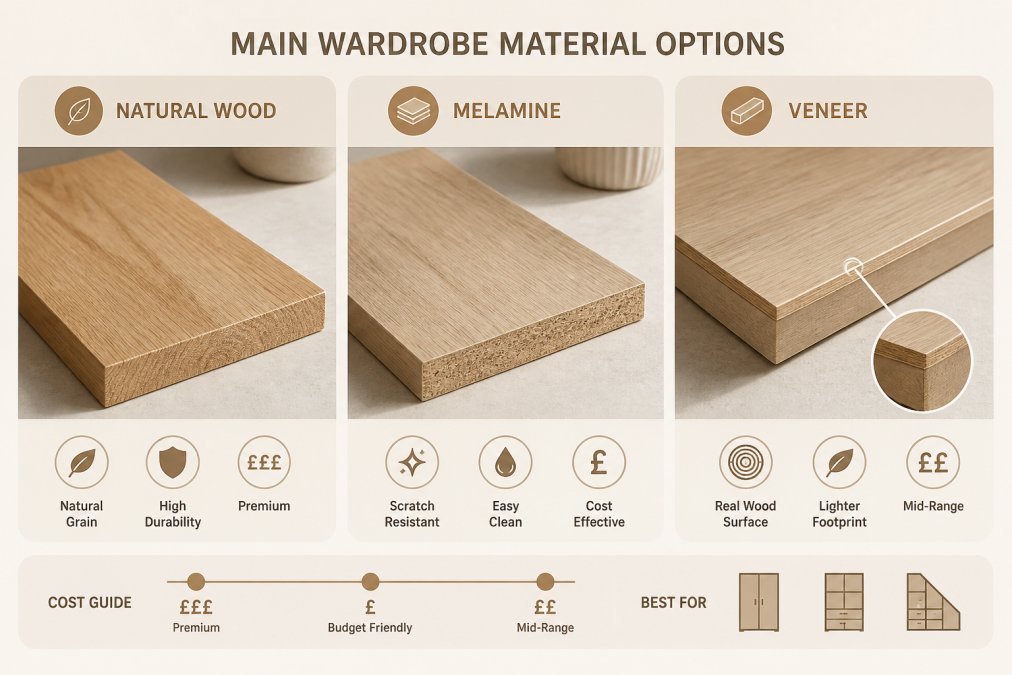
Solid wood represents the premium end of wardrobe construction. Hardwoods like oak, walnut, and maple offer superior structural integrity and can be refinished multiple times throughout their lifespan. A solid wood wardrobe can last 50+ years with proper care, making it a genuine investment piece.
The primary advantage is durability and repairability. Scratches and minor damage can be sanded out and refinished. However, solid wood requires regular maintenance, dusting, occasional conditioning with oils or waxes, and protection from humidity fluctuations. It’s also heavier and more expensive than engineered alternatives.
Plywood and Veneer
Plywood uses multiple thin layers of wood glued with grain running in alternating directions. This cross-grain structure provides excellent dimensional stability, plywood resists warping far better than solid wood. A veneer (typically 2-3mm of real wood) is applied to visible surfaces, giving the appearance of solid wood without the cost or maintenance demands.
Plywood offers practical advantages: it’s significantly more stable than solid wood, making it ideal for large panels and shelving. It’s lighter than solid wood but still feels substantial. Quality plywood wardrobes last 20-30 years, though the veneer can delaminate if exposed to excessive moisture or impact.
MDF and Hardboard
Medium Density Fibreboard (MDF) and melamine-faced chipboard are engineered products made from wood fibres bonded with resin. MDF offers a smooth surface ideal for paint finishes. Melamine-faced chipboard provides a durable, easy-to-clean surface that resists staining and impacts.
The primary advantage is cost and consistency. MDF and chipboard are substantially cheaper than solid wood or plywood. The structural limitation is load-bearing capacity, MDF sags more readily under heavy loads. MDF is also vulnerable to moisture; if water penetrates the surface, it swells and becomes soft.
MDF vs Plywood for Wardrobes: Which Performs Better?
When comparing MDF vs plywood, the answer depends entirely on your specific situation.
Structural Integrity and Load-Bearing
Plywood outperforms MDF for structural strength. The cross-grain construction provides superior rigidity and handles concentrated loads more effectively. If you’re planning heavy loads or long spans without intermediate support, plywood is the more reliable choice.
MDF performs adequately for typical wardrobe loads, clothing, shoes, folded items, but shows noticeable deflection under heavy concentrated weight.
Moisture Resistance and Warping Risk
Plywood resists warping better than MDF. The cross-grain structure provides inherent dimensional stability. MDF swells dramatically when exposed to moisture, and a single exposure can cause permanent damage.
For wardrobes in climate-controlled bedrooms with normal humidity, both materials perform adequately. For bathrooms, en-suites, or high-moisture areas, plywood is substantially more reliable.
Surface Finish and Paint Adhesion
MDF provides a superior surface for paint finishes. The smooth, uniform surface accepts paint beautifully, and the finish is typically more durable than paint on plywood. Melamine-faced chipboard offers an alternative that avoids painting altogether, with a pre-finished surface available in numerous finishes that resists staining better than paint.
Wardrobe Interior Material Options: Carcass and Components
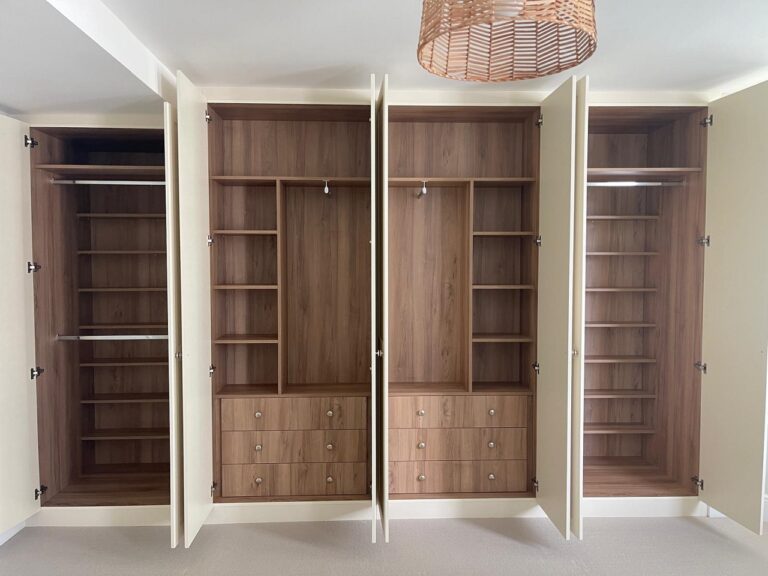
The carcass is typically made from one of the materials discussed above. Interior components involve additional considerations about edge finishing and durability.
Melamine-Faced Chipboard and Durability
Melamine-faced chipboard is increasingly common in fitted wardrobes because it combines cost-effectiveness with practical durability. The melamine facing provides a hard, smooth surface that resists scratching, staining, and moisture better than raw chipboard or painted MDF.
For typical bedroom use, a melamine-faced chipboard wardrobe will perform reliably for 15-20 years. The limitation appears when the edge is damaged, if the melamine facing is chipped or the edge is exposed, moisture can penetrate the chipboard substrate. Proper edge banding is essential for durability.
Edge Banding and Finishing Details
Edge banding covers the raw edges of engineered boards, serving both functional and aesthetic purposes. Functionally, it prevents moisture penetration. Quality edge banding makes a measurable difference in durability. Iron-on edge banding is affordable but less durable. Pre-glued edge banding applied during manufacturing is more reliable. For maximum durability, solid wood edge banding provides the strongest protection and most authentic appearance.
Cost of Fitted Wardrobe Materials: Budget Planning
Material costs vary substantially. Understanding the cost structure helps you make realistic budget decisions.
Material Cost Breakdown by Type
Melamine-faced chipboard is the most budget-friendly option. If cost is your primary concern, it delivers acceptable performance at an accessible price point. MDF sits in the middle price range and offers better value than plywood for painted wardrobes. Plywood with veneer is more expensive than MDF but less expensive than solid wood. Solid wood is the premium option with significantly higher material cost.
Hidden Costs and What to Expect
Material cost is only one component of total wardrobe cost. Installation, design, hardware, and finishing details often exceed material costs. Fitting awkward spaces requires custom solutions that increase cost. Quality hardware significantly affects cost and functionality, budget hinges wear quickly, while quality soft-close hinges transform how the wardrobe functions over a 20-year lifespan.
Durability, Maintenance and Long-Term Performance
How your wardrobe performs over time depends on material choice, build quality, and maintenance.
Scratch Resistance and Surface Protection
Melamine-faced chipboard and painted MDF offer good scratch resistance for typical use. Plywood with veneer is more vulnerable to scratching because the veneer is thinner. Solid wood is moderately scratch-resistant, but scratches can be sanded out and refinished, a 20-year-old solid wood wardrobe can be restored to like-new condition.
Practical protection involves thoughtful use. Soft-close hinges and drawers prevent slamming and impact damage. Proper ventilation prevents moisture accumulation.
Cleaning and Ongoing Maintenance
Melamine-faced chipboard requires minimal maintenance, wipe with a damp cloth and dry immediately. Painted MDF also requires minimal maintenance. Plywood with veneer requires more care to avoid excessive moisture. Solid wood requires the most maintenance but offers the most flexibility, becoming more beautiful over time as the wood develops patina.
Environmental Impact and Sustainable Material Choices
Material sourcing and manufacturing impact environmental sustainability and indoor air quality.
VOC Emissions and Indoor Air Quality
VOC (volatile organic compound) emissions from wardrobe materials affect indoor air quality, particularly in bedrooms. Quality engineered boards use low-formaldehyde or formaldehyde-free adhesives. Water-based paint finishes also emit fewer VOCs than solvent-based alternatives. Solid wood and plywood emit minimal VOCs.
Sustainable Sourcing and Certification
Sustainable forestry certification (FSC, PEFC) indicates materials come from responsibly managed forests. Engineered boards use wood waste and smaller trees that would otherwise be discarded, making them potentially more efficient than solid wood. However, the most sustainable choice involves considering the wardrobe’s lifespan, a wardrobe lasting 50 years has lower environmental impact per year than one lasting 15 years, even if the longer-lasting option uses more material.
Climate and Moisture Considerations for UK Homes
UK homes present specific environmental challenges for wardrobes. Variable humidity, seasonal temperature changes, and poor ventilation test material durability.
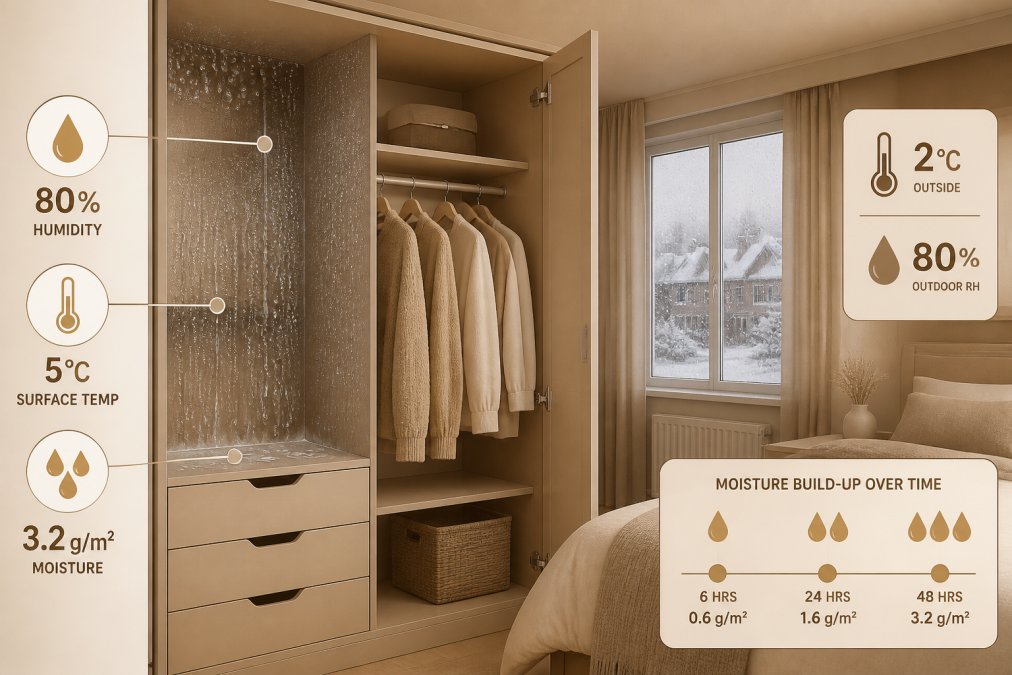
UK humidity varies seasonally. Winter brings damp conditions, particularly in older properties with poor ventilation. MDF and chipboard struggle with this cycle, they swell in damp conditions and shrink in dry conditions, eventually developing gaps and warping. Plywood handles humidity variation better because the cross-grain construction resists warping.
Ventilation is critical. A wardrobe in a well-ventilated bedroom performs better than an identical wardrobe in a poorly ventilated en-suite. In high-moisture areas, plywood or solid wood is more reliable than melamine-faced chipboard. Addressing underlying damp problems is more important than selecting the "best" material, no material performs well in genuinely damp conditions.
Making Your Final Material Choice
Selecting the right material requires balancing performance, cost, aesthetics, and your specific situation.
Matching Materials to Your Space and Budget
Start by assessing your situation honestly. What’s your budget? How long do you expect the wardrobe to last? What’s the environment like? If budget is your primary constraint, melamine-faced chipboard delivers acceptable performance at the lowest cost, expect 15-20 years of reliable service. If you’re willing to spend more, plywood with veneer offers a genuine step up with better moisture resistance.
If you’re planning a long-term investment, solid wood justifies the premium cost through the ability to refinish and modify wardrobes over decades. For painted finishes, MDF offers the best value. For high-moisture environments, avoid MDF and budget chipboard, specify melamine-faced chipboard with quality edge banding, or choose plywood.
Customization and Hardware Compatibility
Material choice affects what customization is practical. Solid wood and quality plywood accommodate custom joinery and internal modifications. Melamine-faced chipboard is less flexible once manufactured. Quality internal fittings make a genuine difference in functionality. A complimentary design visit helps you plan internal organization that actually works for your belongings and lifestyle.
Choosing wardrobe materials is a decision that affects how your storage functions and looks for years. At Finest Furniture Studio, we work with homeowners across London and the South East to select materials that match their specific situation, budget, and long-term expectations. Our complimentary design visit helps you understand these trade-offs and plan a wardrobe that genuinely solves your storage challenges. Book a free design visit and discover how bespoke fitted solutions maximize your space with materials chosen specifically for your home.
| Material | Best For | Lifespan | Maintenance | Moisture Resistance |
|---|---|---|---|---|
| Solid Wood | Long-term investment, natural finishes | 50+ years | Regular conditioning | Good if sealed |
| Plywood with Veneer | Balanced performance, wood appearance | 20-30 years | Light maintenance | Good |
| MDF | Painted finishes, budget-conscious | 15-20 years | Minimal | Fair |
| Melamine-Faced Chipboard | Cost-effective, easy-clean surfaces | 15-20 years | Very minimal | Fair with quality edge banding |
| Material | Cost Level | Load-Bearing | Paint Adhesion | Repairability |
|---|---|---|---|---|
| Solid Wood | High | Excellent | Good | Excellent |
| Plywood with Veneer | Medium-High | Excellent | Fair | Good |
| MDF | Medium | Good | Excellent | Fair |
| Melamine-Faced Chipboard | Low | Fair | N/A | Poor |
Frequently Asked Questions
What is the best material for a long-lasting fitted wardrobe?
Plywood and solid wood offer the best durability for fitted wardrobes, with superior structural integrity and resistance to warping. Plywood combines cost-effectiveness with strength, while solid wood provides premium longevity. MDF is budget-friendly but less durable in high-moisture environments. For UK homes, melamine-faced chipboard (MFC) works well for interior components if properly sealed. The best choice depends on your budget, climate exposure, and expected lifespan, typically 10+ years for quality construction.
Is MDF or plywood better for wardrobe construction?
Plywood outperforms MDF for wardrobe carcasses due to superior dimensional stability and moisture resistance. Plywood resists warping and maintains structural integrity in varying UK humidity levels. MDF is lighter, easier to machine, and offers better paint adhesion for decorative finishes, making it suitable for facing panels and internal shelving. For load-bearing components like side panels and shelves, plywood is the stronger choice. Many custom wardrobes use both materials strategically: plywood for the carcass, MDF for finished surfaces.
How does humidity affect wardrobe material choice in UK homes?
UK homes experience significant seasonal humidity variation, particularly in bathrooms and bedrooms. Plywood and solid wood handle moisture fluctuations better than MDF, which swells and loses structural integrity when exposed to damp. Melamine-faced chipboard resists moisture if edges are properly sealed with edge banding. In high-humidity areas, ensure adequate ventilation and choose materials with moisture-resistant finishes. Climate-specific performance matters: coastal and urban areas with higher ambient moisture require materials with proven dimensional stability.
What are the pros and cons of using melamine-faced chipboard (MFC) for wardrobes?
Melamine-faced chipboard offers affordability, easy cleaning, and scratch resistance from the protective surface layer. It's lightweight and suitable for shelving and interior components. Drawbacks include lower structural integrity than plywood, vulnerability to moisture at exposed edges, and difficulty with repairs, damaged areas cannot be easily refinished. MFC works well for budget-conscious projects and internal shelving but should not be used for main carcass construction in moisture-prone areas. Proper edge sealing extends lifespan significantly.
Are there eco-friendly wardrobe material options available in the UK?
Yes. Look for FSC-certified plywood and solid wood from sustainably managed forests, certification bodies like the Forest Stewardship Council verify responsible sourcing. MDF and chipboard made from recycled wood fibres reduce waste. Check for low-VOC finishes and paints to minimise formaldehyde emissions and improve indoor air quality. Some UK manufacturers offer reclaimed or salvaged wood options. When choosing materials, ask suppliers about certification and emissions testing to ensure your wardrobe meets environmental standards.
How do I choose wardrobe materials that fit my budget?
Budget planning requires understanding cost drivers: solid wood is premium, plywood offers mid-range value, and MDF or chipboard are most affordable. Consider total cost including hardware, edge banding, and finishing. Interior components can use cheaper materials (MFC shelving) while visible carcass uses quality plywood. Transparent pricing from custom makers helps, avoid hidden charges by requesting detailed breakdowns. Finest Furniture Studio provides upfront pricing with no hidden fees, allowing you to plan accurately and choose materials matching your investment level.
What maintenance do different wardrobe materials require?
Solid wood and plywood need regular dusting and occasional polishing with appropriate wood care products; avoid excessive moisture. MDF and melamine-faced chipboard require gentle cleaning with dry or barely damp cloths, water penetration damages them. Melamine's surface resists stains but scratches show easily. Polyurethane paint finishes on all materials need occasional touch-ups. Proper ventilation reduces moisture buildup affecting all materials. Most quality wardrobes require minimal maintenance if installed correctly and kept in normal indoor conditions.
Can wardrobe materials be repaired if damaged?
Repairability varies significantly. Solid wood and plywood can be sanded, refinished, and structurally repaired, making them highly serviceable. MDF accepts paint touch-ups but structural damage is harder to fix. Melamine-faced chipboard is difficult to repair, damaged surfaces cannot be refinished, though edge damage can be resealed. Veneer on plywood can be patched or replaced. Quality construction with durable finishes reduces damage risk. Finest Furniture Studio's 10-year warranty covers manufacturing defects, providing peace of mind for long-term ownership.
This article was written using GrandRanker