
Table of Contents
- Why Under-Bed Storage Works in Small Spaces
- How to Measure Under-Bed Clearance Correctly
- Types of Under-Bed Storage Containers: Stackable, Rolling, and Drawer-Style
- Best Materials for Long-Term Clothing Storage
- Space-Saving Bedroom Organisation Ideas Using Under-Bed Storage
- Keeping Under-Bed Storage Dust-Free and Organised
- Maximising Small Bedrooms with Modular and Bespoke Solutions
- Frequently Asked Questions
Last Updated: September 28, 2026
Why Under-Bed Storage Works in Small Spaces
Under-bed storage containers solve a fundamental problem: wasted space beneath your bed frame. With the right containers, you can reclaim square footage without visual clutter.
An average bed frame sits 30-50cm above the floor. For a small bedroom, that’s often 1-2 cubic metres of usable space. Under-bed storage containers transform this into organized storage for seasonal clothing, bedding, shoes, and items you don’t need daily.
Under-bed storage doesn’t consume vertical wall space, keeping visual clutter hidden and making your room feel larger.
HGTV’s 2026 guide to under-bed storage solutions confirms that stackable containers and rolling drawers are among the most popular choices for maximizing small bedroom space. The key is matching the right container type to your specific needs and available clearance.
How to Measure Under-Bed Clearance Correctly
Before buying under-bed storage containers, accurate measurement is essential. You must also understand how your bed frame design affects what will fit.
Measure bed frame height accurately
Use a tape measure to check the distance from the floor to the lowest point of your bed frame (not the mattress). This is your maximum container height.
Platform beds sit only 20-25 cm above the floor; slatted frames offer 30-40 cm; storage beds can be 45-60 cm but their drawers occupy space. Measure at multiple points (foot, head, both sides) and use the smallest measurement as your maximum container height.
Account for bed frame legs and structural obstacles
Measure from inner edge to inner edge, accounting for legs and central support beams that reduce usable width. Subtract 5 cm from each measurement to ensure smooth sliding, especially on carpet.
Understand the clearance-to-container-height trade-off
Choose between stackability and accessibility. With 35+ cm clearance, stack containers up to 30 cm tall. With 25-35 cm, use single-layer or rolling containers. Under 25 cm, use flat bags or rolling drawers. Account for lid depth and handles when measuring total height.
Check for hidden obstructions
Note any support beams, crossbars, or bracing underneath your bed. These reduce usable space and may halve your width, affecting whether you choose one wide container or two narrower ones.
Test before you buy
Test containers in-store if possible, or order from retailers with 30-60 day returns to test fit in your actual bedroom.
Types of Under-Bed Storage Containers: Stackable, Rolling, and Drawer-Style
Under-bed storage containers fall into three main categories, each with distinct advantages for different situations.
Stackable containers with dust-proof lids
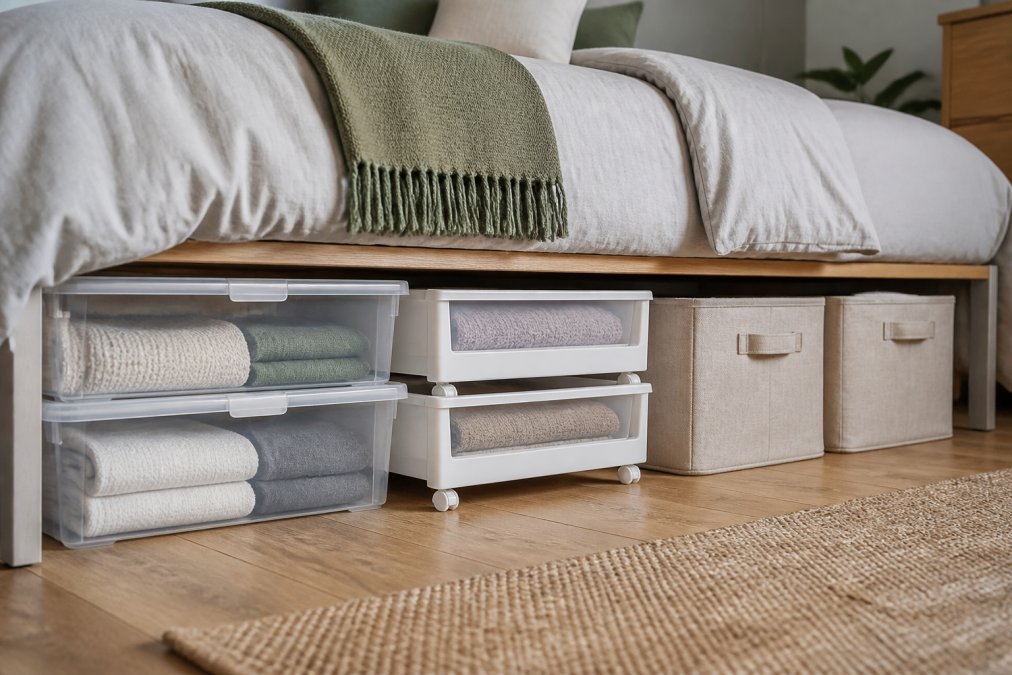
Stackable containers maximize vertical space within your under-bed clearance. They’re typically made from rigid plastic or fabric, with lids that seal out dust. The benefit is obvious: you can stack multiple containers in the same footprint, doubling or tripling your storage capacity.
According to home organization experts at Consumer Reports, “Stackable underbed drawers come with the bonus of keeping contents visible yet dust-free.” Clear plastic stackable containers let you see what’s stored without opening them. This matters when you’re looking for specific items quickly.
The trade-off is accessibility. To reach a container at the bottom of a stack, you need to remove the ones on top. For items you access infrequently, winter coats in summer, Christmas decorations, this is fine. For items you need regularly, stackable containers create friction.
Stackable containers work best when you have adequate clearance (35cm or more) and plan to store seasonal items or things you rarely need.
Rolling storage with easy-glide wheels
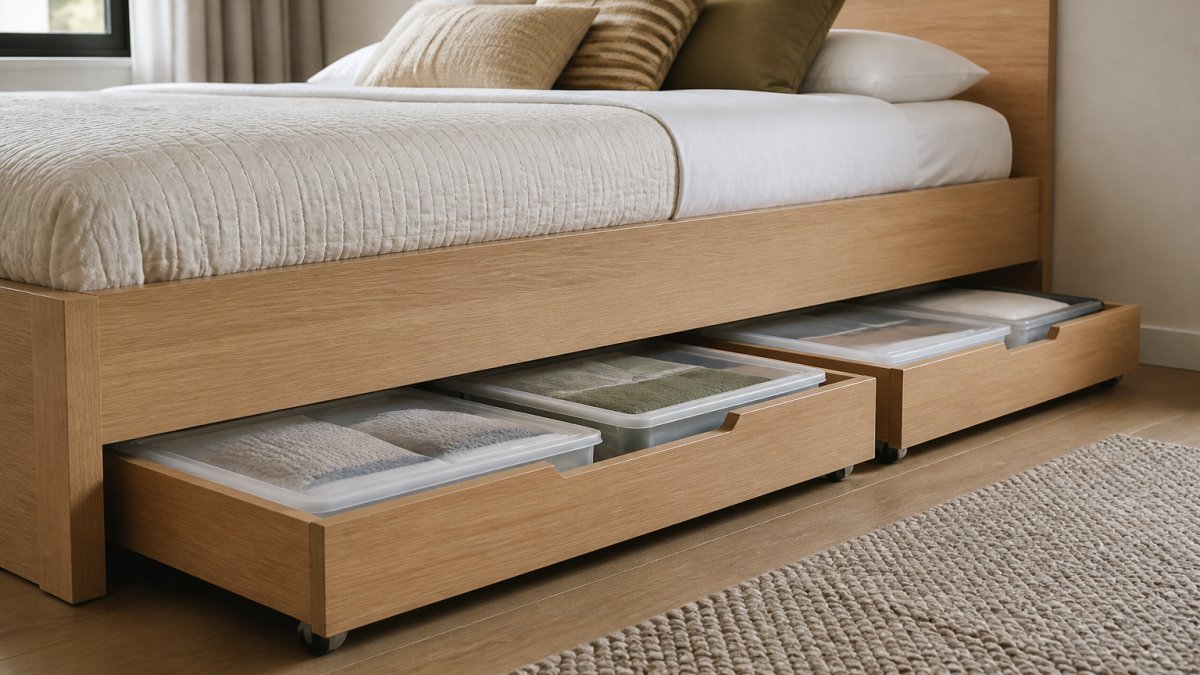
Rolling containers slide out smoothly, bringing everything within reach. Ease of access encourages regular organization. They trade vertical capacity for horizontal convenience and work best where you have space to roll them out. Choose smooth-gliding casters that won’t catch on carpet.
Drawer-style boxes for accessible storage
Drawer-style boxes offer a middle ground between stacked and rolling storage, with better accessibility than stacked boxes and more stackability than rolling units. They require slightly more clearance due to the drawer mechanism.
Best Materials for Long-Term Clothing Storage
Your choice of container material affects how well your stored items survive months in darkness and stillness.
Heavy-duty plastic vs. breathable fabric
Plastic containers are durable, moisture-resistant, and stackable but can trap moisture in humid conditions. Breathable fabric containers allow air circulation and are gentler on delicate clothing but offer less dust protection. Use plastic for short-term storage and fabric for long-term quality clothing storage.
Moisture-resistant and archival options
For valuable items or damp environments, use archival-grade storage with acid-free materials. Vacuum-sealed bags offer extreme moisture protection but can crease delicate fabrics. Wood containers offer excellent archival properties and aesthetic appeal.
Space-Saving Bedroom Organisation Ideas Using Under-Bed Storage
Categorize items by season and frequency of access. Use clear containers or label bins clearly. Store frequently accessed items in rolling containers and seasonal items in stacked containers. Under-bed storage works best alongside other solutions like wardrobes or shelving.
Keeping Under-Bed Storage Dust-Free and Organised
Dust and moisture are the two enemies of under-bed storage. Strategy depends on what you’re storing, storage duration, and your home’s climate.
Dust control: sealed containers vs. air circulation
Sealed plastic containers work for short-term storage but trap moisture in long-term use. For long-term storage, elevate containers slightly off the floor to improve air circulation and prevent mildew. Vacuum under your bed monthly to remove dust before it settles on containers.
Moisture control: the climate-dependent strategy
Moisture is the silent killer of stored textiles. It causes mildew, musty odours, and permanent damage to natural fibres. But moisture control is not one-size-fits-all, it depends on your local climate and storage duration.
In dry climates (low humidity year-round), sealed plastic containers work well. They protect contents from dust and prevent moisture from entering. However, even in dry climates, avoid storing damp items. Ensure clothing is completely dry before placing it in containers. Any residual moisture trapped inside will concentrate over weeks.
In humid climates (coastal areas, regions with high summer humidity, or homes with poor ventilation), sealed plastic containers are actually counterproductive. They trap whatever moisture is already present inside, creating a closed environment where mildew thrives. In these conditions, breathable fabric containers or ventilated plastic containers are safer, even though they offer less dust protection.
For items stored longer than one season in humid conditions, add moisture-absorbing packets inside containers. Silica gel packets, calcium chloride desiccants, or activated charcoal all work. Replace these every 2-3 months, or sooner if you live in a very humid area. You’ll notice the packets becoming saturated (silica gel turns from blue to pink as it absorbs moisture). Saturated packets are useless and should be replaced immediately.
Alternatively, use cedar blocks or cedar-lined storage boxes. Cedar naturally repels insects and inhibits mildew growth. It’s particularly effective for storing woolens, which are vulnerable to moth damage. Cedar scent fades over time; refresh it by lightly sanding the wood or replacing cedar blocks every 1-2 years.
Seasonal reorganization: the preservation checkpoint
Don’t treat under-bed storage as a “set and forget” system. Reorganize seasonally, when you swap winter and summer clothing, take the opportunity to inspect and refresh.
When you open containers after months of storage, check for:
- Seal integrity: Are lids still fitting snugly? Warped lids should be replaced.
- Moisture signs: Condensation on the inside of plastic containers, musty smells, or visible mildew indicate moisture problems. If found, remove items immediately, air them out, and address the underlying cause (humidity, sealed container in humid climate, or damp items stored).
- Pest activity: Look for insect damage, droppings, or webbing. Cedar blocks or mothballs can prevent this, but inspection catches problems early.
- Desiccant saturation: Replace silica gel packets or other moisture absorbers, even if they don’t look saturated.
- Organization drift: Over months, items shift. Reorganize logically so you can find what you need without unpacking everything.
Climate-specific preservation for valuable items
If you’re storing heirloom clothing, designer pieces, or anything you plan to keep for decades, under-bed storage is suboptimal, but if it’s your only option, take extra precautions.
Use archival-grade storage solutions: acid-free tissue paper, unbleached cotton storage boxes, and acid-free dividers. These materials don’t degrade over time and won’t transfer colour or damage delicate fabrics. Avoid plastic storage bags for long-term textile storage; plastic off-gasses and can trap moisture.
Vacuum-sealed bags offer extreme moisture protection but require periodic re-sealing and can cause permanent creasing in delicate fabrics. They’re best for items you won’t access for years and don’t mind being compressed.
For items stored in naturally damp environments (basements, ground-floor bedrooms, or homes with poor ventilation), consider whether under-bed storage is truly suitable.
Labelling and inventory: the organizational backbone
Dust and moisture control are physical; organization is psychological. Without clear labelling and a mental inventory of what’s stored where, you’ll repeatedly open containers searching for items, exposing contents to dust and air every time.
Maximising Small Bedrooms with Modular and Bespoke Solutions
For homeowners seeking long-term storage solutions that genuinely transform small bedrooms, modular and bespoke options go further than off-the-shelf containers.
Frequently Asked Questions
What are the best materials for under-bed storage containers?
Heavy-duty plastic offers durability and stackability, making it ideal for frequently accessed items. Breathable fabric containers suit long-term clothing storage and prevent moisture buildup. For archival preservation, moisture-resistant materials protect seasonal garments and delicate textiles. According to home organisation experts, stackable drawers with dust-proof lids keep contents visible whilst dust-free, combining accessibility with protection.
How do I measure my bed frame for under-bed storage?
Measure three dimensions: height (clearance between floor and bed base), length (along the bed’s longest side), and depth (from bed edge to wall). Use a tape measure on a flat surface for accuracy. Account for bed frame legs, which reduce usable space. Leave 5-10 cm clearance for easy insertion and retrieval. Document these measurements before purchasing under-bed storage containers to ensure proper fit.
What items are best suited for under-bed storage?
Seasonal clothing, footwear, bedding, and off-season items work well under beds. Avoid storing electronics, important documents, or items sensitive to temperature fluctuations. Heavy-duty containers protect against dust and moisture. Label each container clearly for quick identification. Rotate contents seasonally to maximise space and keep frequently used items accessible.
Do I need wheels on my under-bed storage containers?
Wheels are beneficial for small rooms where mobility matters. Easy-glide wheels enable quick access without moving the entire bed, particularly useful in compact bedrooms or for those with mobility concerns. Stackable containers without wheels maximise vertical space and suit stationary storage. Choose based on your retrieval frequency and physical ability to move containers manually.

