
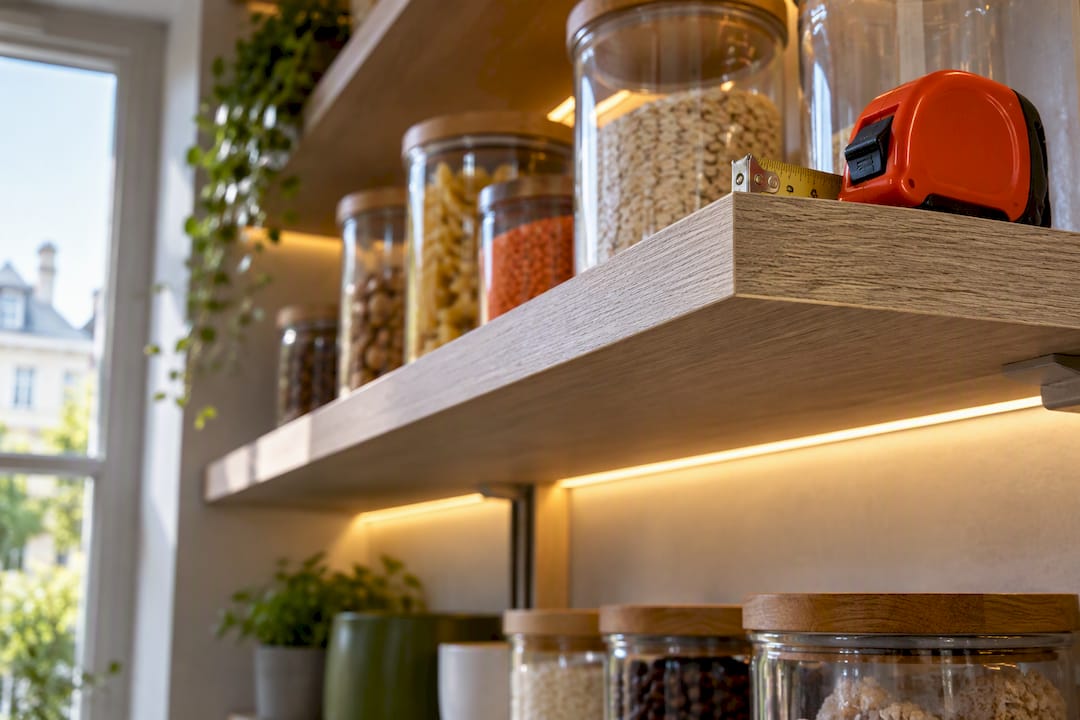
Plywood at 18mm thickness is the best all-round choice for pantry shelving, offering strength, moisture resistance and reliable screw-holding without the edge-sealing work MDF demands. The rule to work from: treat 18mm as your baseline, then size up or add supports whenever a shelf carries bulk tins, appliances, or spans wider than the typical limits for the material. For painted, dry pantries, MR MDF is a solid, budget-friendly alternative.
TL;DR:
- Plywood at 18mm thickness is optimal for strength, moisture resistance, and screw-holding, especially when supporting heavy or wide pantry shelves.
- MR MDF is a budget-friendly alternative for painted, dry pantries with lighter loads, but requires sealing edges to prevent swelling.
- Support spacing should be limited to 600mm for MDF, 800mm for plywood, and 1000mm for solid timber to prevent sagging under load.
- Custom fitting is recommended for irregular openings, long spans, or light-reflective finishes, often outperforming standard DIY solutions.
- Fixings should be selected based on wall type, with proper wall anchors and pilot holes crucial to avoid shelf failure.
Table of Contents
- Common materials used for pantry shelves
- Weighing up the trade-offs between materials
- Thickness and span rules that prevent sagging shelves
- Choosing brackets and anchors for your wall type
- Sealing and finishing so boards survive kitchen humidity
- What pantry shelving actually costs in practice
- When bespoke shelving beats a DIY weekend
- Where the real shelving decision actually sits
- A bespoke alternative worth considering
- Sources
- FAQ
Common materials used for pantry shelves
Walk into any timber merchant or DIY chain and you will find five materials competing for your pantry project: plywood, MDF, solid timber, particleboard, and metal or wire systems, with glass and acrylic sometimes used for display shelving.
Plywood is layers of thin wood veneer glued at alternating grain directions, which gives it stiffness in both directions and resistance to warping. It is sold in various grades, with birch plywood offering a smoother, harder-wearing face than the more common spruce plywood.
MDF (medium-density fibreboard) is compressed wood fibre bonded with resin. Standard MDF swells if it gets damp, so moisture-resistant (MR) MDF, tinted green in most ranges, is the version worth specifying for kitchen and pantry use.
Solid timber, usually pine, oak, or beech for shelving, brings a natural look and the ability to sand out dents or stains over time. It moves slightly with humidity changes, more than engineered boards, but that movement rarely causes structural problems on shelf-length pieces.
Particleboard (chipboard) is the cheapest sheet material, made from compressed wood chips and resin. It holds screws poorly at the edges and is the material most likely to sag or crumble under sustained kitchen humidity.
Metal, wire, and glass solutions suit specific jobs: wire shelving for ventilated fresh-produce storage, powder-coated steel brackets for open industrial-style pantries, and glass or acrylic for display shelves where visibility matters more than load.
Where to find them:
- Plywood and solid timber: independent timber merchants tend to stock better grades and will cut sheets to size.
- MDF and MR MDF: widely available at national DIY chains, usually pre-cut or cut in-store.
- Particleboard: sold everywhere as flat-pack shelving or raw sheet, often the default in budget kitchen units.
- Metal and wire systems: kitchen specialists and larger DIY retailers stock modular wire shelving kits.
- Glass and acrylic: cut to order by glazing specialists, rarely a DIY cutting job.
Suitability flags worth noting before you buy: plywood and solid timber take paint or clear finish equally well; MR MDF is paint-only, since its face lacks the grain for a clear coat; particleboard should be reserved for light, dry storage; metal and wire are the pick for produce that needs airflow; glass belongs on display shelves, never load-bearing ones.
If you are planning the pantry itself rather than just the shelves, shelf depth and layout affect which materials make sense, since deeper shelves need stiffer boards to resist sag.
Weighing up the trade-offs between materials
Each material earns its place for different reasons, and the differences matter more once weight and moisture come into the picture.
Plywood holds screws well at the edges, resists humidity better than fibreboard, and stays straight over long spans. Birch plywood costs more than spruce but gives a cleaner, harder face that survives repeated cleaning without fraying. Cut edges show the ply layers, which some people finish with veneer tape and others leave as a design feature.
MDF and MR MDF take paint beautifully and cut with a cleaner edge than plywood, which is why fitted furniture makers favour it for visible carcasses. The trade-off is that any exposed or unsealed edge will absorb moisture and swell, and MDF’s screw-holding at the edge is weaker than plywood’s, so avoid edge-fixing brackets without pilot holes and adhesive.
Solid timber gives a premium look and can be sanded and refinished for decades, which makes it cost-effective over the life of the pantry even though the sheet price is higher. It will expand and contract slightly with the seasons, particularly wider boards, so leave a small gap at fixed ends.
Particleboard works acceptably for short-term or low-load shelving, but it is the material most associated with sagging, edge crumbling, and swelling once kitchen steam gets to it repeatedly.
Metal, wire, and glass need little structural thought since they are load-rated by the manufacturer, but wire shelving marks soft items and glass needs edge-polishing to be safe to handle.
- Plywood: best all-round strength and moisture tolerance, moderate cost.
- MR MDF: best paint finish, needs sealed edges, mid-low cost.
- Solid timber: best longevity and repairability, highest cost.
- Particleboard: lowest cost, weakest under sustained humidity.
- Metal/wire/glass: specialist use, not a general-purpose shelf material.
Pro Tip: Buy a small offcut of your chosen board and leave it in a damp corner of the pantry for a week before committing to a full sheet order. It tells you more about real-world swelling than any spec sheet.
Thickness and span rules that prevent sagging shelves
Get the thickness and span right and you avoid the single most common shelving complaint: a bow appearing within months of installation.
- Standard loads: use 18mm board as your default thickness for tinned goods, packets, and everyday pantry items, the figure most UK guidance settles on for strength and affordability.
- Light loads: 12 to 15mm is acceptable for shelves holding only lightweight items such as paper goods or spice jars, again per the same Homebuilding guidance.
- Heavy or bulk storage: step up to 25mm or more where shelves will carry catering packs, small appliances, or dense glass jars.
- Unsupported span limits: keep runs to roughly 600mm for MDF, 800mm for plywood, and up to 1000mm for solid timber before you need a centre support.
- Beyond those spans: add a centre bracket or upright divider, fit a front lipping strip to stiffen the leading edge, or build a cleat-and-frame support that carries the shelf along its full depth rather than just at the ends.
- Heavily loaded wide shelves: tighten support spacing to around every 450mm rather than relying on end brackets alone.
A simple front lip, a strip of timber glued and screwed along the front edge, adds meaningful stiffness for very little material cost, which is why it turns up on almost every well-built pantry shelf regardless of the board behind it.
Choosing brackets and anchors for your wall type
The wall behind the shelf decides which fixing will actually hold, and this is where most DIY shelf failures start rather than in the board itself.
- Visible L-brackets: cheap, easy to fit, but visually intrusive and generally rated for lighter domestic loads.
- Heavy-duty brackets: wider footplate and thicker steel, suited to 25mm boards and bulk storage.
- Floating brackets: concealed rods set into the wall and the shelf underside, giving a clean look but needing accurate drilling.
- Cleats: a timber strip fixed to the wall that the shelf sits on, spreading load along the full length rather than at two points.
- Full-frame systems: a ply or timber frame built floor to ceiling, the strongest option for heavy or floor-to-ceiling pantry storage.
For anchors, match the fixing to the substrate: use proper masonry plugs or resin anchors in brick or block walls, and switch to spring toggles or hollow-wall anchors in plasterboard. Wherever possible, locate a stud and screw directly into it rather than relying on a plasterboard fixing alone, since most DIY shelf failures come down to fixings unsuited to the wall type rather than a weak board.
Space brackets no further than the span limits above, drill a pilot hole before driving any screw into hardwood or MDF edges, and check the manufacturer’s load rating on the packet against the weight you actually intend to store.

Pro Tip: Weigh a representative shelf’s worth of jars and tins on a bathroom scale before you buy brackets. It is the quickest way to avoid ordering fixings rated below what you actually plan to store.
Sealing and finishing so boards survive kitchen humidity
Cut edges are the weak point on any engineered board, and sealing them properly is what separates a shelf that lasts a decade from one that swells within a year.
- MDF and particleboard edges need a coat of primer or a dedicated MDF sealer before painting, since an unsealed edge absorbs moisture and swells, even on MR-rated board.
- Plywood edges can be left as a feature, covered with veneer tape for a seamless look, or finished with a solid timber lipping strip that also stiffens the shelf.
- MR MDF is the sensible choice over standard MDF wherever the pantry sees condensation or is near a kettle or dishwasher vent.
- Routine maintenance is simple: wipe down spills promptly, avoid letting standing water sit on any board edge, and use a shallow tray under items prone to leaking, such as oils or opened tins.
A shelf finished properly at the outset rarely needs attention again beyond the occasional wipe, which is worth the extra half hour of sealing work compared with the cost of replacing a swollen board later.
What pantry shelving actually costs in practice
Budgeting for shelving is straightforward once you know the sheet and fixing prices, and where the real savings and costs sit.
- MDF 18mm sheets are generally the cheapest sheet option, a sensible pick for painted, budget-conscious pantry fits.
- Plywood costs more per sheet than MDF but performs better long-term under sustained load, which offsets the higher upfront price over years of use.
- Solid timber sits at the top of the price range but rarely needs replacing, since it can be sanded and refinished rather than swapped out.
- Brackets and fixings add a modest but real amount to any job, and hidden supports or a professional paint finish push the total further.
- DIY versus buying: DIY tends to be cheaper when you need several non-standard or irregular shelves, while ready-made units are competitive for standard sheet sizes and simple runs.
The break-even point usually comes down to how many awkward measurements your pantry has. A single straight run of standard-width shelves rarely justifies a bespoke quote, but an alcove, a sloped ceiling, or several differently sized bays often does.
When bespoke shelving beats a DIY weekend

Some pantries are simple boxes with straight walls and standard widths, and a careful DIY job with 18mm plywood will serve those for years. Others have alcoves, sloped ceilings, or long unsupported runs where getting the material and support right becomes a genuinely fiddly job.
Finest Furniture Studio approaches this the way it approaches awkward kitchen corners generally: measuring the actual opening rather than working to standard sheet sizes, then pairing materials to the job. A typical solution for a mid-size pantry pairs structural 18mm plywood shelving with a painted MR MDF carcass, giving strength where the load sits and a clean painted finish where it is seen.
The right material choice depends less on which board is “best” in the abstract and more on matching thickness, span, and finish to the specific opening you are filling.
Commissioning bespoke work tends to pay off on long spans, visible shelving where finish quality shows, and irregular openings where standard sheet sizes leave gaps or waste.
Where the real shelving decision actually sits
Most guidance on this topic obsesses over which board is objectively strongest, when the more useful question is which board suits the span, load, and finish you actually have. Plywood wins most head-to-head comparisons on paper, yet plenty of well-built pantries run happily on MR MDF because the shelves are short, the load is light, and the edges were sealed properly at the start.
The advice that gets skipped most often is the simplest: measure your actual load before buying anything. A shelf rated fine on a spec sheet still sags if nobody checked what would sit on it. Span and support spacing matter more than the marginal difference between a good plywood and a very good plywood.
If you take one thing from this guide, prioritise the fixing and the span check over agonising between two similar boards. A well-supported MDF shelf outperforms a poorly supported plywood one every time.
— Aureliu
A bespoke alternative worth considering
DIY plywood and MDF shelving handles most pantries well, but irregular openings, long visible spans, or a painted finish you want to get right the first time are where a bespoke installer earns its keep. 
Finest Furniture Studio designs pantry and kitchen storage around your actual space rather than standard sheet sizes.
- Irregular alcoves and sloped ceilings measured and fitted to the exact opening.
- Long spans and heavy storage supported with a proper internal frame rather than end brackets alone.
- A painted or timber-effect finish matched to the rest of your kitchen.
If your pantry has an awkward corner or you would rather have it measured and fitted properly, get in touch for a free design consultation and see how a bespoke fit compares with the DIY route.
Sources
- How to build pantry shelves: What wood should I use? | Homebuilding
- Make or Buy Shelves? Real 2025 UK Cost Breakdown and Decision Guide | EcoFriendlyStuff
FAQ
What is the best material to use for pantry shelves?
Plywood at 18mm thickness is generally the best all-round choice, since it combines strength, humidity resistance, and reliable screw-holding without heavy edge-sealing work. MR MDF is a solid, cheaper alternative for painted, dry pantries with lighter loads.
Is it cheaper to buy shelves or build them?
It depends on how standard your shelf sizes are. DIY tends to work out cheaper when you need several irregular or non-standard shelves, while ready-made units are competitive for simple, standard-width runs.
What to use to make pantry shelves?
Plywood, MDF or MR MDF, solid timber, and particleboard are the common choices, with plywood favoured for strength and moisture tolerance and MR MDF favoured for a clean painted finish. Metal or wire shelving suits ventilated, produce-specific storage rather than general pantry use.
Which is better for shelves, MDF or plywood?
Plywood generally performs better under sustained load and tolerates humidity better than MDF, which needs its cut edges sealed to avoid swelling. MDF costs less and takes paint more smoothly, making it a reasonable choice for lighter, dry pantry shelving.

