

Table of Contents
- Why Shelf Layout Matters for Your Productivity
- Home Office Shelving Ideas That Actually Work
- How to Organise Office Shelves for Daily Use
- Home Office Built-In Shelves: Design and Installation
- Styling Your Shelves Without Sacrificing Function
- Common Mistakes to Avoid When Arranging Office Shelves
- Maintaining Your Office Shelf System Long-Term
- Conclusion
- Frequently Asked Questions
Last Updated: October 21, 2026
Why Shelf Layout Matters for Your Productivity
A better work-from-home setup boosts comfort and productivity, especially in how you style home office shelves for productivity.
Scattered supplies and hard-to-reach reference materials cost focus and time. When everything has a place within arm’s reach, you stay in the flow.
Research from Steelcase on designing home offices that work confirms that thoughtful workspace design reduces friction.
At Finest Furniture Studio, we’ve helped many professionals transform awkward alcoves and underused wall space into functional storage.
Home Office Shelving Ideas That Actually Work
Most guides show pretty shelves filled with decorative objects, fine for a living room, but a home office has a different job. The best home office shelving ideas combine easy access to daily items with enough display space to keep the environment pleasant. You’re building both function and style.
The Three-Zone Approach
Divide your shelf space into three zones based on how often you reach for items.
Zone 1: Eye level (your reach zone). This is where your most-used items live.
Zone 2: Above eye level (secondary storage). This is for items you use weekly but not daily.
Zone 3: Below eye level (archive zone). Reserve this for items you rarely access. Old files, backup supplies, boxes of documents.
Floating Shelves vs. Built-In Storage
Floating shelves offer flexibility: install at any height, adjust later, and remove without damaging walls, ideal for rentals or if you may move. Built-in shelves are permanent, custom-fitted, maximise every inch, and look more polished, especially in awkward spaces like alcoves or under sloping ceilings. If you own your home and plan to stay, built-ins deliver better long-term value; if you’re renting or may relocate, floating shelves make sense.
How to Organise Office Shelves for Daily Use
Organising your shelves isn’t about looking perfect, it’s about making them work for you.
Step 1: Audit What You Actually Use
Before arranging anything, spend a week noting what you actually reach for, books, supplies, equipment, and write it down. Most people keep far more than they use. If you haven’t touched something in three months, it doesn’t belong on an accessible shelf. Move it to storage or donate it.
Step 2: Group by Frequency and Function
Once you know what stays, group items by frequency and function.
Frequency groups:
- Daily use (pens, notepads, current projects)
- Weekly use (reference books, backup supplies)
- Monthly use (archived files, seasonal materials)
Functional groups:
- Writing supplies (pens, pencils, markers)
- Reference materials (books, manuals, guides)
- Equipment (speakers, chargers, cables)
- Decorative items (plants, photos, objects)
This prevents the “everything everywhere” problem: you know exactly where writing supplies live instead of scanning five shelves for a pen.
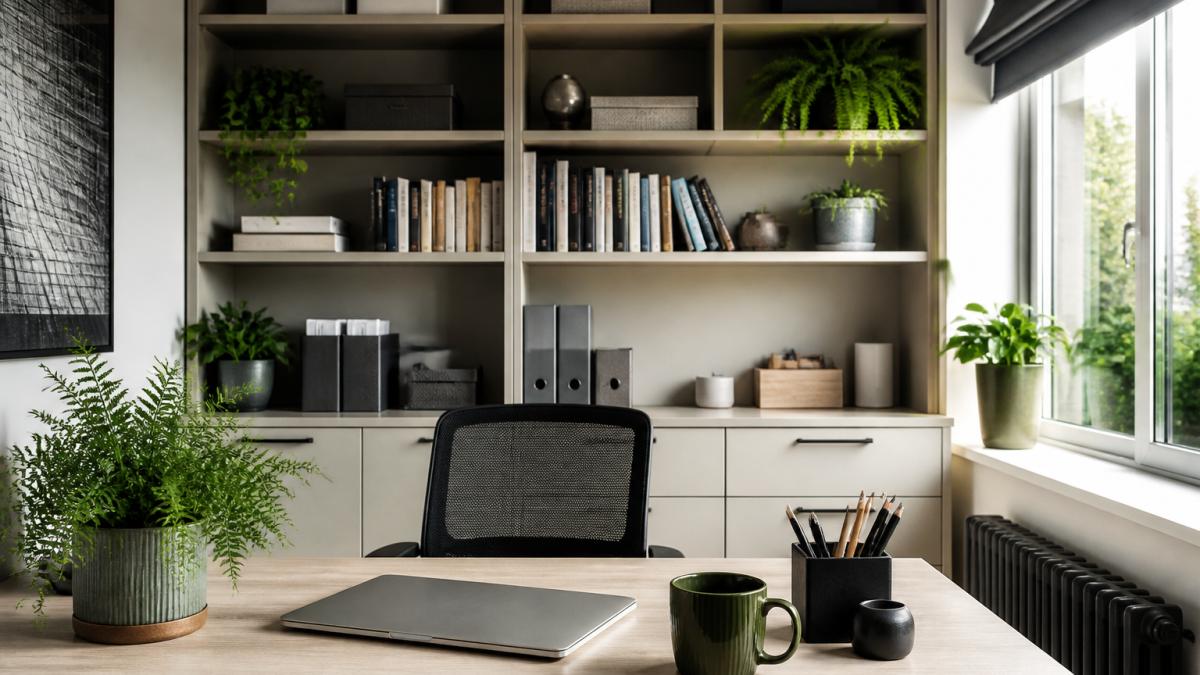
Step 3: Assign Shelf Heights Based on Reach
Place most-used items at eye level, roughly 140-170 cm from the floor for most people. Weekly items go above or below eye level; rarely used items go on the highest or lowest shelves. This cuts wasted motion: no reaching overhead for your pen holder or bending down for your reference book.
Home Office Built-In Shelves: Design and Installation
Built-in shelves transform awkward spaces into functional storage. Unlike floating shelves, they’re custom-fitted to your walls and handle heavier loads. The difference between a built-in that works and one that frustrates comes down to design and installation details, which most guides skip.
Getting the Ergonomics Right Before You Build
Shelf height should follow reach, not aesthetics. Ergonomists commonly set the most-used shelf at roughly 140-170 cm from the floor, so daily items sit between shoulder and eye level; the weekly shelf can sit 30-40 cm above or below that band, and anything above about 180 cm or below about 60 cm should hold only occasional or archive items. Depth matters too: 25-30 cm suits A4 binders and books, while deeper shelves waste space and encourage clutter at the back.
Checking Your Wall Type and Load Limits
Before any built-in is fitted, confirm the wall type. Solid masonry takes heavy shelving with the right fixings; plasterboard on timber studs needs fixings into the studs, not just the board; dot-and-dab or insulated plasterboard often needs specialist cavity fixings or a timber batten fixed through to the substrate. Load limits matter, a shelf packed with hardback books can weigh 30-40 kg per metre run.
Never assume a wall can take the load. Ask your fitter to confirm the substrate and specify fixings for the actual weight you plan to store, especially in older properties where walls may be lath and plaster or have been dry-lined over original surfaces.
Maximising Awkward Spaces
Alcoves are prime real estate, often wasted because standard shelves don’t fit. Custom built-in shelves solve this: wrap them around corners, fit them under sloping ceilings, or build around radiators and pipes, provided ventilation around radiators is maintained. The same applies to understairs storage. Measure the deepest and shallowest points first; a good joiner designs to the shallowest usable depth rather than forcing a uniform shelf that blocks access.
Custom Solutions for Small Offices
If your office is small, every centimetre matters. Built-in shelves go floor to ceiling and wall to wall, eliminating wasted space, and look cleaner than floating shelves because there’s no gap between units. Combination units work well too: a built-in desk with shelves above and beside it creates an integrated workspace. For bespoke home office furniture, design desk height and shelf spacing around your actual chair, monitor, and reach, not standard cabinet dimensions.
Design built-ins around three numbers: your seated eye level, your comfortable reach, and the weight you plan to store. Get those right and the installation will hold up; get them wrong and no amount of styling will fix it.
Styling Your Shelves Without Sacrificing Function
The best office shelves balance practical storage with visual appeal. A purely functional but visually chaotic shelf drains you; a purely decorative but hard-to-use one frustrates you. The fix is a repeatable styling sequence, not a one-off arrangement.
A Five-Step Styling Sequence
Most guides show finished shelves but never the order of work. Use this sequence to restyle any shelf in under an hour.
- Clear everything off. Start from empty shelves so you are not styling around existing clutter.
- Place the functional anchors first. Put your heaviest and most-used items, binders, reference books, equipment, on the lower and eye-level shelves before any decorative item goes on.
- Group in odd numbers. Clusters of three or five objects read as intentional; pairs and singles can look accidental. Group by function first, then by visual weight.
- Add one vertical element per shelf. A tall book, a plant, or a framed print breaks the horizontal line and stops the eye from skimming past.
- Leave negative space. Aim for roughly a fifth of each shelf to be empty. Breathing room is what separates styled shelves from storage racks.
Match the System to Your Work Style
A single styling rule does not suit every job. Adjust the balance to how you actually work.
- Paper-heavy work: prioritise binder depth and label everything. Keep active files at eye level and archive below. Keep decorative items minimal and high up.
- Video-call work: the shelf behind you is part of your professional backdrop. Keep it calm and uncluttered, with one or two intentional objects and no visible cable spaghetti. Check how it looks on camera first.
- Creative work: you need visible materials, swatches, samples, sketchbooks. Use open containers and shallow trays so items are visible but contained, and reserve one shelf for current project materials only.
- Minimal-desk setups: push storage upward. Use closed boxes on upper shelves and keep only the current day’s items within reach, so the desk surface stays clear.
Balance Storage and Display
Use the 60-40 rule: 60% practical storage, 40% display. Practical storage means closed containers, labelled boxes, and functional items; display means books with attractive spines, plants, framed photos, and objects you genuinely like. Combine them on the same shelf, a row of books, a plant, a container of supplies, a framed photo, to break up visual monotony. Avoid the “everything visible” trap: too many small objects create visual noise, so choose a few display items and keep the rest in containers.
Colour and Visual Harmony
Colour affects how a shelf feels: bright colours feel chaotic, monochrome feels boring. Use colour intentionally, choose two or three colours and repeat them across the shelf. If you have blue books, add a blue plant pot or container; if you have wood tones, add natural wood objects. This creates rhythm without chaos.
Photograph your finished shelf. A photo flattens the arrangement and exposes clutter your eye has learned to ignore. If it looks busy in a photo, it will feel busy when you are trying to concentrate.
Maintenance Rules That Keep It Working
Styling is not a one-off. Set three simple rules: nothing goes on a shelf unless it has a designated home; the eye-level shelf is reserved for daily items only; and every Friday, spend ten minutes returning stray items to their zones. Once a quarter, remove anything you haven’t touched since the last reset. A shelf system only stays productive if it’s maintained, and maintenance is easier when the rules are few and visible.
Common Mistakes to Avoid When Arranging Office Shelves
Overstuffing. The most common mistake is trying to fit too much. Your shelves should have breathing room.
Ignoring weight. Heavy books and equipment belong on lower shelves. Upper shelves should hold lighter items.
Mixing everything. Avoid the “random assortment” look. Group similar items together.
Forgetting accessibility. If you can’t reach it easily, you won’t use it.
Neglecting the back. The back of a shelf often sits empty or gets cluttered. Use it intentionally.
Maintaining Your Office Shelf System Long-Term
A well-organised shelf system only stays organised with maintenance. Set aside 15 minutes every Friday to return items to their zones, wipe down surfaces, and check that nothing is precariously stacked. Every three months, do a deeper audit: move anything you rarely use that’s taking up prime space, and bring forward anything you use constantly that’s buried on a lower shelf.
Conclusion
How you style home office shelves for productivity shapes your entire work experience. A thoughtful system removes friction, keeps distractions at bay, and makes your space feel intentional.
If you’re working with awkward spaces, limited square footage, or complex layouts, custom solutions deliver results off-the-shelf options can’t match. Finest Furniture Studio specialises in bespoke home office furniture designed to maximise your exact space, creating built-in shelves and desk combinations that fit perfectly even in alcoves, under sloping ceilings, or around structural obstacles.
Frequently Asked Questions
How should I organise shelves in a home office?
Organise shelves using a three-zone system: eye level for frequently accessed items, upper shelves for secondary storage and display, and lower shelves for heavier reference materials. Group similar items together and keep frequently used supplies within arm’s reach. This arrangement reduces time spent searching and minimises mental clutter, both of which support focus and productivity.
What should I put on shelves in a home office?
Combine functional items with visual interest: reference books, current projects, office supplies in containers, and a few personal touches like plants or photos. Avoid overcrowding; empty space is as important as filled space. Keep active projects at eye level, archive materials on upper or lower shelves, and rotate decorative items seasonally to maintain visual freshness without clutter.
How can I use shelving to improve productivity in a home office?
Strategic shelving reduces time wasted searching for items and minimises visual distractions. By placing frequently used supplies within your reach zone and hiding less-used items behind closed storage or on higher shelves, you create a focused workspace. Research shows that a better work-from-home setup increases engagement and boosts productivity, and organised shelving is central to that improvement.
How do I style built-in shelves in a home office?
Built-in shelves work best when they combine storage with display. Use matching containers for office supplies to reduce visual noise, arrange books spine-out or stacked, and place a few curated personal items at eye level. For small offices or awkward spaces, custom-fitted built-in shelves maximise every centimetre and create a seamless, professional appearance that supports both function and aesthetics.
Place your daily-use items at eye level and group them by function. This simple habit cuts wasted motion and keeps your focus sharp throughout the day.

