

Table of Contents
- Why Minimalist Home Office Storage Matters
- Decluttering a Home Office: The Foundation
- Small Home Office Storage Ideas That Work
- Hidden Home Office Storage Solutions
- Home Office Organisation Ideas for a Clear Desk
- Creating Minimalist Home Office Storage in Awkward Spaces
- Frequently Asked Questions
Last Updated: October 17, 2026
Why Minimalist Home Office Storage Matters
A minimalist home office storage approach transforms how you work. It clears mental clutter and boosts focus. When your desk is clean and supplies are organized, you feel calmer and more productive.
According to Steelcase research on home office design, people with access to suitable furniture and proper storage feel significantly more engaged. They report feeling more productive too.
The challenge most remote workers face is simple: too much stuff in too little space. Papers pile up. Cables tangle. Office supplies scatter everywhere. Before long, your workspace feels chaotic instead of calm.
That’s where minimalist home office storage tips come in. This guide from Finest Furniture Studio covers practical strategies to organize your space.
Decluttering a Home Office: The Foundation
You cannot organize clutter. You have to remove it first. Decluttering is the foundation of minimalist home office storage. Without it, even the best storage solutions just hide mess.
Start by being honest about what you actually use. Most home offices contain items that serve no purpose. Old paperwork. Broken pens. Cables for devices you no longer own. These items take up space and create visual noise.
Decide What to Keep, Store, or Discard
The first step is sorting everything into categories. Create four piles: keep, donate, recycle, and store.
Keep items you use regularly. These go in your active workspace. Think daily-use pens, current projects, and essential reference materials.
Donate items in good condition you no longer need. Other people can use them.
Recycle broken items and old paper. Shred sensitive documents.
Store items you use occasionally but not daily. These go in closed storage away from your desk.
Be ruthless. If you haven’t used something in a year, you probably don’t need it. The goal is a workspace with only essentials visible.
The Paper and Digital Audit
Paper is the biggest culprit in cluttered offices. Most remote workers keep documents they could easily digitize or discard.
Go through every paper on your desk and in drawers. Ask yourself: Do I need this? Can I scan it? Should I bin it?
Digitize important documents using a scanner or smartphone app. Store digital files in a cloud system with clear folders. Once scanned, recycle the paper.
For documents you must keep physically, file them in a drawer or cabinet away from your work surface. Keep only current projects visible.
Digital clutter matters too. Organize your computer files into clear folders. Delete old emails. Unsubscribe from newsletters you don’t read.
Small Home Office Storage Ideas That Work
Once you’ve decluttered, it’s time to store what remains. Smart storage keeps essentials accessible without cluttering your desk. The challenge is that most advice assumes a dedicated room with free walls and a landlord who doesn’t mind drilling. In reality, small home offices come in very different shapes, and the right storage plan depends on your layout, your tenancy, and your budget.
Match Your Storage Plan to Your Layout
A storage system that works in a box room will fail in an alcove. Use this quick layout guide before you buy anything:
- Alcove or chimney-breast recess: This is prime vertical space. A single tall, narrow shelving unit (around 30-40 cm deep) fits most alcoves and holds far more than a desk-side cabinet. Keep the bottom third for closed boxes and the top third for occasional-use items so your eye-level shelf stays calm. If you rent, choose a freestanding unit rather than bespoke shelving, you get most of the benefit without losing your deposit.
- Shared room (living room, bedroom, spare room): Your storage must disappear when work ends. A lidded storage ottoman that doubles as a seat, plus a lidded document box that slides under the bed, lets you clear the work surface in under two minutes. Avoid open shelving here, it reads as office clutter in a living space.
- Very small office (under about 4 square metres): Go vertical and go closed. A single floor-to-ceiling unit on the shortest wall, with doors rather than open shelves, gives you the most storage per square metre. Keep the desk itself free of drawers if space is tight, a slim rolling drawer unit under the desk is easier to reposition than fixed drawers.
- Corner desk setup: The dead corner behind the monitor is wasted space. A corner shelf or a small triangular riser turns it into storage for a printer or router without eating desk depth.
Renter-Friendly Storage That Avoids Drilling
If you can’t put holes in the wall, you can still use vertical space:
- Tension poles and over-door organisers hang on the back of a door or inside a cupboard and hold cables, headphones, and small boxes without a single fixing.
- Freestanding ladder shelves lean against the wall and give you three to five tiers of storage. Choose one with a anti-tip strap, most come with one, and it’s essential in a small room.
- Adhesive hooks and strips work for lightweight items (cable clips, a small pegboard panel, keys) but check the weight rating; they fail in warm rooms and on textured paint.
- Under-bed and under-desk rolling boxes are the workhorses of a renter’s office. Measure the clearance first, most desks allow 60-70 cm of height, enough for a standard lidded box.
Vertical Wall Space and Floating Shelves
Walls are wasted real estate in most home offices. Use them for storage instead, but only where you’re allowed to fix them.
Floating shelves are ideal for minimalist spaces. They hold supplies without taking up floor space. Mount them above your desk or on empty walls. Keep shelves minimal: display only items you use regularly or that look intentional. A few books, a plant, and a small storage box are enough. Avoid cramming shelves with decorations.
Wall-mounted pegboards work well too. Hang frequently used items like scissors, tape, and notepads. The pegboard stays organised because each item has its place. Over-the-door hooks hold bags, headphones, or cables. They use space that would otherwise sit empty.
The key is vertical thinking. Look up, not out.
Under-Desk and Drawer Dividers
The space under your desk is prime real estate. Use it for closed storage.
Rolling storage boxes fit neatly under desks. They slide out when you need something, then push back in. Choose boxes with lids to conceal contents.
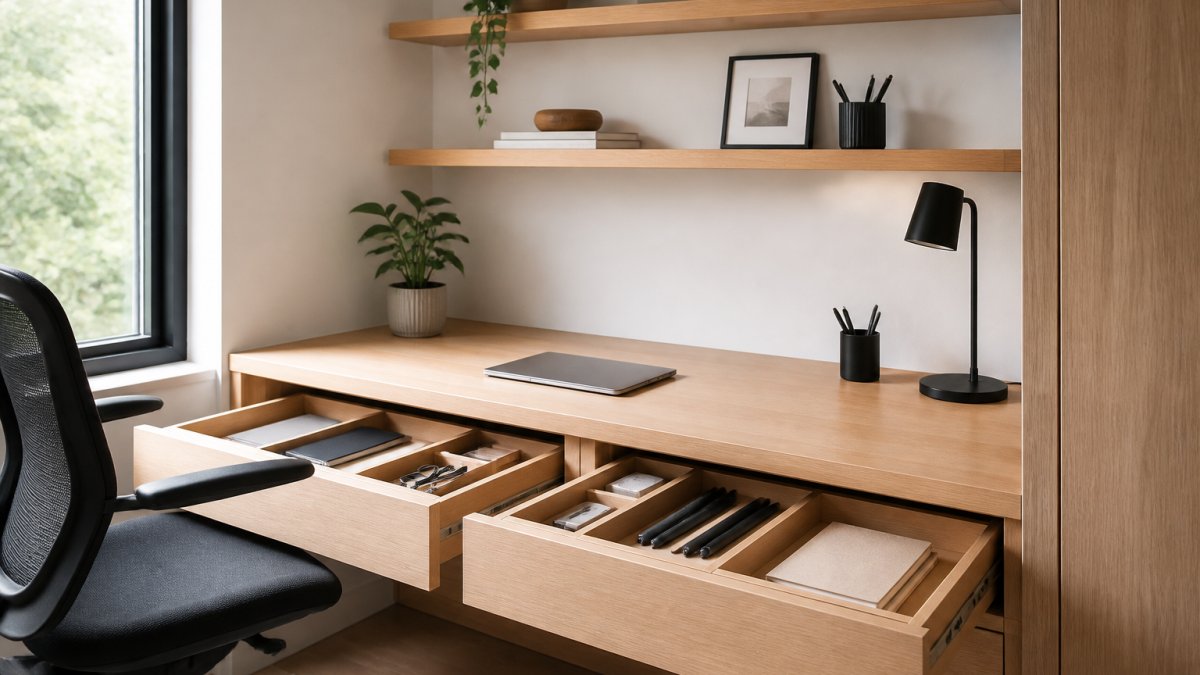
Desk drawers need dividers to stay organised. Without them, supplies jumble together. Dividers keep pens separate from notepads, chargers from cables. Use drawer dividers to create zones:
- Writing supplies in one section
- Charging cables in another
- Notepads and sticky notes in a third
- Miscellaneous items in a final section
Label each zone. This prevents items from migrating back to chaos.
Multifunctional Furniture for Tight Spaces
Multifunctional pieces do double duty. A desk with built-in shelves stores supplies while providing work space. An ottoman with hidden storage holds blankets or files. Filing cabinets serve as desk surfaces, a small cabinet with a flat top becomes a side table and storage solution combined.
Look for furniture that solves two problems at once. This approach maximises space in small offices.
Before buying any storage, measure your available wall length, under-desk clearance, and door swing. A storage plan that ignores these three numbers will fail no matter how good the products are.
Hidden Home Office Storage Solutions
The best storage is storage you don’t see. Hidden solutions keep your workspace visually clean while holding everything you need.
Built-In Storage and Cupboards
Built-in storage transforms awkward spaces. Alcoves, understairs areas, and sloping ceilings become functional storage zones.
Bespoke fitted solutions maximize every inch. Unlike off-the-shelf options, custom storage fits your exact space. It handles sloped ceilings, narrow corners, and irregular walls.
Finest Furniture Studio specializes in custom-fitted home office storage that works in spaces other solutions cannot reach. A cupboard built into an alcove, shelving that follows a sloped ceiling, or a cabinet under stairs can become hidden storage that looks intentional.
Closed cupboards conceal clutter completely. Open shelves display items, so they must stay minimal. For most home offices, closed storage is the better choice.
Cable and Charging Station Management
Cables create visual chaos. Tangled wires behind your desk look messy even if you can’t see them clearly.
Organize cables using clips or sleeves. Bundle cables together and label them. Route them behind your desk or along walls.
Designate a charging station in one drawer or box. Keep all chargers and cables in one place. When you need a charger, you know exactly where to find it.
Cable management boxes hide power strips and excess cable length. These boxes sit under your desk or beside it, keeping the tangle out of sight.
Wireless charging pads reduce cable clutter. Instead of multiple charging cables, one pad charges several devices.
Home Office Organisation Ideas for a Clear Desk
A clear desk is the goal. But a clear desk requires systems that keep items in their place.
Organizing Office Supplies and Accessories
Keep only supplies you use daily on your desk. Everything else belongs in closed storage.
Daily supplies might include:
- Three to five favourite pens
- One notepad
- Sticky notes
- Scissors
- Tape dispenser
That’s it. Everything else goes in drawers or cupboards.
Supplies you use weekly go in your top desk drawer. Supplies you use monthly go in deeper storage. Supplies you use annually can go in a cupboard or storage box elsewhere.
This tiered approach keeps your workspace clear while keeping supplies accessible.
Daily Habits to Maintain Your Minimalist Workspace
A minimalist home office doesn’t stay that way by accident. It requires daily habits.
Spend five minutes at the end of each day clearing your desk. File papers. Return pens to their holder. Move items back to storage.
Weekly, do a deeper tidy. Wipe down surfaces. Check drawers for items that have migrated out of place.
Monthly, audit your supplies. Throw away dried-up pens. Recycle old notepads. Donate items you haven’t used.
These small habits prevent clutter from building up again.
Creating Minimalist Home Office Storage in Awkward Spaces
Not all home offices are simple rectangular rooms. Many sit in alcoves, under stairs, or in corners with sloped ceilings.
Awkward spaces are actually opportunities. Custom storage solutions turn unusable areas into functional zones.
An alcove becomes a built-in desk with shelves above. An understairs space becomes a filing cabinet or supply cupboard.
Off-the-shelf furniture cannot adapt to these spaces. It leaves gaps and wasted corners. Bespoke fitted storage solves this problem.
At Finest Furniture Studio, we design storage that works with your space, not against it.
A minimalist home office storage system transforms your workspace. It starts with decluttering ruthlessly.
The result is a calm, focused workspace where you can do your best work.
Frequently Asked Questions
How do I organise a minimalist home office?
Start by removing everything that doesn’t serve your work, then assign a specific place for each item you keep. Use drawer dividers for pens and small supplies, vertical wall space for books or folders, and closed storage for equipment you don’t use daily. The key is keeping only what you actually use and ensuring everything has a designated home so it returns there after use.
What’s the best way to store office supplies in a small space?
Maximize vertical storage with wall-mounted shelves or pegboards rather than spreading items across your desk. Use drawer dividers to organize pens, notepads, and chargers within desk drawers. Under-desk storage units and wall-mounted baskets keep supplies accessible but out of sight. For truly limited space, choose multifunctional furniture like desks with built-in shelving or storage ottomans.
How can I hide clutter in a home office?
Built-in cupboards and closed storage conceal equipment, cables, and paperwork that would otherwise create visual clutter. Wall-mounted cabinets and over-the-door hooks maximize vertical space without taking up floor area. Cable management boxes hide charging stations and wires. The goal is keeping your desk surface completely clear, anything you don’t actively use during work should be stored behind closed doors or above eye level.
How can fitted storage help create a minimalist home office?
Custom-fitted storage solutions adapt to your specific space, including awkward areas like alcoves or understairs, ensuring no wasted space. Built-in shelving, drawers, and cupboards provide designated homes for everything, making it easier to maintain a clear desk. Fitted furniture also creates clean lines and a streamlined design that naturally supports a minimalist aesthetic, whilst maximizing the storage capacity of your home office.

