

Last Updated: October 31, 2026
Quick Summary
The best modern fitted wardrobe storage solutions zone the interior into hanging, shelving, drawers and shoe space, sized to what you actually own. Double hanging roughly doubles shirt and trouser capacity, while adjustable shelves and movable rails let your fitted wardrobe storage adapt as your clothes change.
- Split the interior into four working zones: hanging, shelving, drawers and shoe space.
- Tally long coats, dresses, shirts, trousers, knitwear, shoes and accessories before drawing any layout.
- Double hanging turns one tall space into two rails, roughly doubling shirt and trouser capacity.
- Fit a bank of internal drawers at waist height and reserve the bottom for shoe trays.
- Sliding doors need no clearance in front, making them ideal for compact bedrooms and tight landings.
Table of Contents
- Why Modern Fitted Wardrobe Storage Beats Freestanding Furniture
- Fitted Wardrobe Interior Ideas That Use Every Centimetre
- Small Bedroom Wardrobe Storage Ideas for Compact Rooms
- Wardrobe Storage Accessories That Earn Their Place
- Sliding Door Fitted Wardrobes for Tight Floor Plans
- Planning Storage Around Awkward Angles and Sloping Ceilings
- Book a Free Design Visit for Your Fitted Wardrobe Storage
- Frequently Asked Questions
Why Modern Fitted Wardrobe Storage Beats Freestanding Furniture
Modern fitted wardrobe storage solutions are built around your room, your clothes and the way you actually live, rather than forcing your belongings into a standard box.
The difference shows up fast. A freestanding wardrobe leaves gaps at the sides and top where dust collects and storage disappears. A fitted unit can seal those gaps and use the space above head height.
If you are weighing up fitted against modular options, our guide on modular versus bespoke wardrobes sets out which suits different homes.
Fitted Wardrobe Interior Ideas That Use Every Centimetre
A fitted wardrobe interior works hardest when it is planned around your actual clothing, not a generic template. The difference between a wardrobe that feels generous and one that feels cramped often lies in how the internal zones are sized and stacked. Designers split the inside into four working zones: hanging, shelving, drawers and shoe space, then size each one to what you own.
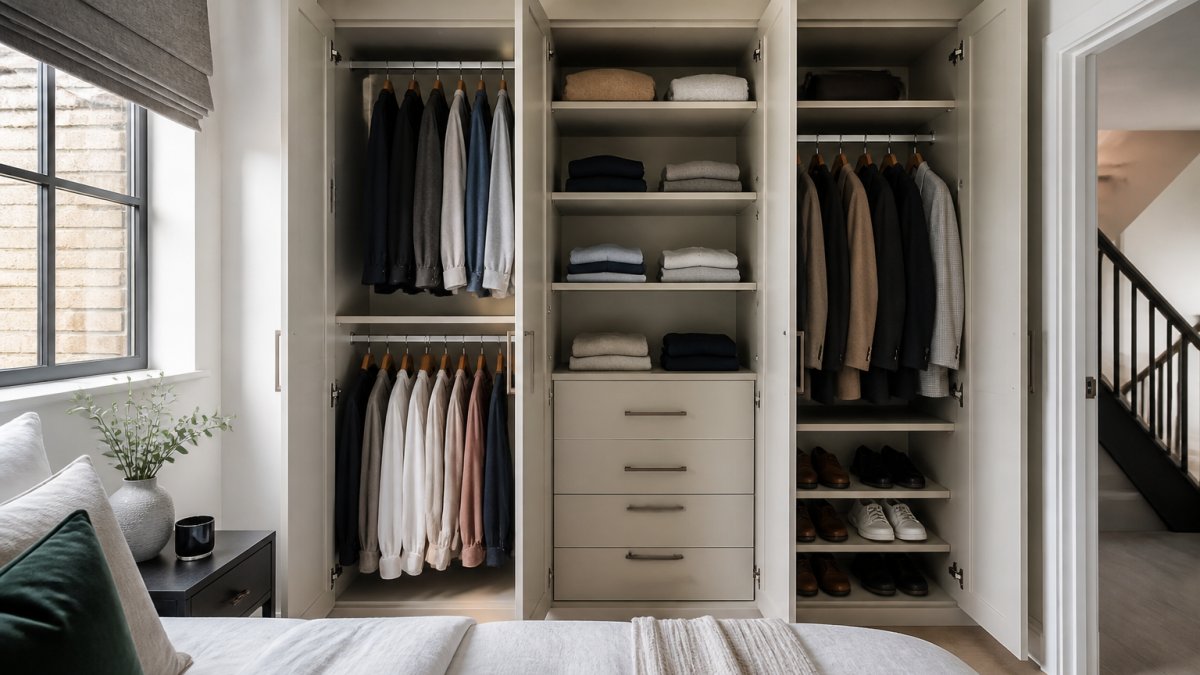
Here is how we approach it:
- Count first. Tally long coats, dresses, shirts, trousers, knitwear, shoes and accessories before drawing anything. A shared wardrobe needs roughly double the hanging run of a single-occupant one.
- Zone the height. Long-hang items need a full drop; shirts and jackets sit comfortably on double hanging; folded knitwear and shoes belong in the lower third where they are easy to see.
- Leave breathing room. Clothes need a little air to stay fresh and crease-free, packed rails crease shoulders and trap damp.
- Add lighting. Integrated LED strips make deep interiors usable and help you spot what you own.
- Plan for change. Adjustable shelves and movable rails let the layout follow your wardrobe over the years rather than locking you into one configuration.
Double Hanging, Long-Hang and Adjustable Shelves
Double hanging turns one tall space into two rails, roughly doubling shirt and trouser capacity. Long-hang storage handles coats and dresses without crushing them. Adjustable shelves let you move levels as your wardrobe changes over the years.
A practical way to map clothing types to zones:
- Long garments (coats, full-length dresses, long shirts): a full-drop hanging zone, kept clear of shelves above.
- Shirts, blouses, jackets, trousers: double hanging, with the upper rail at a comfortable reach and the lower rail carrying shorter items.
- Folded knitwear and jeans: adjustable shelves at chest height, with shelf dividers to stop stacks collapsing.
- Shoes: low shelves or pull-out trays in the bottom third, angled so pairs stay visible.
- Accessories, belts, jewellery: shallow drawers or trays near eye level, not buried at the bottom.
Drawers, Hidden Drawers and Drawer Organisers
Drawers keep small items visible and reachable. Hidden drawers tuck jewellery and paperwork out of sight. A drawer organiser with dividers stops socks and accessories from turning into a jumble.
A common pattern is to fit a bank of internal drawers at waist height, the easiest zone to open and see into, and reserve the very bottom for shoe trays or bulky items. A wardrobe used every day will open its drawers thousands of times, so hardware rated for frequent use is worth choosing over the cheapest option.
Planning by Wardrobe Width and Room Layout
The interior only works if it fits the carcass. Before choosing zones, measure the available width, height and depth, and note any obstructions, chimney breasts, sloped ceilings, radiators, window reveals and door swings. A narrow run rewards full-height hanging and slim pull-outs; a wide run can take a mix of hanging, shelving and a drawer bank side by side. In alcoves and loft rooms, the low-headroom ends are best given over to drawers and shoes, with full-height hanging reserved for the tallest section.
For deeper layout inspiration, see our fitted wardrobe interior storage ideas.
Measure the longest garment you own before finalising the long-hang drop. A coat that touches the shelf above will crease and stay creased.
Small Bedroom Wardrobe Storage Ideas for Compact Rooms
Small bedroom wardrobe storage ideas start with one rule: go up, not out. Floor-to-ceiling units capture the space above head height that most rooms waste. Slim sliding doors avoid the swing clearance a hinged door demands. Integrating these vertical configurations ensures that even a compact room maintains a sense of order, a principle that applies equally well when adapting your home office storage to fit within the same constrained footprint.
A few moves that work well in compact rooms:
- Use the full wall, corner to corner.
- Add a top shelf for suitcases and seasonal bedding.
- Fit internal drawers instead of a separate chest.
- Choose light colours to keep the room feeling open.
Wardrobe Storage Accessories That Earn Their Place
Wardrobe storage accessories only help if they solve a real problem. A few earn their keep; plenty are clutter in disguise. The test is simple: does the accessory make something easier to see, easier to reach, or better protected? If not, it is just another thing to move out of the way.
These accessories are worth considering because each one earns its place:
- Shelf dividers to keep folded stacks upright and stop the lean that turns a neat pile into a slump.
- Trouser and tie racks for quick access and to avoid creasing trousers folded over a hanger bar.
- Pull-out shoe organisers so pairs stay visible and the floor of the wardrobe stays clear.
- Accessory trays for belts and jewellery, ideally in a shallow drawer at eye level.
- Pull-down rails for high hanging zones, useful for anyone who cannot comfortably reach above head height.
- Ventilated shelving and breathable boxes for knitwear and seasonal items, so air can move and damp does not settle.
Accessibility and Inclusive Design
Accessories are where inclusive design lives or dies. A rail you cannot reach is storage you do not use. A common pattern is to keep the most-used rail at a comfortable reach, put a pull-down rail in the high zone, and reserve the lowest drawers for heavier items that are awkward to lift. For children, a lower rail that can be raised as they grow keeps their clothes within reach without rebuilding the wardrobe. Clear access matters too: leave enough space in front of drawers and doors to open them fully, and avoid deep shelves where items disappear at the back.
Lighting, Ventilation and Garment Care
Lighting and airflow are accessories in their own right. Lighting can improve visibility in deep interiors and help you spot what you own, which reduces duplicate purchases and forgotten clothes. Ventilation matters just as much: clothes stored in a sealed, airless wardrobe trap damp and odours, so breathable boxes, ventilated shelves and a little space between garments help protect them. Avoid storing damp or freshly worn clothes in a closed wardrobe, and rotate seasonal items so nothing sits compressed for months.
Materials and Hardware That Last
Accessories are only as good as the hardware behind them. Drawer runners, hinges and rail brackets take daily wear, so choose components rated for frequent use rather than the cheapest option. Interior finishes should be easy to wipe clean and resistant to scuffs from shoes and hangers. A practical approach is to spend the budget where the wear happens, runners, hinges and rails, and keep decorative accessories simple.
For narrow spaces, our round-up of closet organisers for narrow wardrobes covers specific options.
Before buying any accessory, ask whether it makes something easier to see, easier to reach, or better protected. If the answer is no, it will become clutter.
Each of these accessories earns its place by making something easier to see, easier to reach or better protected.
| Accessory | What it does |
|---|---|
| Shelf dividers | Keep folded stacks upright and stop the lean |
| Trouser and tie racks | Quick access without creasing trousers over a hanger bar |
| Pull-out shoe organisers | Keep pairs visible and the wardrobe floor clear |
| Accessory trays | Hold belts and jewellery in a shallow eye-level drawer |
| Pull-down rails | Bring high hanging zones within comfortable reach |
| Ventilated shelving and breathable boxes | Let air move so damp does not settle |
Sliding Door Fitted Wardrobes for Tight Floor Plans
Sliding door fitted wardrobes suit rooms where a hinged door would hit a bed or block a walkway. The doors glide along tracks, so you need no clearance in front. That makes them ideal for compact bedrooms and tight landing spaces.
Mirrored sliding doors are a popular choice, reflecting light and making a small room feel larger. Design articles also flag floor-to-ceiling storage and mirrored fronts as current trends, as Head2Bed’s wardrobe design roundup notes. Just keep tracks clean so the doors keep running smoothly.
Planning Storage Around Awkward Angles and Sloping Ceilings
Awkward angles are where fitted storage proves its worth. Sloping ceilings, chimney breasts, alcoves and understairs voids defeat flat-pack furniture. A made-to-measure design follows the shape of the room instead.
We map the space before anything is built:
- Measure every angle, slope and obstruction.
- Decide which zones suit low headroom (drawers, shoes).
- Reserve full-height areas for hanging.
- Fit doors that clear the slope cleanly.
For trickier rooms, our guides on wardrobe storage for awkward spaces and attic bedroom wardrobe solutions go further.
Book a Free Design Visit for Your Fitted Wardrobe Storage
Getting fitted wardrobe storage right starts with a proper look at your space. Our free design visit lets us measure, listen and sketch a layout that fits your room and your clothes.
We back our wardrobes with a 10-year warranty and a 7-day fitting service. Design articles also point to minimalist styling, integrated LED lighting and natural wood finishes as current directions, as Contemporary Closets’ design trends piece reports, and we can build any of them into your plan.
Ready to use every centimetre? Get started with Finest Furniture Studio and book a free design visit for your made-to-measure wardrobe.
Frequently Asked Questions
What is the best way to organise a fitted wardrobe?
Start by grouping clothes by type and frequency of use, then match each group to the right component. Double hanging suits shirts, blouses and jackets; long-hang storage takes coats and dresses; adjustable shelves handle folded knitwear and bags. Keep everyday items between waist and eye level, and put seasonal clothing on high shelves or in storage boxes. A modular storage system with shelf dividers and a drawer organiser makes the layout easy to adjust as your wardrobe changes.
How can I maximise storage in a small fitted wardrobe?
Go floor to ceiling and use the full depth rather than leaving dead space at the top. Double hanging roughly doubles rail capacity compared with a single rail, and shallow drawers under the hanging section capture space that shelves waste. Sliding doors remove the swing clearance a hinged door needs, which matters in compact rooms. Add shelf dividers to stack folded clothes vertically and use the back of the door for accessories. A made to measure layout designed around your actual clothing will always hold more than an off-the-peg unit of the same footprint.
Are drawers or shelves better in a fitted wardrobe?
Neither wins outright; the right mix depends on what you own. Drawers suit folded clothes, underwear, accessories and anything small that gets lost on open shelving, and hidden drawers make use of the space beneath a hanging rail. Adjustable shelves work better for bags, shoes, folded knitwear and storage boxes, and they can be repositioned as needs change. Most well-planned interiors combine both: a drawer stack at one end, hanging in the middle and adjustable shelving above and below.
Are sliding doors a good choice for a fitted wardrobe?
Sliding door fitted wardrobes suit rooms where floor space is tight, because the doors travel sideways instead of swinging out. They also work well on wide openings where hinged doors would be impractical. The trade-off is that only part of the interior is accessible at once, so plan the layout in zones that each work independently. Mirrored sliding doors add a sense of light and space in smaller bedrooms, while textured finishes and natural wood tones keep the look calm and modern.


