

Last Updated: October 26, 2026
Quick Summary
Good fitted wardrobe storage works on three levels: the layout matches what you own, the fittings match how you use each item, and the interior adapts as seasons change. Plan roughly half the interior for hanging, a quarter for shelves, and a quarter for drawers and small items, then adjust based on your own audit.
- Double-hanging rails are the single biggest capacity gain in most wardrobes, letting you stack shirts and trousers vertically.
- Most narrow wardrobes waste 20 to 30 centimetres at the top and the same at the back, so reclaim both first.
- A shallow felt-lined jewellery drawer is typically 80-120 mm deep and sits at chest height.
- A two-tier pull-out shoe rack typically holds 12-18 pairs depending on shoe type.
- Build a top zone for off-season boxes and an eye-level zone for the current season to make rotation routine.
Table of Contents
- Why Fitted Wardrobe Interior Storage Matters
- Fitted Wardrobe Interior Layout Ideas for Every Space
- Small Wardrobe Storage Ideas That Maximise Every Centimetre
- Wardrobe Accessories and Organisers to Cut Clutter
- Wardrobe Organisation Ideas for Seasonal Rotation
- Planning Measurements and Installation Constraints
- Book a Free Design Visit for Your Fitted Wardrobe
- Frequently Asked Questions
Why Fitted Wardrobe Interior Storage Matters
A fitted wardrobe storage system is only as good as what happens inside it. The carcass looks smart from the bedroom, but the internal layout decides whether you actually get more storage or simply a tidier version of the clutter you already had.
The fix is not more space. It is better planned space.
Good fitted wardrobe storage works on three levels: the layout matches what you own, the fittings match how you use each item, and the whole thing adapts as seasons change. Miss any one of those and you end up with wasted depth, dead corners, and clothes crammed onto a single rail.
This guide from Finest Furniture Studio breaks down seven interior storage ideas for better organisation, from double-hanging layouts to small-item systems. Below, we’ll show you exactly what to specify, what to skip, and how to plan a wardrobe interior that keeps working years after installation.
Fitted Wardrobe Interior Layout Ideas for Every Space
The best fitted wardrobe interior layout starts with an audit of what you actually hang, fold, and store, not with a catalogue of fittings.
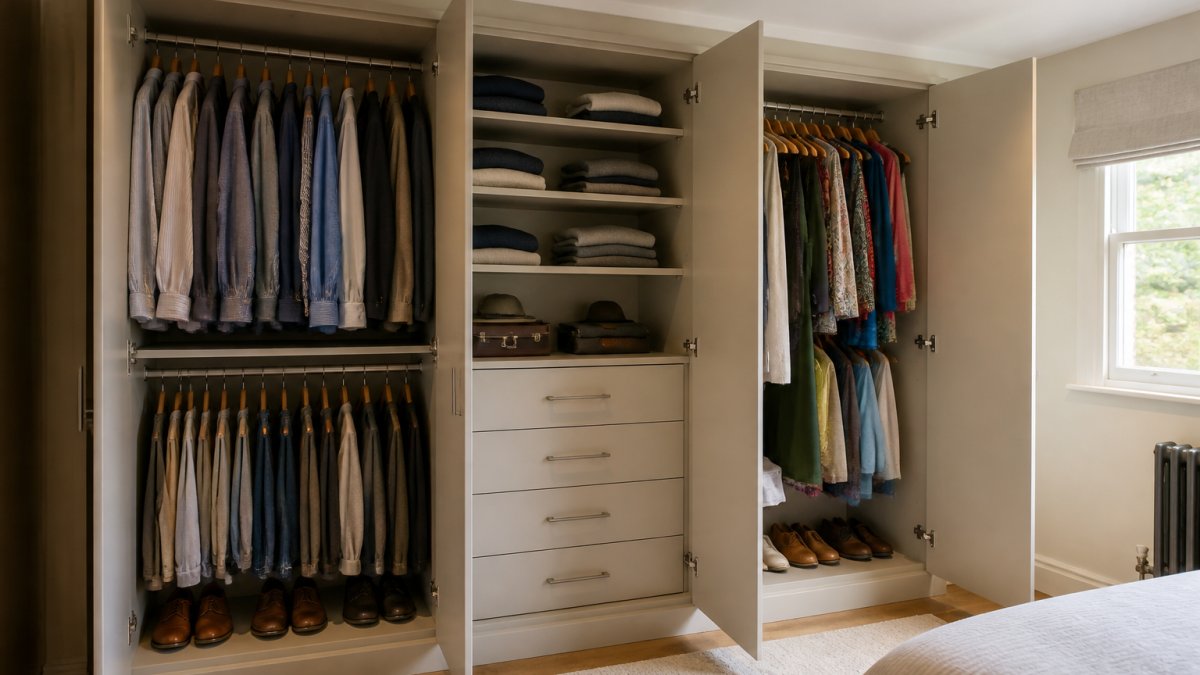
A simple rule: roughly half the interior for hanging, a quarter for shelves, and a quarter for drawers and small items. Adjust from there based on your audit.
Double-Hanging Rails for Shirts and Trousers
Double hanging is the single biggest capacity gain in most wardrobes.
The layout works when the upper rail carries shirts and the lower rail carries trousers or folded-over hangers. Keep the lower rail clear of the floor so shoes can sit underneath.
What most guides miss: double hanging only works if your wardrobe is tall enough to give both rails breathing room. Measure your longest shirt before committing.
Adjustable Shelves for Flexibility
Adjustable shelves are the quiet hero of a flexible wardrobe interior. Fixed shelves lock you into one configuration forever. Adjustable ones let you raise a shelf when you switch from jumpers to handbags, or drop one when boots come back into rotation.
Small Wardrobe Storage Ideas That Maximise Every Centimetre
Small wardrobe storage ideas work best when they attack vertical space and dead zones first. Most narrow wardrobes waste 20 to 30 centimetres at the top and the same at the back. Reclaim both before you buy a single accessory.
Start with these moves:
- Go floor to ceiling. Full-height interiors use the top zone for out-of-season items.
- Add a top shelf for suitcases and bedding.
- Use slim, uniform hangers to free up rail width.
For narrow interiors, specialist organiser fittings make a real difference.
Wardrobe Accessories and Organisers to Cut Clutter
Most guides list the same fittings, pull-out shoe racks, drawers, baskets, trays, and stop there. The useful question is not which accessory to buy but which accessory solves which small-item problem. Belts, jewellery, ties, bags, and underwear each fail in a different way inside a fitted wardrobe, and each needs a different fitting.
These modular additions transform chaotic piles into curated displays, providing the essential foundation for building a cohesive wardrobe that remains functional and refined over time.
Jewellery and watches
Jewellery disappears when it is loose in a general drawer. The fix is a shallow, felt-lined drawer, typically 80-120 mm deep, with compartment dividers, positioned at chest height so you can see the contents without bending. A drop-front or pull-out tray works where full drawer depth is not available. Keep it away from the hanging zone so chains do not catch on garments.
Belts and ties
These are the classic ‘lost in a basket’ items. A dedicated pull-out belt and tie rack, usually a slim side-mounted unit 100-150 mm wide, keeps them visible and stops them tangling. If you prefer drawers, a shallow drawer with a slotted insert does the same job. The trade-off: side-mounted racks eat into hanging width, so only specify one if you have a full-height column to spare.
Bags and handbags
Handbags need shelf space, not hanging space, and they need to stand upright so they keep their shape. Allocate a shelf zone at or above eye level with bookends or low dividers to stop them slumping. Dust bags protect structured bags; open baskets suit soft totes. Avoid stacking bags on top of each other, the bottom one loses its shape within a season.
Underwear and socks
A divided drawer, typically 100-150 mm deep, with a grid insert is the standard solution. The mistake is making the compartments uniform: socks and underwear need different cell sizes, so specify a mixed grid rather than a single-size tray. Position the drawer at waist height so it is reachable without stooping.
Shoes
Pull-out shoe racks keep pairs visible and stop the floor pile. A two-tier pull-out typically holds 12-18 pairs depending on shoe type; angled racks suit flats and trainers, flat racks suit boots. Keep the rack clear of the door swing, a common planning error.
Scarves, hats, and other soft accessories
Open baskets on an upper shelf work well here, but label them. Soft items compress and disappear otherwise. A pull-out basket on runners is easier to reach than a static one at the back of a deep shelf.
Buy organisers to fix a specific annoyance you can name, not to fill a catalogue page. If you cannot describe the problem an insert solves, it will become clutter itself.
If you would rather make your own, our walkthrough on how to make DIY wardrobe dividers and organizers shows simple builds that work inside a standard interior.
Each small-item category fails differently, so match the organiser to the item rather than buying generic inserts.
| Item | Organiser | Key detail |
|---|---|---|
| Jewellery and watches | Shallow felt-lined drawer with dividers | 80-120 mm deep, at chest height |
| Belts and ties | Pull-out side-mounted rack or slotted drawer insert | Rack is 100-150 mm wide, eats hanging width |
| Bags and handbags | Shelf zone with bookends or low dividers | At or above eye level, stand upright |
| Underwear and socks | Divided drawer with mixed grid insert | 100-150 mm deep, at waist height |
| Shoes | Pull-out shoe racks | Two-tier holds 12-18 pairs; keep clear of door swing |
| Scarves and hats | Labelled open baskets on upper shelf | Pull-out basket on runners is easier to reach |
Wardrobe Organisation Ideas for Seasonal Rotation
Seasonal rotation is where most fitted wardrobes quietly fail. The layout is fine in October and chaotic in April, because nothing in the interior was designed to move.
Zone the interior for rotation
Build three zones into the layout from the start:
- Top zone (above eye level): out-of-season clothing in labelled, stackable storage boxes. This is dead space in most wardrobes and the natural home for items you will not touch for months.
- Eye-level zone: current-season hanging and folded items, whatever you wear this month.
- Lower zone: shoes, heavy items, and anything you want to reach without stretching.
The point of zoning is that rotation becomes a swap between two fixed zones, not a reshuffle of the whole interior.
Use the right off-season storage method
Off-season items need protection, not just space. Use breathable storage boxes or cotton bags rather than vacuum bags for natural fibres, vacuum bags compress wool and down and can crease structured garments beyond recovery. Label every box on the visible face, not the lid, so you can identify contents without lifting it down. Cedar blocks or lavender sachets deter moths; avoid sealing natural fibres in plastic.
Run a four-step rotation routine
A practical system, repeated at the start of each season:
- Empty the current-season zone onto the bed and sort into keep, repair, and release piles.
- Clean the empty interior, vacuum the base, wipe shelves, check for moths or damp.
- Bring down the off-season boxes, move the outgoing season into them, and label them with the season and year.
- Reload the eye-level zone with the incoming season, decluttering as you go: if it did not get worn last season, it does not go back in.
The fourth step is the one most people skip, and it is the one that keeps the wardrobe from slowly filling with unworn clothes.
Declutter on a fixed rhythm
Rotation is the natural decluttering trigger. Tie it to the calendar, typically late March and late September, rather than to a vague intention to ‘sort the wardrobe’. A fixed date means the job gets done before the season turns, not after. Keep a single ‘release’ bag by the door during rotation week and take it to a charity shop or textile recycling point at the end of it.
A wardrobe that rotates well is designed for it: a top zone for off-season boxes, an eye-level zone for the current season, and a fixed twice-yearly routine. Build the zones at design stage and rotation becomes a two-hour job, not a weekend.
Planning Measurements and Installation Constraints
Every storage idea depends on measurements taken before anything is ordered. Get these wrong and the cleverest layout will not fit.
Measure and record:
- Internal width, height, and depth at three points each, since walls are rarely square.
- Longest hanging garment to set rail height.
- Door swing or slider clearance so drawers and pull-outs open fully.
Installation constraints matter as much as measurements. Awkward spaces, sloping ceilings, and alcoves need custom solutions rather than off-the-shelf units. Read Modular vs Bespoke Wardrobes: Which Suits Your Home to weigh up which option suits your space and budget.
Book a Free Design Visit for Your Fitted Wardrobe
The ideas above only deliver when they are planned around your actual space and belongings. That is where a design visit earns its keep.
Finest Furniture Studio offers a complimentary design visit, clear upfront pricing with no hidden fees, and a 10-year warranty on wardrobes. Our 7-day fitting service is available.
Once your wardrobe is in, a little care keeps it sharp. Our guide to maintaining custom fitted wardrobes for longevity shows how to keep it in good condition for years.
Frequently Asked Questions
How do I organise the inside of a fitted wardrobe?
Start by sorting clothes into categories: hanging items, folded clothes, shoes and accessories. Keep frequently worn items at eye level and store seasonal clothing on higher shelves.
Are drawers or shelves better inside a wardrobe?
Both have their place. Drawers suit folded clothes, accessories and small items, keeping them dust-free and easy to find. Shelves work well for shoes, bags and bulky items, and adjustable shelves let you change the layout as your needs shift. Many fitted wardrobe interiors combine drawers at lower levels with shelves above, giving you flexible storage without wasting space.
How can I organise a small fitted wardrobe?
Maximise vertical space with double hanging rails and shelves up to the ceiling. Use slim velvet hangers to save width, add over-door hooks for bags and belts, and choose pull-out shoe racks to keep footwear tidy. For small wardrobe storage ideas, consider internal drawers and dividers to separate small items. A made-to-measure design ensures every centimetre is used.
What wardrobe accessories and organisers help keep clothes tidy?
Useful wardrobe accessories and organisers include pull-down rails for high spaces, tie and belt racks, drawer dividers, shoe racks and fabric baskets for small items. Uniform hangers keep clothes neat and save space. Adjustable shelves and internal fittings let you adapt the layout over time. These additions turn a standard fitted wardrobe into an efficient, functional storage system.
Your wardrobe should solve the clutter problem, not hide it behind a smart door. If you are ready to plan an interior that matches how you actually live, book a free design visit with Finest Furniture Studio and get a layout built around your space, your belongings, and a warranty that stands behind the work.


