

Last Updated: November 5, 2026
Quick Summary
Good shoe storage in a wardrobe keeps pairs together, protects leather and suede, and frees up floor space. Fixed shelves suit most shoe types, while pull-out racks give easy access in deeper fitted wardrobes. Open storage works best for daily shoes that need airing.
- Fixed shoe shelves are sturdy and easy to keep clean.
- Shallow shelf bands suit trainers, flats and ankle boots.
- Knee-high boots need a taller opening to fit.
- Pull-out racks let you see every pair without bending.
- Let shoes air before sealing them into a box or wardrobe.
Table of Contents
- Why Shoes Need Their Own Place in a Wardrobe
- Small Wardrobe Shoe Storage: Making Limited Space Work
- Shoe Shelves for Wardrobe Interiors
- Pull-Out Shoe Rack Options for Fitted Wardrobes
- How to Organise Shoes by Type, Use and Season
- Protecting Shoes: Ventilation, Dust and Light
- Planning Your Shoe Storage Layout Before You Build
- Frequently Asked Questions
Why Shoes Need Their Own Place in a Wardrobe
Shoes pile up faster than most people expect. Without a planned home for them, they end up on the floor, under the bed, or jammed into corners where they get scuffed and forgotten. Good shoe storage in a wardrobe fixes that. A wardrobe that handles shoes well is far more useful day to day.
Shoe storage is about more than tidiness. It protects your footwear, keeps pairs together, and makes your morning routine quicker. When each pair has a clear place, you can see what you own and choose faster.
A dedicated shoe zone can help you:
- Keeps pairs together, so you never hunt for a missing left shoe
- Protects leather and suede from being crushed or knocked
- Makes it easy to see your full collection at a glance
- Frees up floor space in the bedroom or hallway
Many people assume shoes can simply go on the floor of the wardrobe. That works for a few pairs. Once your collection grows, the floor becomes a pile, and the pile becomes a problem.
Small Wardrobe Shoe Storage: Making Limited Space Work
A small wardrobe can still hold a surprising amount of footwear. The trick is to use height and depth rather than just floor area. Shoes are narrow, so they fit well on shelves, angled racks, and tiered inserts that use vertical space.
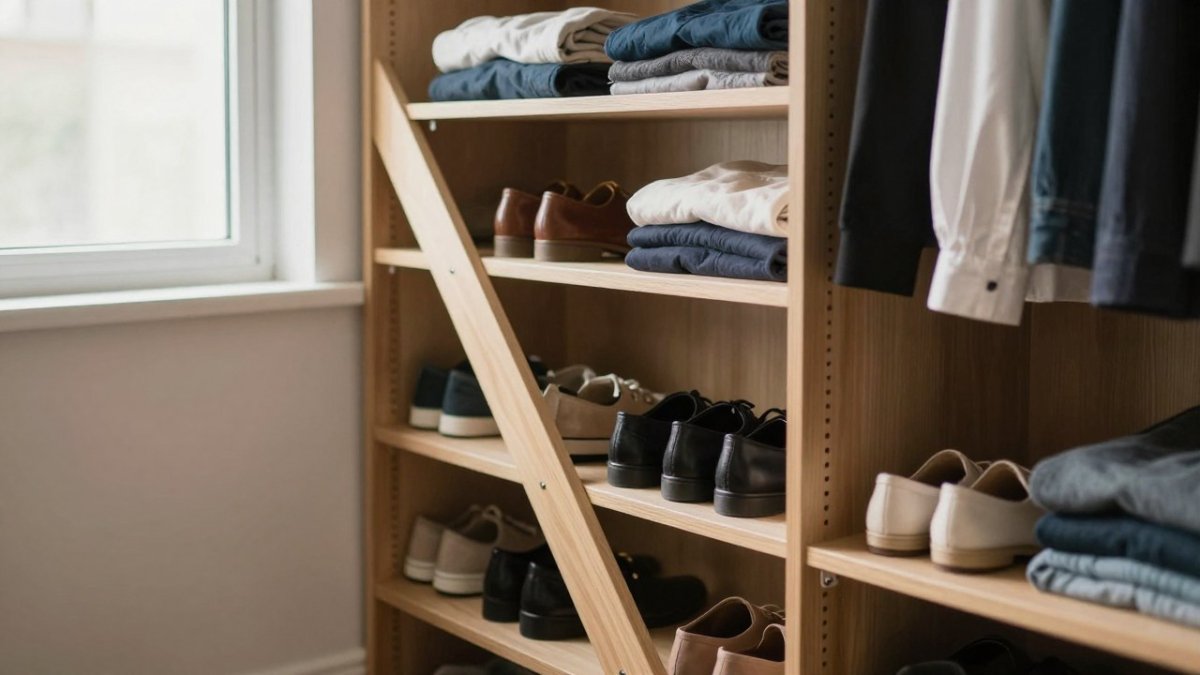
Start by measuring the wardrobe’s internal height and depth. Then decide which shoes you wear most often. Keep those at the front and at a comfortable reach height. Store occasional pairs higher up or further back.
Practical options for limited space include:
- Slim shelves set at shoe height, not full wardrobe height
- Angled racks that stop pairs from sliding off
- Stackable boxes for seasonal or rarely worn footwear
A common mistake is buying a deep rack that wastes the space above it. Match the rack depth to the shoes you actually own, and leave room for boots and heels.
!Tidy small walk-in wardrobe with neatly arranged shoes on angled shelves beside folded clothes
Shoe Shelves for Wardrobe Interiors
Fixed shoe shelves are one of the most reliable ways to store footwear inside a wardrobe. They are simple, sturdy, and easy to keep clean. Shelves work well for trainers, flats, and ankle boots, which stack neatly and do not need much clearance.
When planning shelves, think about the heights you need. Trainers sit comfortably in a shallow band, while knee-high boots need a taller opening. Adjustable shelving lets you change the layout as your collection changes.
Consider these shelf details:
- Lip or ledge edges stop pairs sliding forward
- Open shelves let air circulate, while closed doors hide clutter
Shelves also let you mix shoes with other items, such as a small box of accessories on the top shelf. Keep heavier pairs low for stability. For more layouts, see these fitted wardrobe interior storage ideas.
Fixed shelves suit most shoe types, and the choice depends on the shoes you own.
| Shoe type | Best shelf fit | Key detail |
|---|---|---|
| Trainers | Shallow band | Stack neatly, need little clearance |
| Flats | Shallow band | Stack neatly, need little clearance |
| Ankle boots | Shallow band | Stack neatly, need little clearance |
| Knee-high boots | Taller opening | Need extra height to fit |
| Heavier pairs | Lower shelves | Keep low for stability |
Pull-Out Shoe Rack Options for Fitted Wardrobes
Pull-out shoe racks suit people who want everything visible and within easy reach. A rack slides out from the wardrobe interior, so you can see every pair without bending into the back of the space. This is especially useful in deeper fitted wardrobes, where a fixed shelf at the back becomes a place where shoes go to be forgotten.
Pull-out shoe racks come in several forms, and the right one depends on your collection size and the internal width you have available:
Before committing, check these points:
Pull-out racks can cost more than fixed shelves, so decide how often you will actually use them. A rack you pull out every morning is worth it. One you rarely touch may not be. A common pattern is to combine one tiered pull-out rack for daily shoes with fixed shelves above for occasional pairs, which keeps the cost sensible while giving the most-used footwear the easiest access. Pairing daily shoes with fixed shelves above keeps the wardrobe practical without wasting space, much like minimalist bedroom organisation makes every storage choice earn its place.
How to Organise Shoes by Type, Use and Season
Organising shoes works best when you sort them by how you use them. Start by grouping footwear into clear categories, then decide where each group lives in the wardrobe. This turns a jumble of pairs into a system you can maintain.
Try this simple process:
- Pull out every pair and sort by type, such as trainers, formal shoes, boots, and sandals.
- Set aside any pairs you no longer wear, and check their condition.
- Assign daily-wear shoes to the most accessible space.
- Move seasonal footwear, like sandals or heavy winter boots, to higher or lower storage.
- Label boxes or use clear fronts so you can find things quickly.
Rotating seasonal shoes keeps your daily storage uncluttered. Store out-of-season pairs in boxes, clean first, so they stay in good shape until they are needed again.
Protecting Shoes: Ventilation, Dust and Light
Shoes last longer when they are stored well. Three things matter most: airflow, dust control, and protection from light. Each affects leather, suede, and fabric differently, and the storage method you choose should follow from the material rather than from how the wardrobe looks. For broader upkeep, read about maintaining custom fitted wardrobes over time.
Ventilation. Damp is the main enemy. Shoes worn for a full day hold moisture from feet and from the weather, and sealing them into an airtight box straight after wearing traps that moisture against the lining and upper. Let pairs air for a few hours before they go back into the wardrobe, and favour open shelving or slatted fronts where air can move.
Dust. Dust settles on shoes over time and is harder to remove from suede and mesh than from smooth leather. Closed doors or a fitted front keep most of it off. Wipe shoes before storing them, and dust shelves regularly. Clear boxes protect from dust while keeping pairs visible; fabric covers breathe better than plastic but hide the contents.
Light. Direct sunlight can fade leather and some fabrics and dry out finishes over time. Keep the wardrobe away from a window where possible, and store special-occasion or delicate pairs in dust bags or boxes that block light.
Material-specific storage:
- Leather. Leather needs to breathe, so avoid airtight plastic boxes for anything worn regularly. Condition every few months and keep away from heat sources such as radiators. Use shaped shoe trees to hold the shape and absorb moisture.
- Suede. Brush before storing and keep dry. Suede that gets wet should dry naturally away from direct heat, then be brushed once dry. Store in a breathable dust bag rather than a sealed box.
- Trainers and canvas. Store clean and fully dry. Mesh and canvas trap odour if put away damp, so air them first and consider a cedar block or sachet in the storage zone.
- Boots. Store upright with boot shapers or rolled newspaper to stop the shaft collapsing, and give tall boots a taller shelf opening so the shaft is not bent.
A simple rule of thumb: open storage for daily shoes that need to air, closed or covered storage for occasional and delicate pairs that need protection. That split also keeps the wardrobe looking tidy, because the shoes on show are the ones you wear most.
Planning Your Shoe Storage Layout Before You Build
A good shoe layout starts before anything is built. Count your pairs, measure the space, and decide how you want to use it. This planning step saves money and avoids the frustration of a layout that does not suit your shoes.
Work through these questions:
- How many pairs do you own, and what types are they?
- Which shoes do you wear daily, and which are occasional?
- How tall are your boots, and how deep are your heels?
- Would you prefer fixed shelves, pull-out racks, or a mix?
Sketch the wardrobe interior with rough dimensions, then mark where each category of shoes will sit. If your wardrobe has a sloped ceiling, see internal fittings for sloped wardrobes to find options that suit an awkward space. If you are weighing a modular system against a bespoke build, our guide on Modular vs Bespoke Wardrobes: Which Suits Your Home compares the two so you can decide which fits your space.
At Finest Furniture Studio, we start every project with a free design visit. We measure your wardrobe, learn how you use your shoes, and plan a layout that fits your home. Our wardrobes come with a 10-year warranty and a 7-day fitting service, with clear upfront pricing and no hidden fees.
Book a Free Design Visit with Finest Furniture Studio and plan a shoe storage layout that suits your home.
Frequently Asked Questions
How should I store shoes in a wardrobe?
Store shoes on shelves or in a pull-out rack so the toes face outward and each pair has its own space. Keep frequently worn pairs at eye level and place boots upright at the base of the wardrobe. Avoid stacking shoes in heaps, as this crushes leather and makes it harder to find the pair you need. Shoe boxes with clear fronts work well for occasional-wear shoes, while everyday pairs are best left open for quick access and airflow.
What is the best way to organise shoes in a small wardrobe?
Use vertical space first by fitting shelves above the floor and a slim rack at the base. Group shoes by category, such as work, casual and occasional, so the most used pairs sit at the front. Shallow shelves save depth, and angled shelves let you see every pair at once. Removing shoes you no longer wear is often the quickest way to free up room in a compact wardrobe.
Are shoe racks or shelves better for wardrobe storage?
Shelves suit people who own many pairs of similar height, since they hold shoes securely and keep the look tidy. Racks suit a mixed collection, particularly if you own boots or heels that need different heights. Pull-out racks give the best access in deep fitted wardrobes, while fixed shelves are simpler and cost less to build. Many people combine both, using shelves for everyday shoes and a pull-out rack for the rest.


