

Table of Contents
- Why Material Choice Matters for Custom Office Cabinetry
- Solid Wood: Durability and Timeless Appeal
- Plywood vs MDF for Cabinets: A Direct Comparison
- Painted MDF Cabinets: A Practical Solution
- Office Cabinetry Finishes: Surface Options and Performance
- Moisture Resistance and Indoor Air Quality
- Making Your Material Decision
- Frequently Asked Questions
Last Updated: October 14, 2026
Why Material Choice Matters for Custom Office Cabinetry
The material you choose for custom office cabinetry shapes durability, appearance, maintenance demands, and how well your storage functions.
Custom office cabinetry performs differently depending on what it’s made from. Solid wood responds to temperature and moisture changes; plywood and MDF stay stable but behave differently under stress; painted surfaces hide grain but demand more maintenance. Understanding these differences means choosing materials that match your use, climate, and tolerance for upkeep.
Solid Wood: Durability and Timeless Appeal
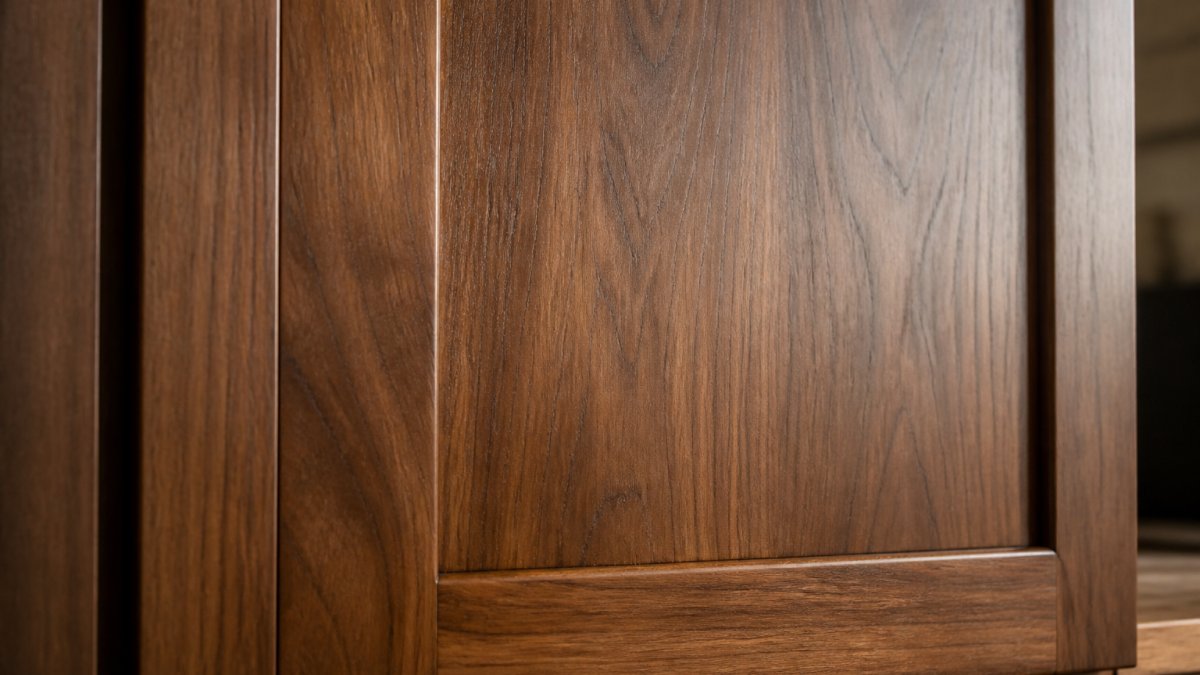
Solid wood remains the gold standard for custom office cabinetry because it’s durable and improves with age. A scratched solid wood cabinet can be sanded and restained; the same damage to MDF or particleboard typically means replacement.
Common hardwood species for office storage
Cherry, maple, and oak dominate custom office cabinetry for good reason. Cherry deepens in colour over time and resists dents; maple is harder still, ideal for high-traffic storage; oak offers visible grain and strength, though it needs careful finishing to avoid a dated look.
Alder takes stain beautifully and costs less than cherry or maple, while hickory’s dramatic grain suits rustic or contemporary designs and rivals oak in hardness. Each species responds differently to finishing: some accept stain evenly, others blotch without proper preparation.
Strength and longevity considerations
Solid hardwood cabinets outlast engineered alternatives by decades when properly finished and maintained. A well-made solid wood cabinet with quality hardware can function for 30+ years without structural failure; the wood may need refinishing, but the structure remains sound. The trade-off is movement: wood expands and contracts with humidity, and near a window or with seasonal swings, panels may shift and affect door alignment.
Plywood vs MDF for Cabinets: A Direct Comparison
Plywood and MDF are the most common engineered alternatives to solid wood. Both bond wood fibres or veneers with adhesive, but they behave very differently in real-world use.
Plywood construction and performance
Plywood consists of thin wood veneers glued with alternating grain directions. This cross-grain construction gives exceptional strength relative to weight, and a plywood cabinet box resists racking better than solid wood of equivalent thickness. Plywood handles moisture better than solid wood because alternating grain minimises expansion and contraction, staying stable where solid wood might move. Its veneer surface, often birch, oak, or cherry, can be sanded and refinished if needed. The downside is visibility: plywood edges show the layered construction unless covered with edge banding or trim.
MDF benefits and limitations
Medium-density fiberboard (MDF) is made from wood fibres compressed with resin binder. Denser and more uniform than plywood, it machines beautifully and accepts paint flawlessly, so painted MDF cabinets look indistinguishable from solid wood at a fraction of the cost. MDF is also heavier than plywood, which some craftspeople prefer because it feels substantial and dampens vibration. The critical limitation is moisture sensitivity: MDF absorbs water readily and swells when wet, so it fails in kitchens and bathrooms.
| Material | Moisture Resistance | Cost | Repairability | Best For |
|---|---|---|---|---|
| Solid wood | Good (with finish) | High | Excellent | Long-term, visible storage |
| Plywood | Excellent | Medium | Good | Stable, durable boxes |
| MDF | Poor | Low | Limited | Painted finishes, dry spaces |
| Particleboard | Poor | Very Low | Poor | Short-term, hidden use |
Painted MDF Cabinets: A Practical Solution
Painting MDF seals the surface and creates a finish indistinguishable from painted solid wood to the eye. The practical advantage is consistency: MDF accepts paint more evenly than solid wood because its surface is uniform, with no grain telegraphing through or colour variation between boards. The catch is that paint only protects the surface. For a home office in a dry space, painted MDF cabinets are cost-effective and visually excellent, and easier to replace if your design preferences change.
Office Cabinetry Finishes: Surface Options and Performance
The finish you choose affects both appearance and durability. A beautiful material can look cheap with poor finishing, and a modest material can appear expensive with excellent finishing.
Wood stains and natural finishes
Stained wood shows grain character and develops patina over time. Clear matte finishes preserve the wood’s natural feel but offer minimal protection; satin and semi-gloss are more durable and easier to clean; high-gloss is striking but shows fingerprints and dust readily. Water-based stains dry quickly with minimal odour, making them practical for occupied spaces, while oil-based stains penetrate deeper and produce richer colour but need longer drying and better ventilation. Natural finishes require regular maintenance, reapply every few years in high-traffic areas, particularly around drawer pulls and cabinet edges.
Laminates and veneers for durability
Laminate is a photographic image of wood grain bonded to plywood or MDF under pressure. Durable, water-resistant, and low-maintenance, it resists scratches and stains far better than natural finishes, you can’t sand or refinish it, but you rarely need to.
Veneer is a thin layer of solid wood bonded to plywood, offering the appearance of solid wood with the stability of plywood.
For a home office that must withstand daily use without constant maintenance, veneer or laminate finishes are practical: they look professional, need only occasional dusting, and last 15-20 years without refinishing.
Moisture Resistance and Indoor Air Quality
Moisture and air quality are the two material risks that most often catch homeowners out after installation, and both behave differently in an office than in a kitchen or bathroom.
How moisture actually damages cabinet materials
Solid wood and plywood expand and contract along the grain with humidity. In a centrally heated office, relative humidity can swing from around 30% in winter to 60%+ in summer, moving a solid wood door panel by several millimetres across its width. Frame-and-panel construction absorbs this movement; a single wide solid panel does not, which is why quality bespoke cabinets use frames with floating panels. MDF and particleboard behave differently: they don’t move gradually but absorb water at exposed edges and swell permanently.
If your office is in a period property, ask your cabinetmaker to use moisture-resistant plywood for the carcass and to seal all cut edges with edge banding or paint. This single detail prevents the most common cause of premature cabinet failure.
Indoor air quality and emissions
Engineered wood products use adhesives that can release formaldehyde, a VOC that irritates eyes and airways at higher concentrations. Off-gassing is strongest when panels are new and diminishes over weeks and months, but it’s worth specifying low-emission boards if you spend long hours in the room. In the UK, the relevant benchmark is the panel’s formaldehyde emission class: E1 is the minimum standard for interior boards, while E0 or ‘super E0’ emit substantially less, and many European manufacturers now offer formaldehyde-free adhesives (often described as MDI or PMDI bonded).
Practical specification by room condition
| Room condition | Carcass recommendation | Door recommendation |
|---|---|---|
| Dry, heated, stable humidity | MDF or plywood | Painted MDF, veneer, or solid wood |
| Period property, occasional damp | Moisture-resistant plywood | Solid wood or painted MDF with sealed edges |
| Basement or cellar office | Moisture-resistant plywood, sealed edges | Solid wood, sealed on all faces |
| Near window with condensation | Plywood | Solid wood or veneer |
For most home offices, a plywood carcass with painted MDF or veneered doors gives the best balance of stability, appearance, and cost. Where the room is genuinely damp, no cabinet material substitutes for fixing the underlying damp, a dehumidifier or improved ventilation will do more for cabinet longevity than any board upgrade.
Making Your Material Decision
The most common mistake in custom office cabinetry is treating the cabinet as a single material choice. A well-specified cabinet uses different materials for different components, each chosen for the job it does, the component-level approach that separates a cabinet still working smoothly in fifteen years from one that sags or delaminates within five.
Material selection by cabinet component
Cabinet boxes (carcasses). The carcass carries the load and holds doors and drawers in alignment.
Shelves. Long shelves carrying heavy files or equipment will sag if underspecified.
Doors and drawer fronts. Appearance matters most here, so the choice is driven by finish rather than structure.
Drawer boxes. Drawer boxes take the most daily wear of any component.
Exposed panels and end panels. Any panel visible from the side or top should match the door material for a coherent look.
A practical specification for a home office: moisture-resistant plywood carcasses, solid wood or plywood shelves with lipping on long spans, painted MDF or veneered doors, and solid wood or quality plywood drawer boxes. This combination delivers durability where it matters and appearance where it shows.
Lifecycle value rather than headline cost
Material decisions are usually framed around the initial outlay, but the more useful comparison is cost per year of service. A cabinet built from moisture-resistant plywood with solid wood drawer boxes and quality hardware typically remains functional for 20 to 30 years with only cosmetic attention; a particleboard cabinet with MDF drawer boxes may need replacement in 5 to 10 years, particularly if drawers are used heavily. Maintenance also differs: painted MDF needs touching up at chipped edges, solid wood and veneer can be sanded and refinished, and laminate and melamine need only cleaning but can’t be repaired.
A short decision sequence
- Assess the room. Dry and stable, or prone to damp? This determines the carcass material first.
- Identify the heaviest loads. Files, printers, and equipment determine shelf thickness and support spacing.
- Choose the visible finish. Painted, veneered, or solid wood, driven by aesthetic and budget, not structure.
- Specify drawer boxes and hardware. These take the most wear and are worth upgrading.
- Confirm emission class and finish type. Relevant if the office is used for long hours or occupied during installation.
For bespoke home office furniture in London, the same principles apply whether the cabinet is a simple alcove unit or a full wall of storage.
If you are commissioning bespoke cabinets, bespoke shelving, or a fitted home office, ask to see samples of the actual boards and finishes proposed, and how edges and cut faces will be sealed. These details reveal more about build quality than any brochure.
Frequently Asked Questions
What is the best material for custom office cabinets?
The best material depends on your priorities. Solid wood offers durability and timeless appeal, ideal for long-term investment. Plywood provides strength and stability at a lower cost. MDF works well for painted finishes and uniform appearance. For home offices where durability matters and you plan to keep the furniture for years, solid hardwood or quality plywood typically deliver the best balance of longevity and performance.
Is plywood or MDF better for office cabinetry?
Plywood generally outperforms MDF in strength, moisture resistance, and lifespan. Plywood handles weight better and resists warping in variable humidity. MDF excels when you want a smooth, uniform surface for painting and offers better cost efficiency. For office storage that must support books, equipment, and daily use, plywood is the stronger choice. MDF works well if you prioritise a flawless painted finish and budget control.
How do I maintain custom office cabinets made from different materials?
Solid wood requires regular dusting and occasional conditioning with appropriate wood oil or polish. Plywood needs gentle cleaning and protection from moisture; wipe spills promptly. Painted MDF should be cleaned with a soft, damp cloth and mild soap, avoid excessive moisture. Laminate and veneer surfaces are low-maintenance; wipe with a damp cloth and dry immediately. All materials benefit from avoiding direct sunlight and maintaining stable humidity levels in your home office.
Are painted MDF cabinets durable enough for a home office?
Yes, when properly constructed and finished. Painted MDF cabinets offer excellent durability for home office use, with a smooth, professional appearance and resistance to visible grain or imperfections. The paint layer protects the surface from minor damage and dust. Quality paint finishes can last many years with routine care. MDF is ideal if you want a clean, contemporary look and don’t require the weight-bearing capacity of solid wood or the moisture resistance of plywood in a very humid environment.
The material you choose for custom office cabinetry determines whether your storage becomes a reliable part of your workspace or a source of frustration. Finest Furniture Studio specializes in custom-fitted office solutions designed for durability and function, with transparent pricing, a 7-day fitting service, and a complimentary design visit to assess your space. Book your free consultation to explore materials that match your office environment and lifestyle.

