

Quick Summary
Choose a bespoke wardrobe’s material by part: veneer or solid wood for visible doors, plywood for structural carcasses and shelves, and MDF where a painted or lacquered finish is required. Solid wood needs humidity allowance, while plywood resists humidity best.
- Veneer gives the look of solid wood with far better dimensional stability for large door panels.
- Plywood is light, strong and holds screws well, and is the most humidity-stable of the four.
- MDF takes paint beautifully but performs poorly if wet, so it suits dry interiors best.
- Unsealed MDF edges are the most common failure point for painted finishes.
- Choose matt or satin for busy family bedrooms, since they hide marks better than gloss.
Table of Contents
- Why Material Choice Matters More Than Style Alone
- Solid Wood, Veneer, MDF and Plywood Compared
- Laminate, Melamine and Painted Lacquer Finishes
- Wardrobe Door Finishes: Glass, Mirror and Textured Options
- Matt or Gloss Wardrobe Doors: Which Suits Your Room
- Designing Bespoke Wardrobe Interiors to Match Your Finish
- Book a Free Design Visit to Choose Your Materials
- Frequently Asked Questions
Choosing the right materials and finishes for a bespoke wardrobe matters more than most buyers expect. Style sets the mood of a room, but the material decides how the wardrobe performs over ten or fifteen years of daily wear.
This guide sets out the main material and finish options, what each does well and where each falls short.
Why Material Choice Matters More Than Style Alone
Two wardrobes can look identical in a showroom photograph and behave very differently after years of use. The difference lies in the core board, the edge sealing and the surface layer, not the colour swatch. Ask for the specification of each component before you approve a design.
Solid Wood, Veneer, MDF and Plywood Compared
Solid wood offers real depth, grain and tactile quality, and can be sanded and refinished later.
Wood veneer is a thin slice of real timber bonded to a stable core such as MDF or plywood.
MDF (medium-density fibreboard) is a smooth, stable engineered board that takes paint and lacquer beautifully and holds crisp edges and profiles.
Plywood is strong, light and resistant to screw loosening, making it a reliable choice for carcasses and shelving.
As a rough guide: veneer or solid wood for visible doors and fronts, plywood for structural carcasses and shelves, and MDF where a painted or lacquered finish is required.
Side-by-Side Performance: Strength, Stability and Weight
| Material | Strength | Stability (humidity) | Relative weight | Best use |
|---|---|---|---|---|
| Solid wood | High, but can crack | Moves with humidity | Heavy | Visible doors, feature panels |
| Wood veneer | Good (on stable core) | Very good | Moderate | Doors, fronts, panels |
| MDF | Moderate, holds fixings well | Good when dry, poor if wet | Heavy | Painted and lacquered fronts |
| Plywood | High, holds screws well | Very good | Light to moderate | Carcasses, shelves, structure |
Relative weight matters for wall-hung and tall units, where the fixing system and wall structure must take the load.
Performance Data: Scratch, Moisture, Repair and Lifespan
| Material | Scratch resistance | Moisture tolerance | Repairability | Expected lifespan (typical domestic use) | Maintenance |
|---|---|---|---|---|---|
| Solid wood | Moderate, dents and scratches can be sanded out | Moderate, moves with humidity, needs sealing | High, sand and refinish | 20+ years with care | Oil or lacquer refresh every few years |
| Wood veneer | Moderate, thin surface, deep scratches expose core | Good on a stable core, but edges vulnerable | Moderate, spot repair possible, full re-veneer rarely economic | 15-20 years | Dust and damp-wipe; avoid abrasive cleaners |
| MDF (painted/lacquered) | Low to moderate, soft surface, chips at edges | Poor if wet; swells and loses strength | Moderate, filler and touch-up paint for chips | 10-15 years | Damp-wipe; avoid soaking; touch up chips promptly |
| Plywood (finished) | Moderate, depends on face finish | Very good, resists humidity better than MDF | Moderate, refinish face or replace panel | 15-20 years | Damp-wipe; check edge sealing |
MDF fronts often look flawless on installation but chip at high-use edges within a few years, while veneered doors age more gracefully if the lacquer is maintained. Solid wood is the most repairable but demands the most attention to humidity; plywood is the most forgiving structurally but rarely the best choice for a visible painted front.
If you want a painted finish, specify a moisture-resistant MDF for any door or panel near a bathroom or in a humid room, and ensure all edges are sealed. Unsealed MDF edges are the most common failure point.
Mixing a warm wood veneer door with a cool grey interior can make the wardrobe look unfinished. Sample the two together under your room’s lighting before approving.
How Material Choice Affects Cost
Material choice is one of the largest drivers of total project cost, alongside door style, finish and internal fit-out. A painted MDF front is usually the most economical route to a seamless colour finish; veneered doors sit in the middle; solid timber doors or feature panels are at the premium end because of material cost, weight and the skill required to detail movement correctly. Internal boards in melamine or laminate keep costs down without affecting the visible result. If budget is tight, spend on the doors and finish you see and touch every day, and use a durable, neutral board inside.
Environmental and Sourcing Considerations
Responsible sourcing is increasingly part of the specification conversation. Ask suppliers about certified timber (for example, FSC or PEFC chain of custody), recycled content in engineered boards, and low-VOC coatings and adhesives. Solid wood and veneer use less processed material but can carry a higher transport footprint; engineered boards make efficient use of timber but vary in binder and formaldehyde content. Ask for certification and VOC information for each component, and prefer low-emission boards and water-based lacquers where a painted finish is specified. A short written specification from your maker is worth more than a verbal assurance.
Laminate, Melamine and Painted Lacquer Finishes
These surface finishes are the most practical option for high-use areas and often the most cost-effective route to a consistent look.
Laminate is a decorative paper layer fused under heat and pressure to a board. It is hard-wearing, easy to wipe clean and available in many colours and wood-grain patterns.
Melamine is a similar resin-coated board, typically used for interior shelving and carcasses. It resists staining well and suits interiors where durability matters more than a premium feel.
Painted and lacquered finishes on MDF or timber give the smoothest, most seamless surface. For upkeep tips on how each sheen holds up over time, see how to keep finishes looking good.
A practical rule: laminate or melamine for interiors and busy households, lacquer for fronts where a flawless colour finish is the priority.
Wardrobe Door Finishes: Glass, Mirror and Textured Options
Doors set the character of a wardrobe more than any other element, so the finish choice deserves careful thought.
Glass can be clear, frosted or tinted, and it brings light into a room while hiding the wardrobe’s contents.
Mirrored doors make a small bedroom feel larger and reflect natural light. They suit compact rooms, but can become a focal point you tire of, and the mirror backing needs protecting from moisture, avoid mirrored panels in humid rooms or ensure the backing is sealed.
Textured finishes, including ribbed or fluted profiles, grain-embossed surfaces and fabric or leather cladding, add tactility and depth.
Finish Suitability by Household and Room
The same finish can be ideal in one home and a poor fit in another. The table below sets out practical recommendations by household type and room condition.
| Household or room condition | Recommended finishes | Finishes to avoid | Why |
|---|---|---|---|
| Busy family bedroom with children | Matt or satin lacquer, laminate, textured wood-grain | High gloss, clear glass, fabric cladding | Hides marks, wipes clean, resists knocks |
| Pet-owning household | Laminate, textured finishes, satin lacquer | Fabric, leather, high gloss, mirror low down | Claw and smudge resistance |
| Humid room or near a bathroom | Sealed veneer, laminate, moisture-resistant MDF with lacquer | Unsealed MDF, mirror with unprotected backing | Moisture tolerance |
| Low-light or north-facing room | Gloss, mirror, light-tinted glass | Dark matt finishes | Reflects and lifts light |
| Small bedroom | Mirror, gloss, light colours | Heavy dark textured panels | Creates sense of space |
| Period or traditional room | Veneer, solid wood, satin lacquer, Shaker profiles | High gloss, stark modern glass | Suits architectural character |
Care, Cleaning and Repair by Finish
How you clean and repair a finish determines how long it looks new. The table below gives practical guidance for each door finish.
| Finish | Cleaning | Fingerprints and dust | Repair and refinishing |
|---|---|---|---|
| Painted or lacquered | Damp microfibre cloth, mild soap; avoid abrasives | Matt hides fingerprints; gloss shows them | Touch-up paint for chips; full respray possible |
| Veneer | Damp cloth, dry immediately; avoid soaking | Shows dust in grain; oiled veneer needs re-oiling | Light sand and re-oil or re-lacquer; deep scratches need a specialist |
| Laminate | Damp cloth, mild detergent | Hides fingerprints well | Chips difficult to repair invisibly; replace panel |
| Glass | Glass cleaner and microfibre | Shows every fingerprint and smudge | Chips and cracks mean replacement |
| Mirror | Glass cleaner and microfibre | Shows every fingerprint and smudge | Replacement only |
| Textured (ribbed, fluted) | Soft brush or vacuum attachment; damp cloth into grooves | Hides fingerprints; traps dust in grooves | Spot clean; deep marks hard to repair |
| Fabric or leather cladding | Vacuum with soft attachment; specialist cleaner for stains | Shows hair and lint | Professional cleaning; stains may be permanent |
Keep a small touch-up kit matched to your lacquer or paint colour. Chips at door edges are the most common cosmetic issue, and touching them in promptly prevents moisture getting into the core.
Mirrored and glass doors are heavy. Confirm that the hinges, sliding tracks and wall fixings are rated for the door weight before approving the design, this is a specification point, not an afterthought.
The trade-off is the same across finishes: the more distinctive the finish, the more it defines the room and the harder it is to change later. Choose the finish that suits how you live, not only how the showroom looks.
Matt or Gloss Wardrobe Doors: Which Suits Your Room
Matt and gloss finishes sit at opposite ends of the reflectivity scale, and each behaves differently in daily use.
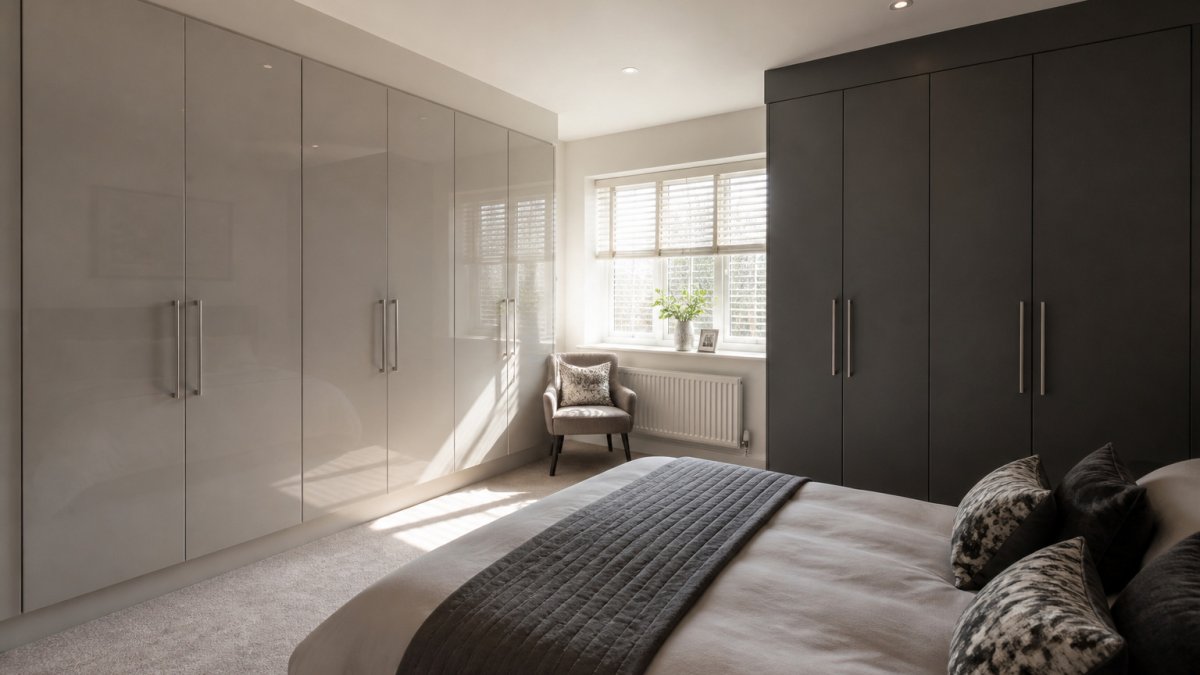
Matt surfaces diffuse light softly and hide fingerprints, marks and minor dust. They suit traditional, calm or contemporary bedrooms where understated elegance is the goal.
Gloss surfaces reflect light and make a room feel brighter and more modern.
Satin or eggshell sits between the two, offering a soft sheen that hides marks reasonably well while retaining a refined look. For many family bedrooms, it is the most forgiving choice.
The room’s light and how often the doors are used should decide the sheen more than fashion does.
Designing Bespoke Wardrobe Interiors to Match Your Finish
The interior fit-out is where the finish is tested in daily use. Shelf material, drawer runners and rail fittings should be chosen alongside the door finish so the whole unit reads as one piece.
Interior boards in melamine or a neutral laminate are usually the sensible choice, since they are hard-wearing and stay clean.
Plan the interior around how you store things. To compare a tailored layout against off-the-shelf options before you commit, read modular vs bespoke wardrobes. For ideas on laying out interiors in tricky, sloped or awkward spaces, see sloped ceiling closet designs.
Watch out: mixing warm wood veneer doors with a cool grey interior can make the wardrobe look unfinished. Sample the two together under your room’s lighting before approving.
Book a Free Design Visit to Choose Your Materials
A free design visit is available. Before you book, plan the whole joinery project so you know what to bring to the visit. book a free design visit
Last Updated: October 27, 2026
Frequently Asked Questions
What materials are best for a bespoke wardrobe?
A free design visit is available to discuss your storage needs.
Are matt or gloss wardrobe doors easier to maintain?
Matt finishes tend to hide fingerprints and fine scratches better than gloss, which shows marks and dust more readily. Gloss surfaces are easier to wipe clean but reveal every smudge in strong light. Both can be cleaned with a soft, damp cloth and a mild, non-abrasive cleaner. Your room’s lighting and how often the doors are handled are the main factors, so consider them alongside appearance when deciding.
Is MDF or plywood better for fitted wardrobes?
Neither is better in every case. Plywood generally offers greater strength and holds fixings well over time, which suits heavier shelving. MDF provides a very flat, smooth surface that takes paint and laminate well, making it a strong choice for painted or sleek finishes. Many bespoke wardrobes use plywood for structural parts and MDF for doors and panels. Ask your designer which combination suits the loads and finish you have in mind.
What should I consider when choosing wardrobe interiors?
Think about what you store and how you access it. Hanging space, shelf depth, drawer size and internal lighting all change how usable a bespoke wardrobe feels day to day. Interior finishes should be durable enough for frequent handling, and matching or contrasting them with the doors can make the design feel coordinated. Pricing depends on the size, materials and fittings you choose, so request a quote for your specific layout.


