

Last Updated: November 17, 2026
Quick Summary
Painted or veneered cupboard doors both last well, but veneered doors on a plywood core have an expected lifespan of 20 to 25 years, while painted MDF doors rely on an intact paint film for protection. Choose painted doors for unlimited colour and a seamless finish, and veneered doors for real wood grain that can be sanded and refinished.
- Veneer on plywood has an expected lifespan of 20 to 25 years with sensible care.
- Shaker doors accounted for 50% of the 300-plus kitchen designs reviewed.
- Wipe painted MDF doors dry after cleaning rather than leaving them wet.
- Seal veneer edges properly, since lifting spreads once water gets underneath.
- Use a shellac-based primer when painting veneer doors to block tannins.
Table of Contents
- What Painted and Veneered Cupboard Doors Actually Are
- Painted vs Veneered Kitchen Cabinets: A Like-for-Like Comparison
- Appearance, Colour Options and Natural Wood Grain
- Veneer Cabinet Door Pros and Cons
- Durability, Wear and Performance in Hot, Steamy Kitchens
- Painting Veneer Cupboard Doors: What Can Go Wrong
- How to Repair Veneer Cupboard Doors and Touch Up Paint
- Choosing a Finish for Bespoke Fitted Cabinetry
- Frequently Asked Questions
What Painted and Veneered Cupboard Doors Actually Are
Painted or veneered cupboard doors sit at the centre of most kitchen and storage decisions, and the choice between painted or veneered cupboard doors comes down to what sits under the surface. Painted doors use a manufactured core coated in sprayed colour; veneered doors wrap a stable core in a thin slice of real timber. The right answer depends on where the door lives and how hard it works.
Painted doors: MDF cores and spray-applied finishes
A painted door is a manufactured board, usually MDF, cut to size and finished with a primer and topcoat applied by spray for an even surface. The appeal is control: you get a flat, seamless face in any colour, with no grain to fight against a minimalist scheme. The trade-off is that the paint film is the protection. Once it chips or cracks, the core underneath is exposed.
Veneered doors: plywood cores and real wood faces
A veneered door bonds a thin layer of real wood, often oak veneer, to a plywood core. You get genuine natural wood grain without the movement of solid wood. According to Kitchen Design Hub’s comparison of door finishes, veneer on plywood has an expected lifespan of 20 to 25 years. That figure assumes sensible care, but it shows the construction is a long-term proposition rather than a short-term fix.
Painted vs Veneered Kitchen Cabinets: A Like-for-Like Comparison
Comparing painted vs veneered kitchen cabinets fairly means judging them on the same criteria: appearance, durability, maintenance and repair. For bespoke cupboard projects, our guide to the best materials for bespoke under stairs cupboards sets out the material options. Neither wins outright. Painted doors win on colour flexibility and a seamless finish; veneered doors win on authenticity and their ability to be refinished rather than repainted. Here is how they stack up.
| Criterion | Painted doors | Veneered doors |
|---|---|---|
| Core material | MDF | Birch plywood |
| Surface | Sprayed paint finish | Real wood veneer |
| Appearance | Flat, seamless, any colour | Natural wood grain |
| Colour options | Virtually unlimited | Limited to species and stain |
| Everyday durability | Good, but chips show | Good, and marks sand out |
| Moisture behaviour | Paint film must stay intact | Needs sealed edges |
| Repair approach | Touch up or repaint | Sand back and refinish |
| Best for | Bold colour, handleless doors | Warm, natural look |
For readers weighing fitted cupboards against open shelving as an alternative, our guide to fitted cupboards versus open shelving sets out the storage trade-offs.
Appearance, Colour Options and Natural Wood Grain
Appearance is where the two finishes diverge most sharply. A painted door gives you a single, uninterrupted plane of colour. A veneered door gives you grain direction, figure and the subtle variation that only real timber provides. Shaker doors remain the dominant style in the market: ProCraft Cabinetry’s analysis of more than 300 kitchen designs found Shaker doors accounted for 50% of the schemes it reviewed, and 52% used two-tone cabinetry.
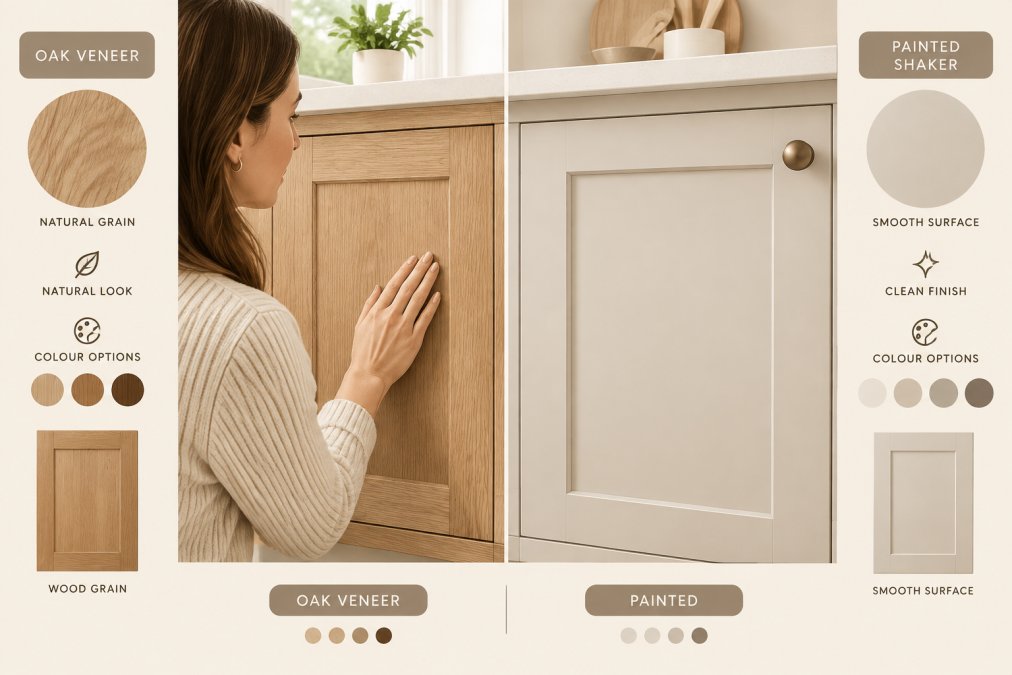
Colour trends have shifted too. Captivating Cabinets, citing Houzz data reports green at 6% and grey at 5%, a sign that warmer, earthier tones are gaining ground on the long-standing grey default. Painted doors make those shades easy to specify. Veneered doors answer a different brief: oak veneer, walnut or stained finishes that let the grain do the talking.
Veneer Cabinet Door Pros and Cons
The veneer cabinet door pros and cons come down to authenticity versus fragility at the edges. Veneered doors look and feel like real timber because they are, and they can be sanded and refinished rather than stripped and repainted. The weak point is the edge and any spot where moisture gets behind the veneer.
Pros:
- Genuine natural wood grain and warmth
- Can be sanded back and refinished
- Stable plywood core resists movement
- Ages with a patina rather than looking worn
Cons:
- Edges need protection from moisture
- Colour options limited to species and stain
- Chips at the edge are harder to disguise
- Costs more to specify than a basic painted door
Best for: period homes, warm natural schemes, and rooms where timber grain is the point.
Skip if: you want a bold uniform colour or a fully handleless flat front.
Durability, Wear and Performance in Hot, Steamy Kitchens
Durability in a working kitchen is less about the finish label and more about how well the surface is protected. Both painted and veneered doors handle everyday knocks; the difference shows up in heat, steam and water. Painted MDF needs protection from prolonged water exposure, and Conestoga Wood’s guidance on door materials advises wiping painted MDF doors dry after cleaning rather than leaving them wet.
Veneered doors face a different risk. The veneer itself is thin, and any lifting at an edge spreads if water gets underneath. Near a hob or sink, specify a protective coating and seal the edges properly. Watch out: a door fitted directly beside a boiling kettle or an unvented tumble dryer will degrade faster than the same door across the room, whatever the finish.
In practice, painted doors can fail at the bottom edge and around handle fixings, where water sits and the paint film cracks. Veneered doors can fail at the edges first, where heat and steam soften the adhesive and water can wick behind the veneer.
For high-heat zones, a moisture-resistant core and a fully sealed edge on veneered doors are sensible considerations. In steamy rooms, extraction matters as much as the finish: a working extractor hood and a door that is not directly in the steam plume will outlast the same door in a poorly ventilated corner. When planning fitted storage, match the finish to the room’s moisture load rather than choosing on appearance alone.
Painting Veneer Cupboard Doors: What Can Go Wrong
Painting veneer cupboard doors is possible, but it is the riskiest job in this comparison. The main hazard is moisture: 27estore’s guide to painting veneer doors warns that water in paint can cause veneer to expand and contract, which leads to peeling. Preparation matters more here than on any other surface. Careful surface preparation and a coating suited to veneer can reduce the risk of peeling, while Balderas Painting highlights how coating choices and application affect how long a finish lasts.
If you go ahead, the sequence is unforgiving:
- Confirm the door is veneered, not a wood-effect laminate
- Degrease and sand lightly to give the primer a key
- Use a shellac-based primer to block tannins
- Apply thin coats of a suitable topcoat, not one heavy layer
- Keep the room dry while the paint cures
A common mistake is skipping the primer because the veneer looks smooth. It is smooth, and that is exactly why paint fails to grip it.
How to Repair Veneer Cupboard Doors and Touch Up Paint
Repair depends on which finish you have, and the first step is to confirm what the door actually is. A simple inspection prevents most failed repairs: look at the edge profile for a visible veneer line or a painted MDF edge; check inside the cupboard for an unfinished face that shows plywood layers or a uniform board; and test an inconspicuous spot with a light scratch to see whether you expose timber grain or a painted surface. Confusing veneer with wood-effect laminate is the most common mistake, because laminate will not accept stain or oil and paint adheres differently.
For painted doors, touch-up is straightforward: clean the area, fill any chip with a fine filler, sand level and apply matching paint in thin coats. For veneered doors, minor scratches can be sanded out and re-oiled or re-stained; lifting edges need careful re-gluing and clamping before the damage spreads. Knowing how to repair veneer cupboard doors properly saves a replacement. The rule we follow is simple: if the damage is surface-level, refinish it; if the veneer has lifted across the face, the door is usually beyond a tidy repair.
Repair economics matter as much as technique. A painted door can often be touched up in place with matching paint, while a veneered door that needs refinishing usually has to be removed and sanded back. Where a veneered door has failed at the edge, re-gluing and clamping is a short-term fix; if the veneer has lifted across the face, replacement is usually the better long-term value. Specifying sealed edges and a repairable finish at the outset can reduce the lifetime repair burden. Once repairs are done, our guide to maintaining custom fitted wardrobes covers the routine that keeps both finishes looking sharp for years.
Choosing a Finish for Bespoke Fitted Cabinetry
Choosing a finish for bespoke fitted cabinetry is a decision about the room, not just the door. High-heat and high-steam zones favour a sealed, wipe-clean surface. Bedrooms and living spaces can carry a warmer veneer without the same moisture pressure. Match the finish to the environment and the maintenance you will realistically do.
For a deeper look at materials and finishes, read our guide to choosing bespoke wardrobe materials and finishes, and if you are planning a wider project, our guide to planning a bespoke joinery project maps out the stages. At Finest Furniture Studio, we build fitted wardrobes and storage with a 10-year warranty on wardrobes, a 7-day fitting service, clear upfront pricing with no hidden fees, and a free design visit.
The finish you choose will outlast most of the decisions around it, so it is worth getting right before a single door is cut. Finest Furniture Studio can help you weigh painted against veneered for your space, with a free design visit, a 10-year warranty on wardrobes and a 7-day fitting service that keeps disruption short. Get started with Finest Furniture Studio and specify a finish that still looks right a decade from now.
Frequently Asked Questions
Are painted or veneered cupboard doors better?
Neither wins outright; it depends on the room and the household. Painted doors give you any colour you want and are straightforward to touch up, which suits busy family kitchens. Veneered doors show real wood grain and hold up well in dry, low-traffic areas. One comparison puts veneer on plywood at a 20 to 25 year lifespan, though the source does not state the conditions behind that figure, so treat it as a rough guide rather than a promise.
Are veneered cupboard doors durable?
A well-made veneered door on a stable plywood core handles everyday knocks, but the face is thin and can lift if water gets behind an edge. Keep the surface dry, wipe spills promptly and avoid soaking the door when cleaning. In kitchens with heavy steam or a dishwasher venting nearby, a painted finish is often the safer choice because there is no veneer edge to lift.
Can you paint over veneered cupboard doors?
Yes, but preparation decides the result. Lightly sand the surface, apply a suitable primer and use a water-based paint made for the job. Moisture in paint can make veneer expand and contract, which risks peeling, so seal edges and avoid over-wetting. If the veneer is already lifting or chipped, repair it first, otherwise the new paint will fail along the same line.
Can damaged veneer on cupboard doors be repaired?
Small chips and lifted edges can usually be glued, clamped and filled, then touched in with a matching stain or wax stick. Larger patches may need a veneer offcut spliced in. Where the damage covers a wide area or the core has swollen, replacement is more reliable.


