

Last Updated: November 19, 2026
Quick Summary
Ventilate an under stairs cupboard with two passive grilles, one low near the floor and one high near the top, ideally on different faces so air sweeps the whole space. Where the cupboard is sealed or holds heat-generating equipment, fit a low-speed continuous fan instead. Diagnose the damp source first, because vents will not fix a leak or rising damp.
- Check whether damp worsens in cold weather, which points to condensation that ventilation can fix.
- A fan rated at 15 to 30 m³/h is typically ample for a domestic under stairs cupboard used for storage.
- Cutting a vent into a fire door under the stairs can breach fire safety, so check with building control.
- Leave a 50 mm to 100 mm gap between shelving and the wall so air can rise to the high vent.
- A persistent humidity gap of more than about 10 percentage points means air exchange is still inadequate.
Table of Contents
- Ventilation for Under Stairs Cupboards: Why Airflow Matters
- Diagnosing Under Stairs Cupboard Damp Before You Fit Anything
- Passive Ventilation Vents: Grilles, Placement and Airflow
- When to Fit an Extractor Fan for Cupboard Airflow
- Step-by-Step: Fitting a Vent in Your Cupboard Door or Wall
- Controlling Condensation, Mould and Musty Smells
- Under Stairs Storage Ideas That Keep Air Moving
- Book a Free Design Visit for Bespoke Under Stairs Storage
- Frequently Asked Questions
Ventilation for Under Stairs Cupboards: Why Airflow Matters
Ventilation for under stairs cupboards is the deliberate movement of air through an enclosed storage space so moisture and stale air can escape. Without it, the cupboard traps damp, condensation and musty smells.
The core problem: an under stairs cupboard is usually a small box with one door, no window, and at least one cold external wall.
The fix is not complicated, but most guides jump straight to “drill a vent in the door” without checking where the moisture is actually coming from.
Diagnosing Under Stairs Cupboard Damp Before You Fit Anything
Before you cut a hole in anything, work out what kind of damp you have.
Start with a simple check:
- Is the damp worse in cold weather? That points to condensation, which ventilation can fix.
- Is there a tide mark low on the wall? That suggests rising damp, which needs a damp-proof course, not a grille.
- Does the smell get worse after rain? Check for a leak or a bridged damp-proof course outside.
- Is the cupboard next to a bathroom or kitchen? Warm, moist air from those rooms is a common culprit.
A cheap hygrometer will tell you the relative humidity inside the cupboard.
Watch out: sealing a damp cupboard to “protect” the contents makes condensation worse, because trapped moisture has nowhere to go.
If you are planning a cloakroom conversion in that space, our guide to planning modern understairs cloakroom designs shows how ventilation fits into the wider layout.
Passive Ventilation Vents: Grilles, Placement and Airflow
Passive ventilation vents are grilles that let air move through a cupboard without power, using the natural stack effect: warm air rises and escapes through a high vent while cooler air is drawn in through a low one.
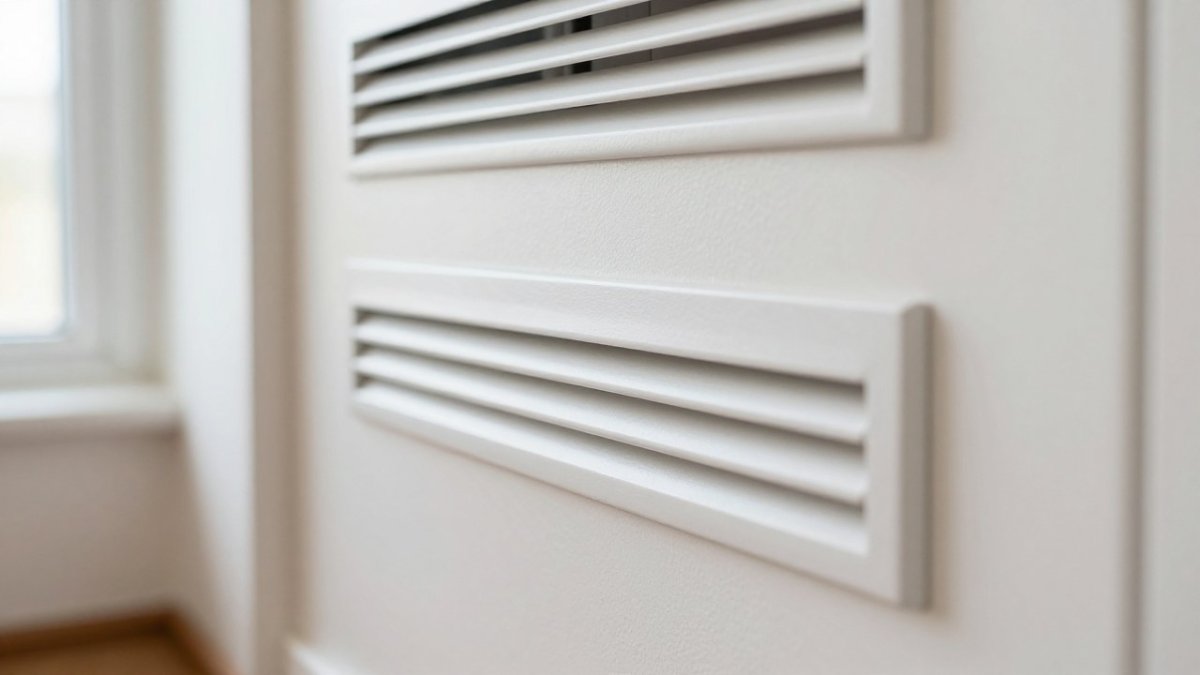
The principle is simple: two openings, one high, one low, on opposite sides where possible. Air enters low, warms up, rises, and leaves high. That continuous exchange keeps humidity down.
Where to Position High-Level and Low-Level Vents
Put the low-level vent near the floor and the high-level vent near the top, ideally on different faces. A door grille at the bottom plus a wall vent at the top creates a diagonal path that sweeps the whole space rather than short-circuiting straight across.
Keep both vents clear. A high vent hidden behind a stack of boxes does nothing. Leave a gap of at least a hand’s width around each grille.
Choosing the Right Grille for Door, Wall or Stair Riser
Door grilles are the easiest retrofit because you can remove the door and work on a bench. Wall vents need a core drill and a clear path to open air or another room. Stair riser vents are neat but fiddly, and you must not cut into a structural stringer without advice.
For cupboard doors, louvre grilles in painted MDF or hardwood suit most interiors. Our guide to materials for bespoke under stairs cupboards covers which boards and finishes work best around vents.
When to Fit an Extractor Fan for Cupboard Airflow
An extractor fan for a cupboard is worth fitting when passive vents cannot keep humidity down on their own: a sealed space with no external wall, a cupboard used for moisture-sensitive items, or a home office packed with heat-generating equipment.
A small inline or cabinet fan moves far more air than a grille and can run continuously at low speed. The trade-offs are noise, a power supply, and somewhere for the duct to go.
Sizing a Fan for a Small Cupboard
Fan capacity is usually quoted in litres per second (l/s) or cubic metres per hour (m³/h). For a cupboard, you do not need a bathroom-sized extractor.
Multiply the cupboard’s width, depth and height in metres.
A fan rated at 15 to 30 m³/h is typically ample for a domestic under stairs cupboard used for storage. Larger inline fans are only needed where the duct run is long or the heat load is significant.
Ducting, Noise and Controls
Short, straight duct runs move air more efficiently than long, bendy ones.
Noise matters in a hallway cupboard. A fan mounted on a solid wall or ceiling joist will transmit vibration into the structure; rubber mounts or a short flexible connector reduce this.
A fan needs a permanent live supply for continuous running or a humidistat. Electrical work of this kind is best carried out by a registered electrician.
Passive Versus Powered: A Quick Decision Guide
- Use passive high-and-low grilles where the cupboard has at least one external wall or opens onto a well-ventilated hall, and the contents are not moisture-sensitive.
- Use a door transfer grille plus a wall vent where the cupboard is internal but adjoins a ventilated room.
- Use a low-speed continuous fan where the cupboard is sealed, has no external wall, or holds heat-generating equipment.
- Use a humidistat-controlled fan where moisture levels fluctuate, such as a cupboard next to a bathroom.
If you are unsure which route suits your space, a free design visit is a sensible way to look at the cupboard, the adjacent walls and the duct route together before committing to any cutting.
Here are the fan sizing figures the article gives for a typical under stairs cupboard.
| Item | Value | Note |
|---|---|---|
| Example cupboard size | 1.2 m wide, 0.8 m deep, 2.2 m high | Volume of about 2.1 m³ |
| Air changes for storage cupboard | Roughly one to two per hour | Aim higher with heat-generating equipment |
| Typical fan rating for domestic cupboard | 15 to 30 m³/h | Usually ample for storage use |
| Fan capacity units | Litres per second (l/s) or cubic metres per hour (m³/h) | As quoted by manufacturers |
Step-by-Step: Fitting a Vent in Your Cupboard Door or Wall
Fitting a passive vent is a half-day job for a confident DIYer.
Total time: 2 to 3 hours
Difficulty: Beginner to intermediate
What you’ll need:
- Louvre vent grille and matching inner grille
- Hole saw or jigsaw
- Drill, pencil, tape measure
- Masking tape
- Sandpaper and paint
Step 3: Cut the opening. Work slowly and keep the blade square to the surface.
Step 4: Test-fit the grille. Sand the edges until the grille sits flush.
Expected result: a neat pair of grilles with a clear path between them.
Watch out: cutting a vent into a fire door under the stairs can breach fire safety.
Controlling Condensation, Mould and Musty Smells
Condensation is the most common cause of under stairs cupboard damp, and the one ventilation solves best. Moisture control comes down to three habits: keep the cupboard dry, keep the air moving, and deal with spills fast.
- Wipe down any cold surfaces where water beads
- Store clothes and linens in breathable bags, not sealed plastic
- Keep the cupboard door ajar for an hour a day to let air exchange with the hall
- Treat small patches of mould with a suitable cleaner and fix the cause
If you spot black mould spreading across a wall, treat it as a warning sign, not a cleaning job. It means moisture is persistent. Sort the ventilation before you repaint.
Damp also ruins finishes. Our comparison of painted versus veneered cupboard doors explains which surfaces cope better with moisture.
Under Stairs Storage Ideas That Keep Air Moving
Good storage design and good airflow are not enemies. The trick is to leave gaps, raise what you store, and avoid packing the space solid.
- Fit slatted or open shelving so air can pass between shelves
- Leave a gap at the back of deep cupboards for air to rise
- Use baskets and crates rather than sealed boxes
- Keep the floor clear so the low vent stays unobstructed
- Store the damp-prone items highest, where warm air collects
For design inspiration and layout options, see our bespoke understairs storage ideas guide. If you are planning a pantry in the space, our understairs pantry design guide covers airflow-friendly layouts for food storage.
Layouts That Do Not Block the Vents
Most under stairs cupboards have a sloping ceiling, so the high vent often sits on the tallest wall at the back.
Deep cupboards benefit from a 50 mm to 100 mm gap between the back of the shelving and the wall, letting air move vertically behind the contents to feed the high vent.
Drawers and sealed boxes are the enemy of airflow. Where you need dust protection, use lidded baskets or breathable cotton storage bags rather than airtight plastic tubs.
Monitoring After Installation
Fitting vents is only half the job; the other half is checking they worked.
A simple tissue test is a quick check: hold a tissue near the low vent with the door closed. If it flutters, air is moving.
Check the grilles every few months. Dust and cobwebs reduce free area, and insect mesh clogs faster than you expect. Wipe the grilles and vacuum the mesh.
When Storage Design and Ventilation Need to Be Planned Together
In a bespoke fit, ventilation is easiest to get right when designed in from the start rather than retrofitted. Decide where the high and low vents will sit, then design shelving and drawers around them so nothing blocks the airflow path.
If the cupboard is being converted into a cloakroom, pantry or home office, agree the ventilation strategy before the layout is fixed.
Book a Free Design Visit for Bespoke Under Stairs Storage
Getting ventilation right is one half of a usable under stairs cupboard. The other half is storage that fits the slope, the door swing and the awkward corners without blocking the airflow you have just created.
That is what we do.
If your cupboard is damp, smelly, or simply unusable, we will look at the space, talk through ventilation, and design storage that works with the airflow rather than against it.
Frequently Asked Questions
Does an under stairs cupboard need ventilation?
Yes, if it holds anything that can hold moisture or give off heat. The space is small and enclosed, so warm air from the home meets cooler surfaces and condenses, which is what drives musty smells and black mould. Adding a low-level and a high-level vent lets air circulate and keeps relative humidity closer to the 30%-50% range where mould struggles to grow. Cupboards used for coats, shoes, pantry goods or electrical equipment benefit most.
Will a vent stop damp in an under stairs cupboard?
A vent only helps if the moisture is coming from condensation inside the cupboard. If damp is rising through the floor, seeping through an exterior wall or coming from a leak, ventilation will not fix it and may make it worse by pulling more moist air in. Diagnose the source first: check for tide marks, salt deposits, wet patches after rain and a damp, earthy smell. Fix the water source, then ventilate.
Should I use an extractor fan in an under stairs cupboard?
A small extractor fan or cabinet fan is worth fitting when passive vents alone cannot keep up, for example in a sealed cupboard with no exterior wall, one storing heat-producing equipment, or a pantry that stays humid. Choose a quiet, low-power unit and duct it to outside rather than into a wall cavity. Run it on a humidity sensor or timer so it works without you remembering to switch it on.
Can I store electrical equipment in an under stairs cupboard without ventilation?
It is not advisable. Routers, servers, games consoles and smart home hubs all produce heat, and a sealed cupboard traps it, which shortens equipment life and raises fire risk. Fit high and low vents so hot air can escape and cooler air can enter, keep equipment off the floor and away from soft furnishings, and leave a gap around devices. If the cupboard is fully enclosed, add a small fan.


