
Modular wardrobe design is defined as a pre-fabricated storage system made of interchangeable units, including cabinets, shelves, drawers, and hanging rods, that are assembled on-site to fit a specific room and set of storage needs. Unlike a wardrobe built by a carpenter directly in your bedroom, modular systems are manufactured off-site and delivered as components ready for home assembly. This approach gives homeowners and renters in areas such as Richmond, Chelsea, and Wimbledon a practical way to create organised, stylish storage without the disruption of traditional on-site joinery. Whether you are furnishing a compact flat in Fulham or a family home in Kingston, understanding how modular wardrobes work will help you make a far better decision about your bedroom storage.
How does modular wardrobe design differ from fitted wardrobes?
The core distinction between modular and fitted wardrobes lies in where and how they are made. A fitted or built-in wardrobe is constructed on-site by a carpenter who measures, cuts, and assembles the unit directly within your room. A modular wardrobe, by contrast, arrives as a set of pre-made components that you or an installer assembles in your home. Off-site fabrication enables better quality control and significantly faster installation than traditional methods.
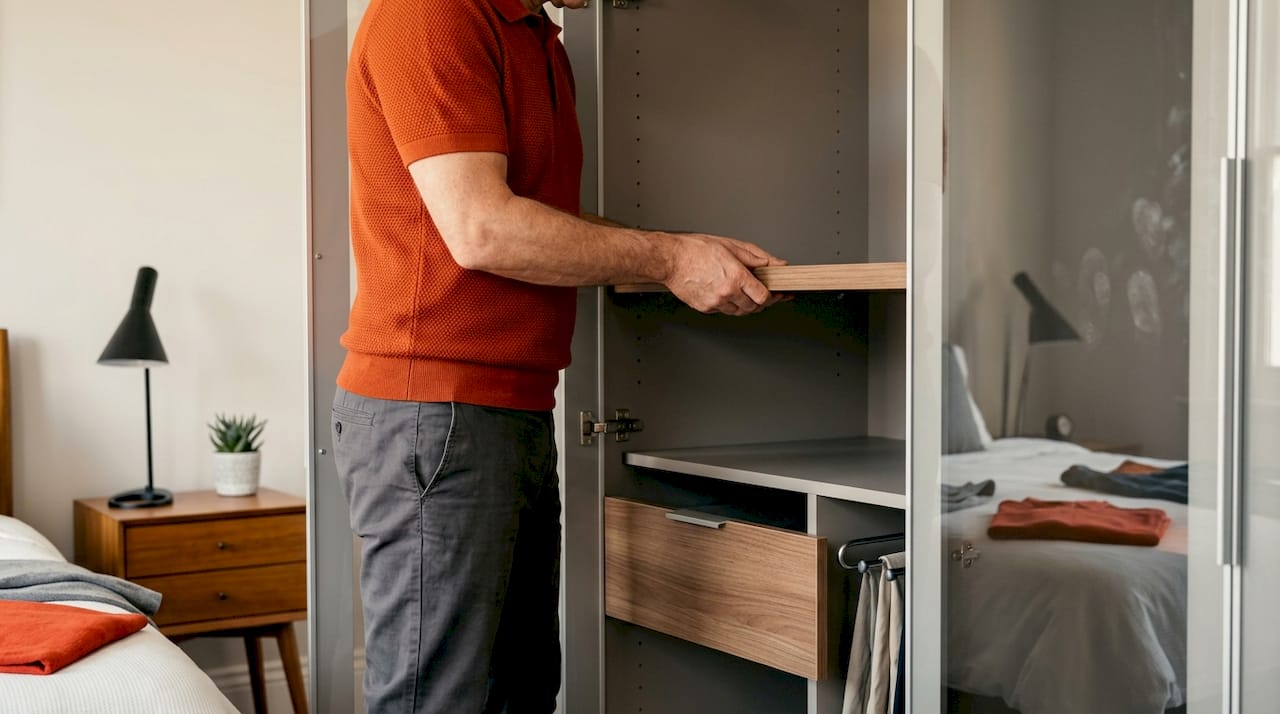
From a structural standpoint, modular systems use standardised, reversible interfaces that allow components to be connected, disconnected, and reconfigured without specialist tools or permanent alterations to your walls. This is the defining technical characteristic that separates true modular design from conventional carpentry. A fitted wardrobe, once built, is essentially permanent. A modular system can be taken apart, moved to a new home, or reconfigured as your storage needs change.
The table below summarises the key differences at a glance:
| Feature | Modular wardrobe | Fitted or built-in wardrobe |
|---|---|---|
| Where it is made | Off-site factory | On-site by a carpenter |
| Installation time | Faster, less disruptive | Longer, more disruptive |
| Flexibility | Reconfigurable and moveable | Permanent once installed |
| Cost entry point | Lower initial cost | Higher, bespoke pricing |
| Customisation depth | Standardised module sizes | Fully bespoke to your space |
There are also two distinct types of modular system worth knowing. Frame-based systems with interchangeable inserts allow ongoing micro-adjustments after installation, while fully prefabricated volumetric kits reduce on-site assembly time but offer less flexibility once in place. The IKEA PAX system is the most widely recognised example of a frame-based modular wardrobe, offering a broad range of internal organisers that can be swapped in and out over time.
Pro Tip: If you are renting, a modular system is almost always the better choice. Because it uses reversible connections and does not require permanent fixings to walls, you can take it with you when you move without losing your deposit.
What are the main benefits of a modular wardrobe?
Modular wardrobes offer a distinct set of advantages that make them particularly well suited to modern homes and rental properties. The benefits extend well beyond simple convenience.
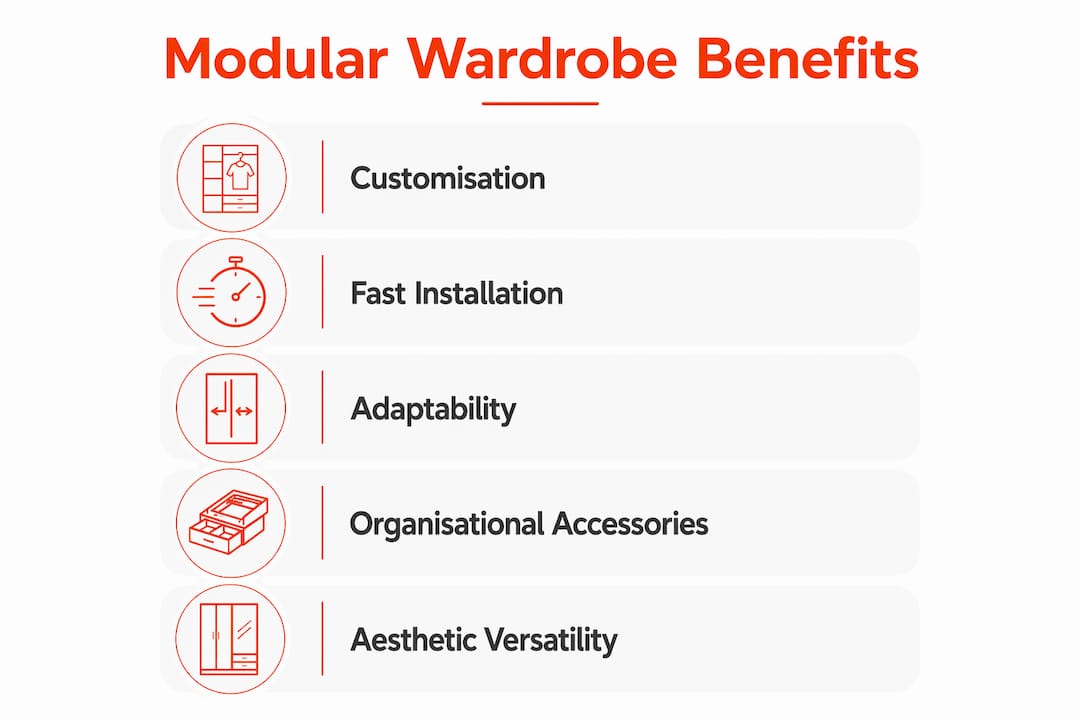
Customisation to your exact space
Modular wardrobes can be configured to suit almost any room shape or size, from a narrow alcove in a Putney terrace to a generous bedroom in a Chiswick semi-detached. You select the module types and quantities that match your storage requirements, rather than accepting a one-size-fits-all solution. This level of personalisation was once reserved for bespoke fitted furniture, but modular systems have made it accessible at a much lower price point.
Faster, less disruptive installation
Modular wardrobe installation is generally quicker and less disruptive than traditional built-on-site wardrobes because the components arrive ready to assemble. For busy households in areas such as Hammersmith or Ealing, this matters. There is no sawdust, no extended building work, and no need to vacate your bedroom for days at a time.
Adaptability over time
One of the strongest arguments for modular design is its ability to evolve with you. Modular wardrobes accommodate evolving storage needs, making them adaptable for moves, seasonal changes, or varying clothing volumes. If you add a child to the household, change your wardrobe significantly, or simply decide you need more hanging space and fewer shelves, you can reconfigure the system without replacing it entirely.
Space efficiency through specialised modules
Modern modular systems include a range of purpose-built accessories that maximise every centimetre of available space:
- Pull-out shoe racks that use floor-level space efficiently
- Jewellery organisers and velvet-lined drawers for accessories
- Integrated LED lighting strips that make the interior visible and visually appealing
- Tie and belt racks, trouser presses, and pull-down hanging rails for high-level storage
- Adjustable shelving to accommodate folded items of varying heights
These specialised storage accessories improve both space efficiency and daily organisation in ways that a standard wardrobe simply cannot match.
Aesthetic versatility
Modular wardrobes are available in a wide range of finishes, from wood-effect panels and shaker-style doors to high-gloss lacquers and matt whites. This means you can match the system to your existing bedroom décor rather than designing around it. For homeowners in Chelsea or Barnes who invest in their interiors, this flexibility is genuinely valuable.
How to plan and design your modular wardrobe layout
Designing a modular wardrobe layout is a process that rewards careful planning. Rushing this stage is the single most common reason people end up with a system that does not quite work. Follow these steps to get it right.
-
Measure your space accurately. Record the width, height, and depth of the area where the wardrobe will sit. Note any obstacles such as skirting boards, coving, ceiling slopes, or radiators. Loft rooms in Twickenham and Barnes, for example, often have sloped ceilings that require specific module configurations.
-
Audit your storage needs. Before selecting modules, catalogue what you actually need to store. Count your hanging garments and note whether they are long items such as dresses and coats or shorter items such as shirts and jackets. Estimate your folded items, shoes, and accessories. This audit determines the ratio of hanging rails to shelves and drawers.
-
Use a planning tool. The IKEA PAX Planner is a well-known online tool that lets you visualise module combinations before purchasing. Many bespoke wardrobe designers also offer digital planning services. Using a planner prevents costly mistakes and helps you see the finished result before committing.
-
Work within the system grid. Ignoring system dimensional grids can cause unusable gaps or failed adjustments. Every modular system is built around a set of standard unit widths, typically 50 cm, 75 cm, and 100 cm. Your total wardrobe width must be achievable using combinations of these standard sizes, or you will be left with awkward gaps at the sides.
-
Select your module types and quantities. Based on your audit, decide how many hanging sections, drawer towers, shelf units, and corner modules you need. A common starting point for a double bedroom is two hanging sections flanking a central drawer tower, but your audit may point to a very different configuration.
-
Plan your lighting and finishing touches. Integrated lighting transforms the usability of a wardrobe, particularly in bedrooms with limited natural light. LED strip lights inside hanging sections and above shelf areas are now standard in well-designed modular systems. Consider also the door style, handle design, and interior colour to create a cohesive look that complements your room.
Pro Tip: Always add 10 to 15 per cent extra storage capacity to your initial plan. Most people underestimate how quickly a wardrobe fills up, and building in headroom from the start prevents the need for a costly reconfiguration within the first year.
For inspiration on small walk-in wardrobe ideas, particularly in compact London bedrooms, it is worth exploring layouts that use vertical height as well as floor space.
How to organise a modular wardrobe for maximum efficiency
A well-designed modular wardrobe is only as effective as the organisation system inside it. The flexibility of modular design means you can adjust the internal layout as your habits and wardrobe evolve, but a few core principles will serve you well from day one.
Balance hanging and folded storage
The most common organisational mistake is allocating too much hanging space and too little shelf or drawer space. In practice, a significant proportion of most wardrobes consists of folded items: knitwear, jeans, T-shirts, and accessories. Aim for a roughly equal split between hanging rails and folded storage unless your wardrobe is predominantly formal wear.
Use the full height of the unit
Most modular systems allow double hanging rails in sections where you store shorter items such as shirts and jackets. This effectively doubles the hanging capacity of that section. Reserve the upper shelves for seasonal items, luggage, and infrequently used accessories. Planning for future changes is fundamental to getting the most from a modular system, and the upper zone is the easiest area to reconfigure as needs shift.
Organise by frequency of use
Place the items you reach for every day at eye level and within easy arm’s reach. Seasonal clothing, spare bedding, and occasional-use items belong at the top or bottom of the unit. This principle sounds obvious, but it is frequently ignored in the excitement of filling a new wardrobe.
Seasonal rotation made simple
One of the genuine advantages of modular wardrobes for renters and homeowners alike is the ease of seasonal rotation. Homeowners and renters gain most from modular systems when they anticipate lifestyle changes such as seasonal wardrobe swaps. Dedicate one section or a set of upper shelves to out-of-season clothing stored in vacuum bags or lidded boxes. When the season changes, swap the contents rather than reorganising the entire wardrobe.
Maintain accessibility and aesthetics
- Use matching storage boxes and baskets on open shelves to create a visually consistent look
- Label shelf sections or drawer fronts if you share the wardrobe with a partner
- Keep the floor of the wardrobe clear to make cleaning easier and to avoid the creeping clutter that undermines even the best storage system
- Revisit the configuration every six to twelve months and adjust module positions as your needs change
For broader ideas on home storage design trends that complement modular wardrobes, it is worth considering how your wardrobe fits within the wider storage strategy of your home.
Key takeaways
Modular wardrobe design delivers genuine flexibility, faster installation, and long-term adaptability that traditional fitted wardrobes cannot match, making it the most practical storage solution for modern homeowners and renters.
| Point | Details |
|---|---|
| Definition is clear | A modular wardrobe is a pre-fabricated system of interchangeable units assembled on-site. |
| Installation is faster | Off-site manufacturing reduces disruption compared to traditional on-site carpentry. |
| Flexibility is the core advantage | Reversible connections allow reconfiguration as storage needs change over time. |
| Planning prevents costly errors | Working within the system’s dimensional grid avoids gaps and failed adjustments. |
| Organisation multiplies the value | Balancing hanging and folded storage, and rotating seasonally, maximises daily usability. |
Why I think most people choose the wrong system type
Having worked with homeowners across London, from Wimbledon to Walton-on-Thames, I have seen the same mistake repeated more often than any other. People choose a modular system based on price or aesthetics alone, without understanding the fundamental difference between a frame-based system and a fully prefabricated volumetric kit. That distinction changes everything about how the wardrobe performs over five or ten years.
Frame-based systems, of which the IKEA PAX is the most familiar example, give you genuine ongoing flexibility. You can swap internal organisers, add a drawer tower, or change the door style years after installation. Fully prefabricated kits are faster to assemble initially, but once they are in place, meaningful reconfiguration is limited. For a homeowner who plans to stay in a property for a decade, the frame-based approach almost always wins. For a renter who moves every two or three years, the prefabricated kit may be the more practical choice.
The second mistake I see regularly is ignoring the system’s dimensional grid. A modular wardrobe is not infinitely adjustable. It is built around standard unit widths, and if your room does not divide neatly into those widths, you will have gaps. I have visited homes in Putney and Chiswick where a beautiful modular system was undermined by a 12 cm gap at one end that the homeowner had not anticipated. Measuring twice and planning with the grid in mind is not optional. It is the difference between a wardrobe that looks professionally installed and one that looks like an afterthought.
My honest view is that for most London homeowners, a bespoke fitted wardrobe from a specialist will outperform a modular system over the long term. It fills the space precisely, it is built to your exact specification, and it adds genuine value to the property. Modular systems are excellent for renters, for rooms with unusual dimensions that a standard grid cannot accommodate, and for homeowners who want a lower upfront cost. But if you are staying put and you want the best result, integrated fitted wardrobes remain the superior long-term investment.
— Aureliu
How Finest Furniture Studio can help you create the perfect wardrobe
At Finest Furniture Studio, we design and install bespoke wardrobes across London, including Richmond, Wimbledon, Chelsea, Fulham, Chiswick, Ealing, and surrounding areas such as Walton-on-Thames, Woking, and Guildford. Every wardrobe we create is tailored to your room’s exact dimensions and your personal storage requirements, with no standardised grid constraints and no awkward gaps.
Our service includes a free design visit, expert planning consultation, and installation completed within seven to twelve days. We also remove and dispose of your old wardrobe at no extra charge. All our fitted wardrobes carry a 10-year guarantee. Whether you are considering a bespoke wardrobe in West London or exploring options for a loft room, a walk-in wardrobe, or a sliding door design, we are ready to help. Call us on 07468 150807 or book a free design visit today.
FAQ
What is a modular wardrobe in simple terms?
A modular wardrobe is a storage system made of pre-manufactured units, such as shelves, drawers, and hanging sections, that are assembled in your home to create a customised wardrobe. Unlike a built-in wardrobe, it can be reconfigured or moved without permanent alterations to your room.
Are modular wardrobes suitable for small bedrooms?
Yes. Modular wardrobes are particularly well suited to small bedrooms because you can select only the module types and sizes that fit your available space, including narrow units and double-hanging configurations that maximise vertical height. Exploring compact bedroom storage ideas alongside modular planning tools will help you get the most from a limited footprint.
How long does it take to install a modular wardrobe?
Because the components are pre-fabricated off-site, modular wardrobe installation is generally completed in one to two days, which is significantly faster than traditional on-site carpentry. The exact time depends on the size and complexity of the system.
Can I reconfigure a modular wardrobe after installation?
Yes. The defining feature of a modular system is its use of standardised, reversible connections, which means internal components such as shelves, drawers, and rails can be repositioned or replaced without specialist tools. Frame-based systems such as IKEA PAX offer the greatest ongoing flexibility for reconfiguration.
What is the difference between a modular and a bespoke wardrobe?
A modular wardrobe uses standardised pre-made units assembled to fit your space, while a bespoke wardrobe is designed and built specifically for your room’s exact dimensions and your personal requirements. Bespoke wardrobes from specialists such as Finest Furniture Studio offer a more precise fit, greater design freedom, and long-term added value to your property.