

Last Updated: November 20, 2026
Quick Summary
To learn how to add a charging station to a wardrobe, plan the layout, power route and airflow before cutting anything. Choose a mid-height shelf or drawer near a socket, leave about 20mm clearance per device and at least 25mm above and below for ventilation.
- A middle shelf roughly 900mm to 1,100mm from the floor is easiest to reach.
- Keep the charging bay at least 50mm back from the door line.
- A cable pass-through with a plug-in power strip is the simplest DIY route.
- Drill vent holes high on one side and low on the other for convection.
- Add up charger wattage and keep it well below the strip’s 13A rating.
Table of Contents
- Planning a Charging Station Wardrobe Before You Cut Anything
- Building a DIY Charging Station Drawer Step by Step
- Wardrobe Cable Management That Keeps Cords Out of Sight
- Creating a Safe Charging Station for Electronics in an Enclosed Space
- Rental-Friendly and No-Drill Alternatives
- When to Bring in a Bespoke Fitted Wardrobe Specialist
- Book a Free Design Visit for a Built-In Charging Shelf
- Frequently Asked Questions
Planning a Charging Station Wardrobe Before You Cut Anything
Adding a charging station to a wardrobe works best when you plan the layout, the power route and the airflow before any tool touches the wood. This guide walks you through how to add a charging station to a wardrobe without wrecking the carcass or creating a fire risk.
A charging station is a dedicated shelf, drawer or bay where phones, tablets and other devices charge out of sight. The key detail is that it needs power, airflow and a clear cable path. Get those three right and the rest is straightforward carpentry.
Choosing the Right Spot Inside the Wardrobe
Pick a spot with a nearby socket and a short cable run. A middle shelf at hip height (roughly 900mm to 1,100mm from the floor) is easiest to reach. Avoid the very top shelf, where heat gathers, and never box devices into a sealed drawer with no air gap.
Think about daily use. A charging bay near the door means you can drop your phone in as you walk past. A bay at the back means reaching over coats every night. Check door clearance too: a hinged door needs its swing arc kept clear, and a sliding door needs its track unobstructed, so the bay should sit at least 50mm back from the door line.
Measuring the Space and Checking Access
Measure the internal width, depth and height of the bay before you buy anything. Leave a finger’s width (about 20mm) of clearance around each device. Check how the wardrobe sits against the wall, because you need a route for the power cable. Measure the distance from the nearest socket to the bay and add 300mm of slack so the cable is not under tension when the drawer or door moves.
Check what sits behind the wardrobe back panel before you drill.
Comparing Installation Options for Different Wardrobe Layouts
Not every wardrobe suits the same approach. The four common options are:
- Surface-mounted outlet: a socket or fused spur fixed to the inside of the carcass. Best for deep wardrobes with a clear back panel, but requires fixed wiring and likely a registered electrician.
- Cable pass-through: a grommet or port through a shelf or drawer back, feeding a power strip plugged into an existing socket. The simplest DIY route and the easiest to reverse.
- Shelf-mounted power strip: a shallow strip fixed to the underside of a shelf with devices charging on the shelf above. Good for tall wardrobes with adjustable shelving.
- Charging drawer: a dedicated drawer with a pass-through and dividers. Best for hiding everything when closed, but needs a deep drawer at waist height and careful cable routing around the runner.
Match the option to the layout: a floor-to-ceiling fitted wardrobe with a solid back panel usually rules out surface mounting without professional help, while a freestanding wardrobe with a thin back panel suits a pass-through and a plug-in strip.
Below, we’ll show you exactly where to site it, how to measure, and which build suits your wardrobe. The five approaches we cover range from a no-drill shelf to a fully fitted solution.
Here are the four installation options and what each one suits best.
| Option | Best for | Key difference |
|---|---|---|
| Surface-mounted outlet | Deep wardrobes with a clear back panel | Requires fixed wiring and likely a registered electrician |
| Cable pass-through | Freestanding wardrobes with a thin back panel | Simplest DIY route and easiest to reverse |
| Shelf-mounted power strip | Tall wardrobes with adjustable shelving | Shallow strip fixed under a shelf, devices charge above |
| Charging drawer | Hiding everything when closed | Needs a deep drawer at waist height and careful cable routing |
Building a DIY Charging Station Drawer Step by Step
A DIY charging station drawer hides everything when closed. It suits a deep drawer at waist height and takes an afternoon for a confident DIYer.
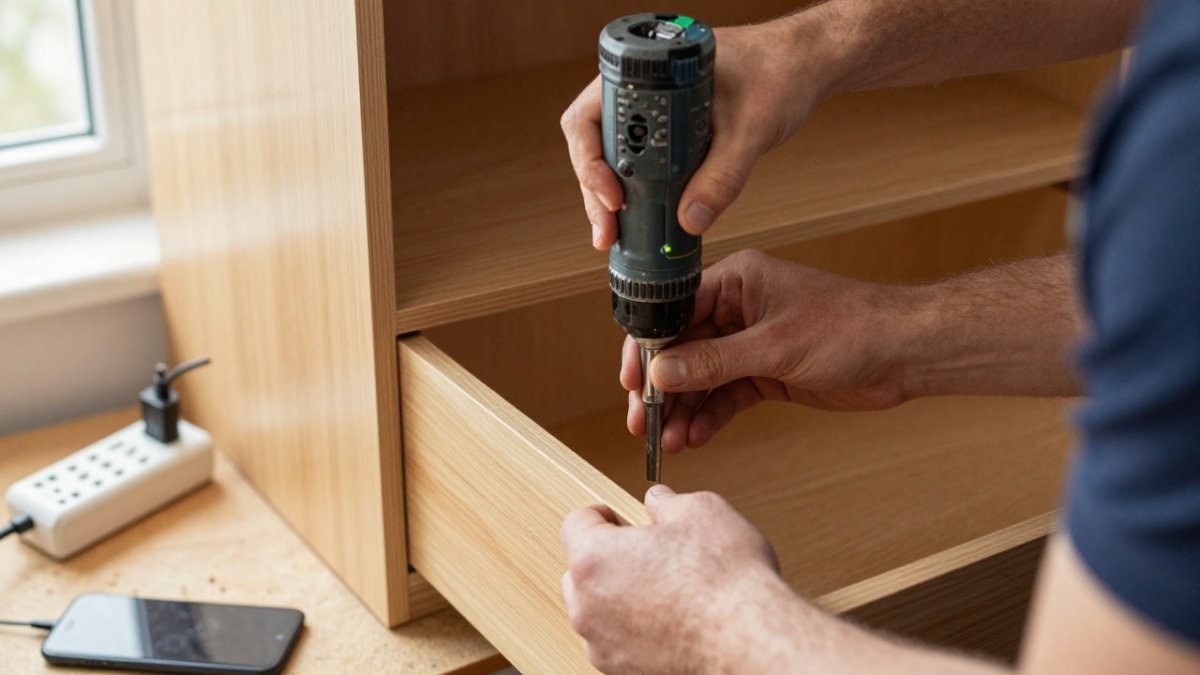
Here is the sequence we would follow:
- Remove the drawer and measure the internal floor space.
- Mark the cable pass-through point at the back corner, clear of the runner.
- Drill a hole just wide enough for the plug head to pass through.
- Sand the hole edges so the cable cannot chafe.
- Fit a rubber grommet or cable port to protect the cord.
- Fix a shallow power strip to the drawer base with the sockets facing up.
- Add a divider to separate devices from the strip.
- Feed the cord through the hole and test the drawer closes fully.
If you want to build your own dividers, our guide on DIY wardrobe dividers and organizers shows how to cut and fit them cleanly.
Tools and Materials You Will Need
- Drill with a hole saw or spade bit
- Tape measure and pencil
- Fine sandpaper
- Rubber grommet or cable port
- Shallow power strip with a surge protector
- Short charging cables
- Divider board or small storage tray
- Cable clips or ties
Wardrobe Cable Management That Keeps Cords Out of Sight
Good wardrobe cable management turns a tangle into a tidy bay. Route the main power cable along the back corner, clip it flat, and keep charging cables short so they do not loop over the shelf edge.
A few habits make the difference:
- Use velcro ties rather than zip ties so you can adjust later.
- Label each charging cable at the plug end.
- Keep one spare cable in the bay for guests.
- Run cables behind a divider so devices sit in front.
For more ideas on hiding and organising cords, see our guide to modern fitted wardrobe storage solutions.
Creating a Safe Charging Station for Electronics in an Enclosed Space
A safe charging station for electronics needs three things working together: airflow, a correctly rated power supply, and a cable route that cannot be damaged by the wardrobe itself. For a closer look at how smart charging features fit into modern wardrobe design, see our guide to smart technology features for modern wardrobes. Enclosed spaces trap heat, and heat is the main risk when charging electronics in a wardrobe. The details below go further than most guides because wardrobe charging sits at the intersection of furniture and fixed electrical installation.
Ventilation, Heat and Overnight Charging
Every charger converts some energy into heat, and a sealed drawer or closed bay has nowhere for that heat to go. A common pattern is a phone or tablet that charges fine on a bedside table but runs warm in a wardrobe drawer because the ambient temperature inside the bay is already higher.
Overnight charging is fine when the bay has airflow and you use the charger supplied with the device. Chargers that do not carry recognised certification may not meet UK safety standards. Give the bay a vent, keep it clear, and never charge on a soft surface such as a folded jumper.
Electrical Safety in a Wardrobe
If you are adding a new spur or socket inside a wardrobe rather than plugging a power strip into an existing outlet, the work is likely to be fixed electrical installation and should be checked against current UK requirements.
For a plug-in approach, a surge-protected power strip from a reputable brand is acceptable provided it is rated for the total load.
Watch out: cutting into a wardrobe back panel that hides wiring or pipework is a common and expensive mistake. Check what sits behind the panel before you drill, and never route a cable where a drawer runner or door hinge can pinch it.
Device Compatibility and Charging Performance
USB-C Power Delivery (PD) chargers deliver more wattage than older USB-A chargers and are now the standard for phones, tablets and many laptops. A multi-device strip shares its total output, so four devices on a 30W charger will charge slowly. Match the charger to the device: a phone may need 20W, a tablet 30W, and a laptop 45W or more. Use short, certified cables and avoid incompatible adapters, which can cause slow charging or heat build-up.
For electrical safety guidance in the home, the Electrical Safety First guidance on electrical safety at home is a sensible reference point.
Rental-Friendly and No-Drill Alternatives
Renting or not ready to cut? You can still add a charging station without touching the wardrobe. A freestanding shelf insert, an over-door organiser or a lidded storage box with a cable notch all work.
A shallow storage tray on an existing shelf, with a flat extension lead run along the skirting, avoids holes and marks.
For more low-impact ideas, read our guide to cost effective ways to upgrade fitted wardrobes.
When to Bring in a Bespoke Fitted Wardrobe Specialist
Call a specialist when the power route is unclear, when the wardrobe is floor to ceiling, or when you want the charging bay built into the carcass.
At Finest Furniture Studio, we offer a free design visit, clear upfront pricing with no hidden fees, and a 10-year warranty on our wardrobes.
If you are planning a larger project, our guide to planning a bespoke joinery project explains how the process runs from first sketch to fitting.
Book a Free Design Visit for a Built-In Charging Shelf
A built-in charging shelf solves the clutter problem for good. It hides the cables, keeps devices cool and looks like part of the room rather than an afterthought.
That is the challenge most people hit: a DIY drawer works, but it rarely matches the finish of the rest of the wardrobe. A fitted solution does.
Finest Furniture Studio designs and fits bespoke wardrobes. Our 7-day fitting service keeps disruption short, and our free design visit means you see the plan before you commit.
Get started with Finest Furniture Studio and turn that dead wardrobe space into a tidy, safe charging bay.
A charging point is only as good as the wardrobe around it. If your current storage is fighting you, we can help.
Frequently Asked Questions
Can you put a charging station inside a wardrobe?
Yes, provided the space is ventilated and the electrics are safe. A charging station wardrobe works best in a dedicated drawer or shelf with a cable pass-through hole and a power strip that has surge protection. Keep devices away from clothing, avoid charging under piles of fabric, and never run a standard extension lead through a wall or door frame. If you are unsure about the wiring, ask a qualified electrician before you drill.
How do you hide charging cables in a wardrobe?
Good wardrobe cable management starts with a single cable pass-through hole at the back of the shelf or drawer. Feed the cord through, then use adhesive cable clips or a cable spine to keep runs tidy. Label each charger so you can swap devices without untangling everything. A shallow tray or divider keeps phones and tablets upright, and a fabric or vented cover hides the power strip while still letting heat escape.
Is it safe to charge devices inside a wardrobe?
It can be safe if you treat the wardrobe as an enclosed space that needs airflow. Leave a gap around the power strip, avoid charging on soft furnishings, and unplug devices once they are full. Never charge e-bikes, power tools or large batteries in a wardrobe. Check that your charger carries a recognised safety mark and plug it into a socket protected by an RCD where one is fitted. If the socket feels warm or you smell burning, stop using it and get it checked.
Can a fitted wardrobe include a built-in charging shelf?
A bespoke fitted wardrobe can be discussed with a designer during a free design visit, where you can show which devices you charge and where the nearest socket sits.


