

Last Updated: November 12, 2026
Quick Summary
To learn how to choose custom office cabinet materials, start with how you use the room rather than the timber, then specify materials by component: moisture-resistant board for the box, a hard-wearing face for doors, the stiffest board for long shelf spans, and a thin structural back panel. Match shelf stock to span and load, and seal every exposed cut edge.
- There is no single best material for office cabinets; a well-built cabinet mixes materials by component.
- Plywood suits long spans and heavy filing, while MDF suits painted door fronts and smooth finishes.
- Solid wood belongs on doors, frames and visible edges, not a full carcass.
- Ask for the emissions class of any board, stated for the finished board, not just the raw panel.
- Specify edge-banding or sealing on every exposed cut, including shelf fronts and the back panel rebate.
Table of Contents
- Start With How You Use the Room, Not the Timber
- The Best Material for Office Cabinets Depends on the Component
- MDF vs Plywood Cabinets: What the Difference Means in Practice
- Solid Wood, Veneer and Metal: Where Each Earns Its Place
- Cabinet Finishes for Home Offices: Painted, Stained and Powder-Coated
- Office Cabinet Shelving Materials for Heavy Files and Equipment
- Indoor Air Quality, Moisture and the Conditions in Your Room
- Book a Free Design Visit and Specify the Build Together
- Frequently Asked Questions
Start With How You Use the Room, Not the Timber
Most people start by asking which wood looks best. That is the wrong first question. Learning how to choose custom office cabinet materials starts with what the cabinet has to survive: the weight on the shelves, the light in the room, the heat from a radiator, and whether the doors will open a hundred times a day or twice a week.
Get the use case right and the material shortlist almost writes itself.
A cabinet that holds box files needs a different build from one holding a printer and a paper stack. Decide those jobs first, then let the material follow. If you are still working out what the room needs to store, our guide to custom home office storage solutions puts function before finish.
The Best Material for Office Cabinets Depends on the Component
There is no single best material for office cabinets. A well-built cabinet mixes materials by component: a stable manufactured board for the box, a harder-wearing face for the doors, a stiffer board for the shelves, and a thin panel for the back.
That component-led approach is what separates a cabinet that still closes cleanly in ten years from one that sags and squeaks in three. Each part does a different job, so each part deserves its own specification.
Cabinet boxes, doors, shelves and backs each need different stock
- Cabinet box: moisture-resistant manufactured board is the practical default for the carcass. It holds its shape and takes fixings well.
- Doors and drawer fronts: a painted or veneered board, or solid timber where the design calls for it. This is the face you touch daily, so wear resistance matters most here.
- Shelves: the longest spans need the stiffest board. A shelf carrying files over a wide span will bow if the stock is too thin.
- Back panel: a thin panel keeps the cabinet square and stops the box racking. It is structural, not decorative.
A well-built cabinet mixes materials by component, so each part gets the stock that suits its job.
| Component | Material | Why it suits |
|---|---|---|
| Cabinet box | Moisture-resistant manufactured board | Holds its shape and takes fixings well |
| Doors and drawer fronts | Painted or veneered board, or solid timber | Wear resistance matters most on the face you touch |
| Shelves | Stiffest board for the longest spans | Thin stock bows under files over wide spans |
| Back panel | Thin panel | Keeps the cabinet square and stops racking |
MDF vs Plywood Cabinets: What the Difference Means in Practice
MDF vs plywood cabinets comes down to how each board behaves under load and moisture. Plywood is layered timber, so it resists bending and holds screws along its edge well. MDF is dense and uniform, which makes it superb for painted doors and crisp profiles, but it is heavier and less forgiving if water reaches a raw edge.
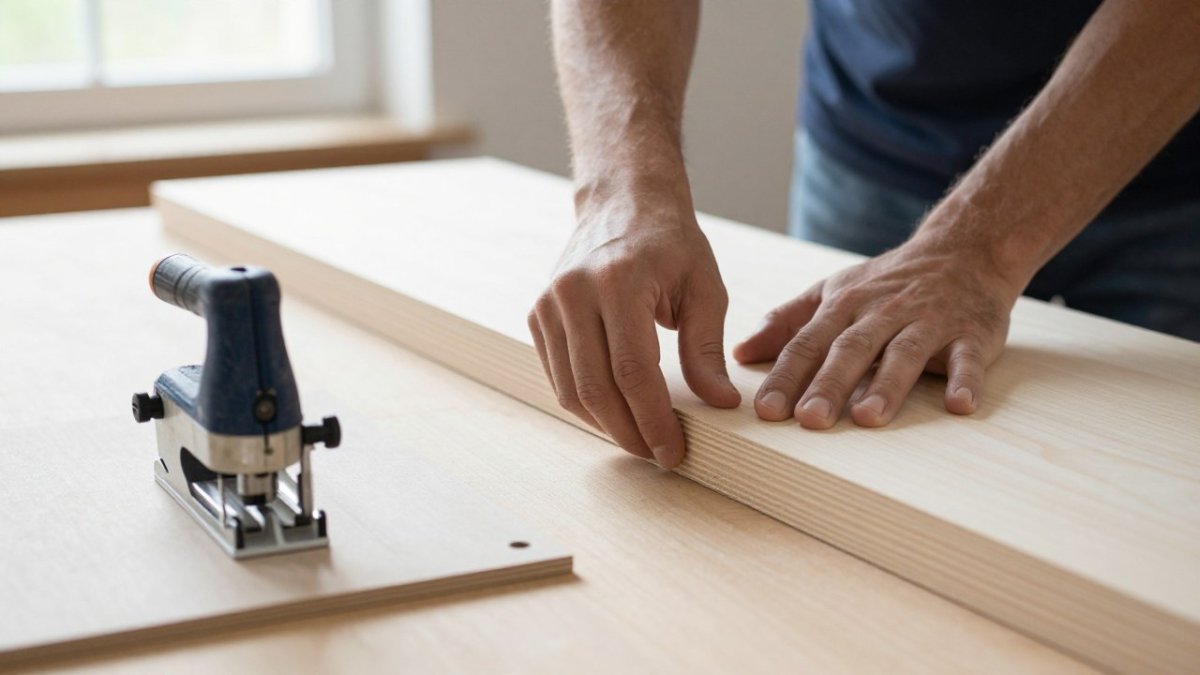
For office boxes, plywood suits long spans and heavy filing. MDF suits door fronts and painted finishes where a smooth surface matters. For a deeper comparison of board options, see our guide to the best materials for custom office cabinetry.
Solid Wood, Veneer and Metal: Where Each Earns Its Place
Solid wood earns its place on doors, frames and visible edges, where grain and character carry the design. It is rarely the right choice for a full carcass, because solid timber moves with the seasons and an office runs warm and dry.
Wood veneer gives you the look of oak, walnut or maple on a stable core, which keeps long doors flat. Metal cabinets suit utility zones: a powder-coated steel unit handles heavy files and wipes clean, but it reads industrial. In a home office, metal works best as an accent or a lockable section rather than the whole run. Integrating these specialized materials requires precise joinery and finishing techniques, which explains why custom cabinets cost more than mass-produced alternatives.
Cabinet Finishes for Home Offices: Painted, Stained and Powder-Coated
Cabinet finishes for home offices should match the room’s light and the daily wear. Painted finishes give the widest colour choice and hide board texture, which makes them ideal over MDF. Stained finishes let grain show through, so they belong on veneer or solid timber. Powder coating is the finish for metal, baked on for a hard, wipeable skin.
The finish matters as much as the board underneath. A beautiful veneer under a soft finish will mark quickly in a busy room. If you are weighing finishes across a whole fitted scheme, our guide to choosing bespoke wardrobe materials and finishes covers the same decisions for fitted furniture.
Office Cabinet Shelving Materials for Heavy Files and Equipment
Office cabinet shelving materials decide whether a shelf stays flat under a full run of lever-arch files. The governing factor is span: the wider the gap between supports, the thicker and stiffer the shelf stock needs to be. But span alone is not enough, the load itself matters, and office loads are heavier and more concentrated than most people assume.
Match shelf stock to span and load
A common mistake is sizing shelves for the look rather than the load. If you know a bay will hold files and a printer, tell the designer at the survey stage so the shelf spec is set before the build.
Indoor Air Quality, Moisture and the Conditions in Your Room
Two conditions quietly shorten a cabinet’s life: damp and off-gassing. Manufactured boards can release volatile organic compounds, so it is sensible to ask for the emissions class of any board before you commit. Check that the class is stated for the finished board, not just the raw panel.
Moisture is the other risk. A home office beside a bathroom wall, or under a window that catches condensation, needs moisture-resistant board and sealed cut edges. The UK government guidance on formaldehyde in construction products is worth reading if emissions are a concern, and the Health and Safety Executive pages on hazardous substances explain why ventilation matters in a room used daily. Where a cabinet sits against an external wall, a small air gap behind the back panel helps.
Lifecycle cost and repairability
The purchase price is only the first cost. Over a cabinet’s useful life, the bigger costs are often refinishing, repairing damaged doors, and replacing shelves that have sagged. A painted MDF door can often be filled and repainted in place; a veneered door with a chipped edge may need replacing. Solid timber doors can be sanded and refinished, but they move with the seasons and may need adjustment. When you compare materials, compare the repair path as well as the purchase price: a slightly dearer board that can be refinished twice will often cost less over its life than a cheaper one that has to be replaced.
Watch out: sealing every cut edge matters more than the board label. An unsealed edge on moisture-resistant board still swells, and an unsealed edge on a low-emission board still releases more than the face does. Specify edge-banding or sealing on every exposed cut, including shelf fronts and the back panel rebate.
Book a Free Design Visit and Specify the Build Together
The last decision is the one most people skip: getting the specification written down before anything is cut. A design visit lets us measure the room and discuss the build with you.
Before the visit, it helps to know what the project is likely to cost. Our cost of custom home office furniture guide sets out the factors that move the figure, and our guide to planning a bespoke joinery project walks through the timeline from survey to fitting.
Choosing cabinet materials without a clear brief is how good rooms end up with storage that does not quite work. We would rather specify it properly from the start. Finest Furniture Studio offers a free design visit, a 7-day fitting service and a 10-year warranty on wardrobes, with clear upfront pricing and no hidden fees. Get started with Finest Furniture Studio and specify office cabinetry built around how you actually work.
Frequently Asked Questions
What is the best material for office cabinets?
There is no single winner because a cabinet is a system of parts. Doors can be MDF if you want a flawless painted finish, or solid wood or veneer if you want visible grain. Back panels are usually thinner plywood or MDF. Ask your maker to specify each component rather than quoting one material for the whole unit.
Is MDF or plywood better for custom cabinets?
For shelves carrying files and printers, plywood wins: its cross-layered construction resists sagging over a long span and holds fixings far better. MDF wins on finish, because its dense, uniform surface takes paint without visible grain and machines into moulded door profiles cleanly. Many well-built offices use both, with plywood boxes and shelves paired with MDF or timber doors, which is the combination most bespoke joiners recommend.
Which office cabinet materials are easiest to maintain?
Powder-coated metal and factory-sprayed painted MDF need only a damp cloth and mild detergent. Oiled or waxed solid wood needs periodic re-oiling to stop it drying out, and veneer should never be soaked because moisture can lift the surface layer. Ask what touch-up products the maker supplies, and keep a small pot of the original finish so small scuffs can be repaired without a call-out.
Can custom office cabinets be made to fit awkward spaces?
Yes, and that is where made-to-measure work earns its keep. Sloping ceilings, chimney breasts, alcoves and understairs voids can all be turned into usable storage when each panel is cut to the actual site dimensions rather than bought in standard sizes. A complimentary design visit is a good opportunity to talk through the space before anything is built.


