
Table of Contents
- Why Vertical Space Matters in Small Bedrooms
- Floating Shelves and Wall-Mounted Units
- Bespoke Fitted Wardrobes for Awkward Spaces
- Bespoke Shelving Solutions That Work Around Obstacles
- Hooks, Rails, and Pegboards for Daily Essentials
- Under-Bed Storage and Multifunctional Furniture
- Organization Hacks to Prevent Visual Clutter
- Frequently Asked Questions
Last Updated: September 25, 2026
Why Vertical Space Matters in Small Bedrooms
Small bedrooms demand vertical strategy, and creative wall storage ideas for small bedrooms transform how these compact spaces function. Most people focus on floor space, but walls stretching floor to ceiling represent untapped storage potential. Every inch of vertical space becomes valuable real estate.
A bedroom measuring just 3 metres by 4 metres can feel cramped with conventional furniture. But extend your storage upward, and suddenly the room breathes. Research from Cubby at Home on vertical storage integration shows that maximizing vertical space can transform how a small bedroom functions. Rather than spreading items across the floor, vertical storage keeps essentials accessible while maintaining clear sightlines.
Clutter-free floor space makes a room feel larger. Stacking storage upward preserves the open feeling small spaces need.
Vertical storage is not optional in small bedrooms, it’s the foundation of any space-saving strategy. Focus on extending storage to the ceiling, not just filling wall space at eye level.
::: By shifting your perspective toward these higher elevations, you can effectively maximise space in small homes while maintaining a clean and organized aesthetic throughout the room.
Floating Shelves and Wall-Mounted Units
Floating shelves mount directly to the wall, leaving the area below open. This creates an illusion of more space while delivering genuine storage capacity.
Position floating shelves at varying heights: 1.2m for everyday items, 2.1m for seasonal pieces. This staggered approach prevents institutional appearance and customizes storage for actual use.
Wall-mounted units offer deeper storage (25-30cm projection) without dominating the room. Ensure the wall can handle the weight using stud finders and proper fixings.
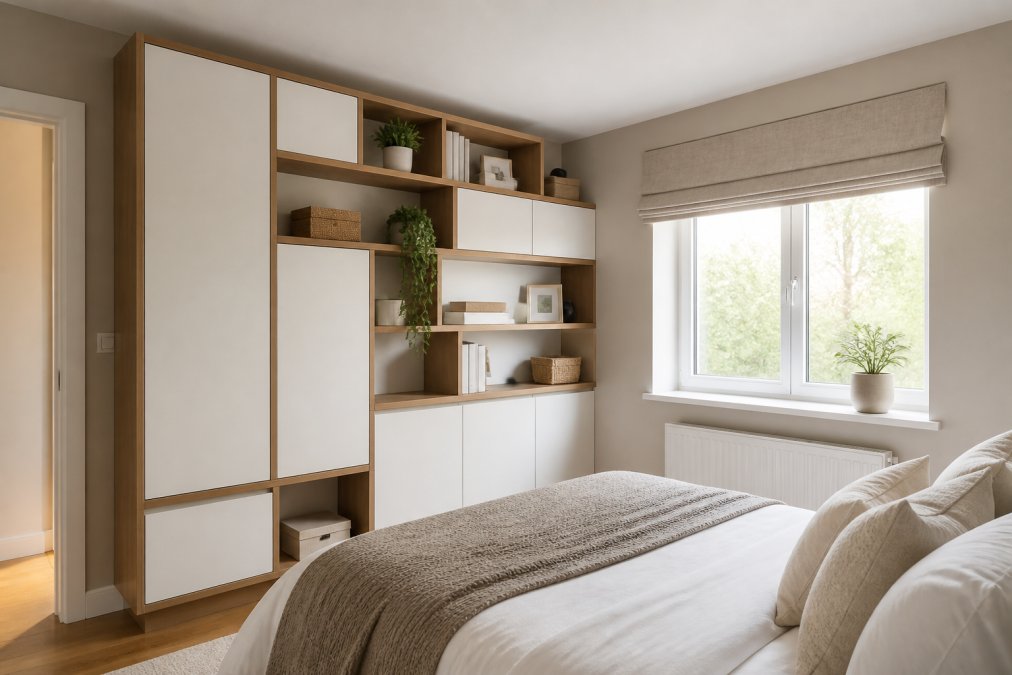
According to Architectural Digest on multifunctional wall-mounted furniture, wall-mounted solutions increasingly blend storage with display, serving double duty as both functional and decorative elements. Consider units that incorporate open shelving alongside closed storage, open areas for display, closed sections for items you’d rather hide.
Install floating shelves slightly wider than you think you need. A 60-centimetre shelf feels generous; a 45-centimetre shelf looks cramped. Generous proportions make small rooms feel more intentional, not cluttered.
Bespoke Fitted Wardrobes for Awkward Spaces
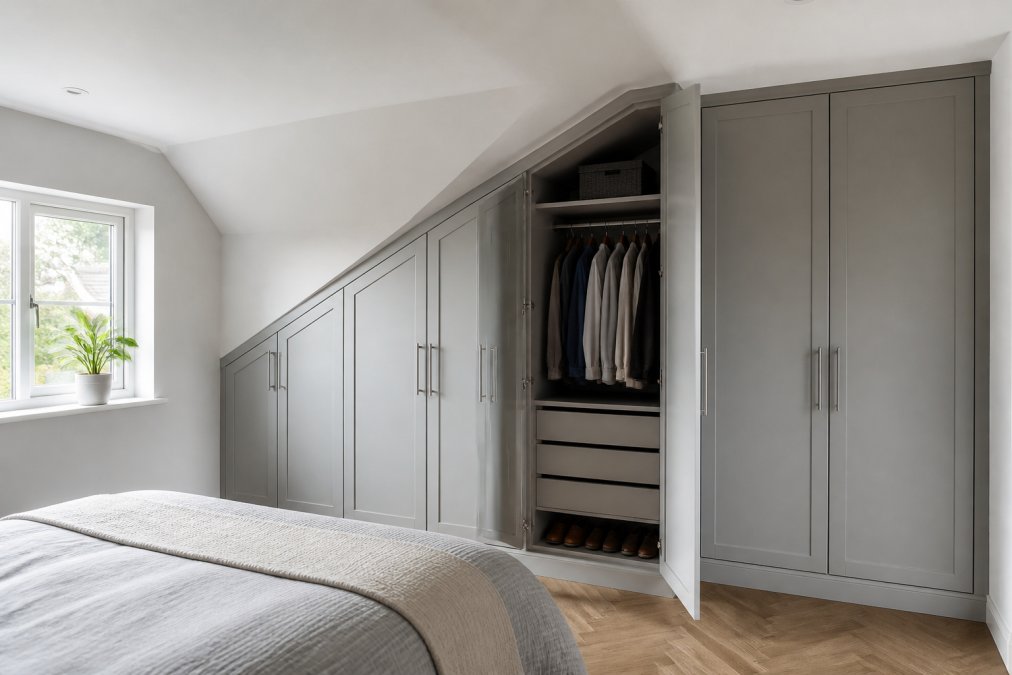
Most bedrooms have sloping ceilings, alcoves, or corners that standard wardrobes cannot address, spaces where creative wall storage ideas for small bedrooms truly shine.
Bespoke fitted wardrobes work with the room’s actual geometry. A sloping ceiling becomes usable storage when custom-built to follow that slope. An alcove too narrow for conventional wardrobes becomes a perfectly fitted solution.
A bespoke fitted wardrobe uses nearly 100% of available space, whereas standard units leave gaps and dead zones, translating to dozens of extra items stored without additional floor space.
At Finest Furniture Studio, we design bespoke fitted wardrobes for awkward spaces, understairs areas, sloping ceilings, and alcoves. A free design visit measures exact dimensions and identifies storage opportunities. Our 7-day fitting service minimises disruption, and the 10-year warranty reflects our confidence in durability. Unlike mass-produced options, a bespoke fitted wardrobe is engineered for your specific space, delivering better organisation and cleaner aesthetics.
Bespoke Shelving Solutions That Work Around Obstacles
Shelving is only effective when it fits the space. Radiators, window frames, and electrical outlets require shelving that accommodates them rather than fighting them.
Bespoke shelving is built to fit exact space. A radiator becomes an opportunity for shelving above or beside it without blocking heat. A window frame becomes a reason to design two narrower shelves that frame it.
Varying depths (20cm for lightweight items, 35cm for books or boxes) prevent monotony and enable efficient storage of different item types.
According to House & Garden on bespoke storage solutions, bespoke shelving that works around obstacles demonstrates thoughtful design. Emma Ainscough built bespoke shelves directly into a wall to maximise storage in a compact flat, successfully accommodating a large collection of items in a space-constrained environment. Her solution shows how custom design transforms what seems like an impossible space into functional storage.
Avoid shelving that ignores obstacles. A shelf that partially blocks a radiator reduces heating efficiency and can create safety hazards. Always design around fixed features, not over them.
Hooks, Rails, and Pegboards for Daily Essentials
Daily items, bags, belts, scarves, jewellery, accessories, benefit from wall-mounted hooks and rails. For renters, this offers flexibility without permanent wall damage.
Rental-Friendly Installation Options
Adhesive-backed hooks rated for 2-5 kg offer damage-free alternatives to drilling. Tension rods installed between wall studs or inside alcoves provide secure storage for heavier loads (coats, bags) without drilling.
Pegboards mounted with adhesive strips or leaning against a wall require no permanent installation. A 60cm × 60cm pegboard holds 8-12 items depending on peg spacing and weight.
Weight Limits and Safety
Adhesive hooks hold 2-5 kg per hook; heavy-duty versions reach 10 kg. Rail systems anchored to studs support 15-20 kg. Use a stud finder before installation; hooks mounted into drywall alone will fail under heavy loads.
Use adhesive hooks for jewellery and scarves; stud-mounted rails for coats and bags. Never exceed the manufacturer’s weight rating.
Item-Specific Placement Strategy
Position daily-use hooks at shoulder height (1.4-1.6m); occasional-use hooks higher (1.8-2.0m). This prevents chaos and ensures natural reach.
A pegboard with small hooks keeps jewellery visible and untangled. A 45cm pegboard organises 20-30 pieces without crowding.
Space bag hooks 20-25cm apart. A 1.2m rail holds 5-6 bags comfortably.
A 60cm belt rack holds 10-15 belts, or roll belts into a small basket on a shelf to free wall space.
Pegboards vs. Fixed Rails: When to Use Each
Pegboards suit renters and those changing storage frequently. They install easily and remove without damage, but have lower weight capacity (2-3 kg per peg) than fixed rails.
Fixed rails suit permanent residents storing heavier items. They integrate into the room’s design and support greater loads, though installation requires drilling.
Mix hook heights and styles to create visual interest. A wall with hooks all at the same height looks institutional; varying heights (1.2 m, 1.5 m, 1.8 m) creates a dynamic, curated appearance while accommodating different item types.
Under-Bed Storage and Multifunctional Furniture
Under-bed storage reclaims floor space without sacrificing layout. Shallow boxes keep seasonal items and extra bedding out of sight.
Choose low-profile storage (15cm tall fits most frames; 25cm may not). Measure bed clearance first. Labelled containers make finding items easier.
Multifunctional furniture multiplies storage. An ottoman provides seating and hidden storage. A bedside table with drawers holds essentials in the same footprint. A window seat with built-in storage creates a reading nook and storage simultaneously.
Multifunctional pieces feel intentional rather than cluttered, making the room feel designed rather than cramped.
Organization Hacks to Prevent Visual Clutter
Storage capacity means nothing if everything remains visible or inaccessible. Three mechanics prevent clutter: concealment strategy, accessibility hierarchy, and visual consistency.
Concealment Strategy: Balancing Open and Closed Storage
Closed storage, wardrobes, cabinets, drawers, hides items completely. Open shelving displays items, which can feel cluttered unless carefully curated. The most effective approach combines both: closed storage for everyday items you use but don’t want visible, open shelving for a few carefully chosen pieces that contribute to the room’s aesthetic.
A practical ratio is 70% closed, 30% open. This means three-quarters of your storage (wardrobes, under-bed boxes, drawer units) holds daily essentials and seasonal items out of sight. One-quarter (a floating shelf, a pegboard section, a display area) showcases items that are both functional and visually appealing, a few favourite books, a plant, a jewellery display, a collection of small objects.
Within closed storage, use vertical dividers to prevent items from shifting and creating visual disorder. A drawer filled with jumbled scarves looks chaotic; the same scarves sorted into vertical sections (one section per colour or style) look organized. Dividers cost £5-15 and transform perception without adding storage capacity.
Accessibility Hierarchy: Frequency-Based Placement
Organization fails when items are hard to reach. A well-organized bedroom places items based on how often you use them, not just where they fit.
Daily-use items (work clothes, underwear, phone charger) should be at arm’s reach: 0.9-1.5 metres from the floor. These go in open drawers, accessible shelves, or hooks at eye level.
Weekly-use items (weekend clothes, hobby supplies, books you’re reading) can be at shoulder height or slightly higher: 1.5-1.8 metres.
Visual Consistency: Colour, Texture, and Container Uniformity
Labelling and Inventory Systems
The Decluttering Foundation
- Keep: Items you use regularly (at least once a month) or that bring genuine joy.
- Donate: Items in good condition you no longer use. Charities, friends, or online marketplaces are better homes than storage.
- Discard: Broken items, worn-out clothes, duplicates, gifts you don’t like. These belong in the bin, not hidden in storage.
The “One In, One Out” Rule
Avoid the trap of “just in case” storage. Items kept “just in case” you might need them someday occupy valuable space and create mental clutter. If you haven’t used something in a year and it’s not sentimental, it should go.
Frequently Asked Questions
What are the best wall storage solutions for a very small bedroom?
Floating shelves, wall-mounted cabinets, and pegboards are ideal for small bedrooms because they use vertical space without consuming floor space. Bespoke fitted wardrobes tailored to your room’s dimensions, including awkward alcoves or sloping ceilings, maximize storage capacity while maintaining a clutter-free aesthetic. The key is choosing solutions that match your lifestyle: open shelving for display items, closed cabinets for concealed storage, and hooks for frequently used accessories.
How can bespoke fitted wardrobes help organize a small bedroom better than freestanding furniture?
Bespoke fitted wardrobes are custom-designed to fit your exact space, including understairs areas, alcoves, and sloping ceilings where standard furniture cannot go. They maximize storage capacity by extending to the ceiling and fitting snugly against walls, eliminating wasted space. Unlike freestanding wardrobes that leave gaps and take up floor space, fitted designs create a seamless, integrated look while providing significantly more storage for the same footprint.
Are open shelves or closed wall cabinets better for small bedroom storage?
Open shelving works best for displaying curated collections and creating visual lightness, but requires constant organization to avoid clutter, which can make a small room feel cramped. Closed wall cabinets hide mess and maximize perceived space, making them ideal for storing seasonal items, bedding, and miscellaneous clutter. Many designers recommend combining both: open shelves for decorative items and frequently accessed essentials, closed storage for everything else.
Can wall storage solutions work in rental properties?
Yes. Temporary wall storage options include adhesive hooks, tension rods, and removable shelving systems that require no drilling or permanent fixtures. If your tenancy agreement permits, lightweight floating shelves with simple brackets can be installed and removed without damage. For longer-term rentals, discuss permanent solutions like bespoke shelving with your landlord, many appreciate improvements that increase property value and appeal.

